A handy checklist to see if you are raising the spawn of Satan. Has your five-months-and-one-day-old baby:
Kicked you in the nuts?
Kicked you in the chin?
Twisted your beard until you screamed?
Backhanded you across the mouth?
Backhanded you in the nose?
Punched you in the Adam’s Apple?
Scratched your neck?
Scratched your forehead?
Used your ears as leverage to pull herself to her feet?
Crushed your bottom lip in her meaty little hand while trying to ram her other fist down your throat?
Shoved her fingers up your nostrils?
Pulled off your glasses?
Palm punched you repeatedly in the eyes?
Tried to bite your head?
Screamed when you tried to feed her?
Screamed when you hugged her?
Screamed when you put her down?
Screamed on her front?
Screamed on her back?
Screamed non-stop right in your face?
Thrown up pureed apple and banana down your shirt?
Thrown up pureed apple and banana down your vest?
Thrown up pureed apple and banana down your bare chest?
Pulled out a handful of chest hair?
Tugged on your armpit hair until your eyes watered?
Spat on you?
Sneezed on you?
Done a pile of liquid yellow-green poo thirty seconds after you changed her nappy?
Laughed uproariously as you tried to change her again while she kicked you and hit you?
Shrieked like a banshee as you tried to put her sleepsuit back on while she kicked you and hit you?
Stood up unassisted against the sofa for the first time?
All of the above in the space of two hours this evening?
If the answer to all the above questions is yes, you may very well be raising the offspring of Beelzebub a.k.a. a teething baby.
To assist parents like us, I have set up a support group named Demon Dads Anonymous. Call me on 1-800-I-need-an-exorcist and we can help each other! Or we use more teething gel, yes, more teething gel, now.
Top of the list of words that should be expunged from the English language is ‘should’. Unfortunately, in order to make that statement, I’ve had to use it, so perhaps banning it isn’t the right answer. To rephrase, then: I would greatly appreciate it if the word ‘should’ was avoided in any conversation about life, lifestyle, parenting, babies, child development, behaviour and relationships, because ‘should’ is the world’s worst word.
Implicit, and often explicit, within the word ‘should’ is that there is only one way of doing things, the right way, and therefore if people use that word at you, they are telling you that you are not only falling short of the ideal, you are doing things wrong. ‘You should leave her to cry,’ means: ‘A proper parent leaves their child to cry. This is the only way to respond to a baby that cries. By not leaving her to cry, you are not being a proper parent. You suck.’
Okay, maybe that’s my autism reading too much into it, but how much nicer would that same sentence be if you replaced ‘should’ with ‘could’? ‘You could leave her to cry,’ means: ‘there are many options available to parents, of which this is just one. I leave it to you to make the decision as to which option is right for your family.’ See? Much better.
‘Should’ also fills your life with pressure. ‘She should be drinking five bottles a day.’ Great, but what if she only wants four? Or those days that she wants six? What then? Should we be forcing milk into her, denying her it when she’s hungry? Instead of following your instincts and adapting to reality, you feel an obligation to try to squeeze reality into a ‘should’-shaped hole, and that doesn’t make life easy for anyone.
That horrible imperative also changes the power relationship between you and whichever person said it. ‘You should change the brand of milk she drinks,’ is another way of saying, ‘I don’t respect you. There is no point in us having a conversation as adults because you are a child who cannot be trusted to make decisions. Therefore, I must fill the role of your parent and tell you exactly what to do. Switch to Aptamil.’
‘But Aptamil and Cow & Gate are the same company with different coloured packaging.’
‘Shut up, imbecile. You are incapable of deciding what is best for your baby so I will take that choice away from you. You are the hydrant and I am the dog.’
You see what I’m saying? ‘Could’ means that we are equals, you are making a suggestion and you respect my ability to sort through the conflicting information and select an appropriate course of action. ‘Should’, on the other hand, means you’re the expert and I’m the dunce, and I should do what you say because you’re the Man, and I’m the poop he just stepped in.
So next time you’re giving someone advice, think about turning that first phoneme from a ‘sh’ to a ‘c’, unless you really are that arrogant that you think you know the best way to raise my baby.
While walking the dog round the forest yesterday, I met a French lady who peered at the 16-odd pounds of baby strapped to my chest and asked me how old she was.
‘Just coming up to five months,’ I replied.
‘They grow up so fast,’ she said, and then added, ‘Make sure she grows up strong. There aren’t enough strong women in this world.’
Since I had no idea how to respond to that, I said, ‘I will. She’ll be a strong woman. She’ll be a Nobel Prize winner.’
‘Good,’ she said. ‘We need more strong women. Promise me you’ll make her strong.’
‘I will,’ I repeated, as though solemnly undertaking a blood oath.
And then she was gone.
It was all a bit surreal, actually, particularly as her dog seemed to be a cross between a black lab and a hell hound, all teeth and drool and mad staring eyes. But for the rest of the walk, her imperative was bouncing around my head – make her strong, make her strong – and my agreement to do it.
But how exactly do you make a girl into a strong woman? Bathe her in ice water and dry her with sandpaper? Teach her to toy with men’s hearts and crush them underfoot like Miss Havisham’s pet Estella? Sure, I plan on taking her to karate lessons as soon as she’s old enough so she can defend herself, but other than that, I’m kind of at a loss as to how I’m meant to achieve this. And how much power over Izzie’s personality am I meant to have?
Back in the early part of the twentieth century, Dr John Watson, a behavioural psychologist and not Sherlock Holmes’ fictional biographer, said something along the lines of: ‘give me a dozen babies and I’ll make them into lawyers, doctors, artists, thieves or beggars depending on how I raise them and in spite of any natural proclivities they might have.’ Now, we know, and have known for a long time, that this is a pile of hooey – genetics and individual differences count equally as much as environmental factors in how we turn out – but people still seem to think that as parents we can control the development of our children.
My mother, for example – at the age of 27, while working for the police, I had a breakdown. Ten years later, my brother has just had a form of burn out after his wife left him and took the kids. So my mum is all, ‘Two kids, two breakdowns, how bad a mother am I? I should have made you stronger.’
So I asked her the same question: how, exactly, should she have made us stronger? Besides which, she tried – my parents used to send me to boys camp over the summer to build my character, toughen me up and force me to become more sociable. I found every summer a form of cruel and unusual punishment; my brother, on the other hand, was in his element. While I wandered down to the village every afternoon to lock myself in a toilet cubicle and cry, he thrived. While I was bookish and introverted, he was sociable and outgoing; while I was moody and introspective, he was laid back and confident. We were raised in the same house by the same parents and given the same guidance, moral framework and experiences, but were completely different people from the start. And the fact we both had breakdowns is plain bad luck, not a fault in our upbringing.
Because kids are not balls of clay that can be moulded into whatever we want – they’re people with their own thoughts, ideas, desires and abilities. Izzie already has a personality – two parts wilfulness, one part stubbornness, mixed with an insatiable curiosity and a happy disposition – and that’s without any input from me.
This is the lesson all parents need to learn – just because we made our children, it does not mean that we own them. They belong to the Universe. We brought them into being but they are themselves. They are not us in miniature, or a mirror of our beliefs and ideals. They are rivers that will find their own way to the sea, irrespective of the routes we took. We can guide them on their journey, steer them from our experience and insight, and love them for who they are – we cannot make them into something they’re not. They will disagree with us, and they’re not wrong to – for however much we teach our children, they teach us the same.
Will Izzie grow into a strong woman? I think so, because she’s fearless and determined already. All we have to do is nurture that independent spirit, and prevent it getting her into trouble. The same goes with any parent – we have to work with what is already there, and accept things as they are, instead of trying to turn our kids into something they’re not. So long as we remember that, we’ll be doing our job.
Resentment, disappointment, annoyance, frustration, and a sense that everything in the world is unfair and fundamentally wrong, all stem from having expectations that it should be other rather than accepting what it really is. We spend far too much time looking at where we’ve come from, where we’re going, and where we think we should be, and not enough time living in the here and now and grasping what is right in front of us.
Having expectations when you’re a parent is fatal.
Last night, Lizzie went out to see the new James Bond film and have a pizza, leaving me looking after Izzie. ‘Great,’ I thought. ‘She’s been awake all day, she’s behaved like a gem, and I actually got more of her Sweet Potato Bake in her than on her, so she’ll be tired and contented. I’ll have her in bed by seven, cook some dinner, and have some much-needed time to myself. I’ll spend an hour on the Xbox and a couple of hours writing. Awesome. I’m looking forward to my evening.’
Fatal.
The fact it took me three hours to get her to sleep on Saturday and four hours on Sunday should have indicated that you can’t bank on a bedtime, but I somehow forgot this rudimentary aspect of parenting in the expectation of a restful evening. So when it took me from six till ten to get her to bed, trying milk, water, rocking, singing, reading aloud, dummy, teething gel, Calpol, cuddles, TV, hypnotism (which made her laugh), teddy bear, womb sounds, and ultimately she fell asleep from exhaustion, I was pissed. I mean, seriously pissed.
It was no fault of Izzie’s – she’s a baby – it was my fault. I hadn’t managed my expectations to fit reality, and the reality is that my time belongs to the baby, and any extra I get to myself is a bonus, not a given. Expecting you can have an independent existence in the first six months of a baby’s life is just barmy. Get on with what you can when you can, and accept that what you can’t you simply can’t. If I had no expectations of the evening, I wouldn’t have had a problem – I’d probably even have been happy.
I think that’s as good a lesson as any for life in general.
As a kid, I wanted to be a famous author. Everyone told me I would be, because that’s what you tell a four-year-old, and I accepted it because you believe everything an adult tells you. But as I grew older, they kept saying it. When I was ten, my grandfather told me that not only was I going to be an author, I was going to be one of the greatest authors in the world. When I was thirteen, my teacher told my parents I’d be on This Is Your Life one day. When I was seventeen another teacher told me I had a gift and it was my duty to share it with the world. Everyone – family, friends, educators, peers – thought I would go on to be the most successful thing ever to come out of the little town of Frimley, population 5,000.
I therefore lived my life with the unshakable expectation that I’d be a famous author at eighteen. I saw future me as a rich, successful author living in the city, attending movie premieres and society parties, frequenting all the best theatres, museums and art galleries the world had to offer. Essentially, all glitz, glamour and sophistication. Monaco, Cannes and Val D’Isere – that was going to be my life.
Skip eighteen years ahead and you find me a balding, pot-bellied autistic guy on antidepressants who lives in his partner’s house in a village on the edge of nowhere and has spent his life working in shops, office administration, domestic care and call centres. There’d be nothing wrong with it if it it wasn’t so far away from where I expected to be.
In my twenties, I couldn’t stand that my life didn’t match my plan for it. Why the hell wouldn’t anyone publish my novels? How could I possibly live the rest of my life an unknown? I was meant to be special, damn it – everyone said so. So why am I broke and alone? I spent my twenties writing novels and waiting for my life to begin.
It took me until my thirties to realise that my life had begun – and begun many years ago – it simply differed from my expected path. I still write my novels, still try to get them published, and sometimes I do feel as though the parade is passing me by, but I’m less discontented about the whole thing. I hope they get published, but I’m not suffering unduly because they’re not – it’s just the way my life has worked out. And there’s nothing wrong with my life.
The life I’m comparing it to – the successful me with the apartment in New York and the A-list friends – is nothing more than a fantasy. How can I feel bad that I’m not living the life of a person that never even existed anywhere but in my head? It’s like getting upset because the sky isn’t green – it never was nor could be green, so what’s the point of those tears?
My advice to anyone feeling they’ve not lived up to their potential is: don’t look at where you think you ought to be, look at where you are, because if it’s anything like my life, it’s not bad at all, just different. Disappointment comes from looking at the future and remembering the past, comparing your situation with what it was and how you think it should be. When I was eighteen, the thought of living in a little village, unknown, with a baby, and London a hundred miles away, was intolerable; at thirty-six, it’s pretty darn great. Live in the moment, appreciate the present for what it is – your life – and remember that those other lives you’re comparing yours to aren’t real.
So long as there’s air in our lungs, blood in our veins, and the sun is still up there somewhere, even if it’s hidden in cloud, we’re doing okay.
That’s the key to parenting, and to life itself: no expectations. Life and babies refuse to conform to preconceived notions. The sooner you can make peace with that, the happier you’ll be.
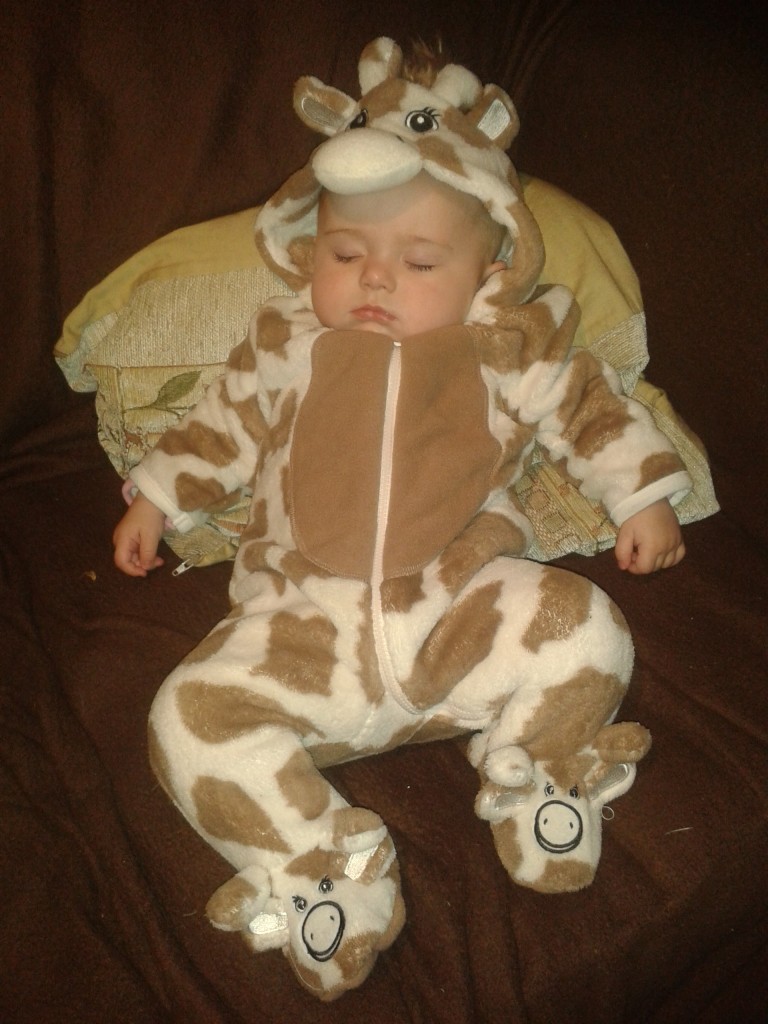
And if you’re still not happy, here’s Izzie asleep in a giraffe onesie to cheer you up!
Unfortunately I have Limp Bizkit stuck in my head, coz all that baby’s doing is rollin’, rollin’, rollin’, rollin’, come on!
I guess there are worse earworms – Vanilla Ice’s ‘Rolling in my 5.0’ popped into my head yesterday, which is an indication both of my age and how crap my taste in music was circa 1990. But Proud Mary (‘Rollin’, rollin’, rollin’ on the river’) would be far better. Hell, I’d even accept the theme from Rawhide, but I’m stuck with Nu-metal. When she starts crawlin’ I’m going to get lumbered with Linkin Park, and Pantera when she starts to walk, but hey ho, that’s the penalty for a youth misspent in rock clubs.
Anyway, what started as something to be celebrated (‘Wow, she rolled over, how crazy cool!’) has become something awkward and life-changing. Because Izzie doesn’t gently roll over onto her belly, hang out there a moment, and then roll back, oh no. Instead she rolls at speed over and over and over again, and for some reason, she can only go to her left.
You put her on the floor beside the sofa, and five complete rolls take her to the sideboard, where she starts to cry because she can’t go any further. So you turn her around, and five rolls later she bumps into the sofa, and starts to cry because she can’t go any further, so you turn her round again, and so on, and so forth. Two hours later, dizzy and knackered, she asks for a feed, has a brief kip, and gets right back to the rolling.
It was funny, at first. But gradually it dawns on you that your life has just developed a mess of practical problems because that stationary bundle of joy is now mobile.
Before she discovered she could move, Izzie was perfectly happy bouncing in her Jumparoo or lying her on her play mat, so we could get on with things, provided we were in the room and kept an eye on her. Now, we have to keep an eye on her, and that’s all we can do. She stays on the play mat about a minute and then decides she’d rather be the other side of the room, so ‘Wheeee!’ – she’s off. She couldn’t care less about the Jumparoo because she can’t move around in it. So the time available to do chores has shrunk dramatically.
Then comes the hoovering. Because she’s off the mat and all over the floor, the carpet has to be spotless. With a dog in autumn and a massive old oak tree in the garden, it’s impossible to keep the leaves, mud, twigs and other random detritus outside – you open the door and half a forest blows in. Which means you have to vacuum twice a day.
And putting her to bed has become a nightmare. The moment you put her on her back in the cot, she rolls and faceplants against the wooden slats, and cries because she’s stuck, so you move her onto her back further from the edge, and watch her roll onto her stomach and then cry because she’s stuck again. You hold her in your arms and rock her to sleep, put her gently down on her back, leave the room, and ten minutes later she’s crying again because she’s rolled onto her stomach and can’t roll back the other way. And always to the left.
It’s spread to other areas, too. If I’m lying in bed with Izzie having tummy time on my belly, one of my favourite morning routines, she tries to throw herself off and onto the floor. In her Bumbo chair that we use with solids, she leans to the left and tries to roll the whole thing over on top of her. I just want to tell her to stop trying to grow up so fast, to enjoy being a baby – I mean, she’s not even five months old yet – but she smiles at me, leans her head to the left and over she rolls.
There is a persistent myth that people with Asperger’s Syndrome don’t feel emotions. It’s a myth because, if anything, I think many of us feel emotions more strongly than neurotypicals – it just doesn’t look like it.
I liken emotions in autism to a case of arrested development. Our emotional development suddenly stops while our bodies and cognitive abilities continue to grow. Unfortunately, it usually gets stuck on the ‘teenage’ setting, meaning we don’t understand what we feel, but we feel it all so intensely – the manic highs and the desperate lows – that we become overwhelmed and cease to function. Imagine being stuck as a hormonal fourteen-year-old your whole life – doesn’t bear thinking about, does it?
Since our emotions can confuse, unsettle, and even scare us, we embrace routines, predictability, systematic thinking and mental reasoning. We live in our minds and try to keep our nasty, unpleasant feelings pushed down deep where they can’t harm us. Many resort to antidepressants to keep our feelings at bay. And when our emotions do get the better of us, and we can’t cope, we seek out solitude and experience them alone. The emotionally unresponsive Aspie, approaching situations from the head and not the heart, is therefore in many ways a defence mechanism against our dangerous unbridled passions.
At least, that’s how I see it.
Yet even knowing this, I did wonder why I didn’t feel more when Izzie was born. The father across from us in the Transitional Care Unit was always crying when he was hugging his newborn. ‘I love him so much, I just love him so much,’ he kept saying, until even his missus told him he was being pathetic. I just couldn’t relate to those feelings.
I was told, before Izzie was born, that the first time you hold your baby in your arms it’s special, the love is instantaneous, you’re overwhelmed with emotion, and yada, yada, yada. I’ve mentioned before that when I first met my baby I was pretty dazed and distracted by the whole ordeal of ambulances, operating theatres and incubators and it took me a good four hours to really start feeling the love. But I never got that emotional rush, that powerful knock-you-on-your-ass thrill of being a parent.
Until now.
This is going to sound really saccharine and namby-pamby, but the past few days I’ve been almost overwhelmed by this incredible feeling of love. I feel like I want to cry all the time. When the baby sleeps I feel this surge of emotion well up in my chest, and I watch her for hours because she’s perfect in every way. When I went to work in the charity shop yesterday, I missed her horribly – I was only gone three hours. And when customers asked about her, I showed them a picture and could have cried with pride. I can’t believe she’s only been here nineteen weeks. It feels like she was always with us, just waiting to be born to make us all complete.
See? It’s so horribly sweet and sickening I want to disown myself. Part of me wonders if it’s because I’ve reduced my caffeine intake and started a diet to knock off the twenty pounds I’ve put on in the last nineteen weeks, mostly through chocolate, chocolate and more chocolate; another part wonders if it’s because I haven’t had a good night’s sleep for almost five months; whereas in truth, it’s probably because I’m more relaxed about being a dad these days. The fumbling, panicked hell of the first couple of months, and the laboured, mind-sapping slog of the next two, have given way to a quiet confidence and acceptance of the new routine. And that allows me to see her and enjoy her for what she really is: an angel in our midst.
Actually, that’s going a little too far. She’s suddenly discovered she can squeak like R2-D2, so every time she’s displeased with something, which is often, she treats us to a sound even dolphins wouldn’t enjoy. It’s a high-pitched, screeching whine, somewhere between a dial-up modem and that awful sound you used to get when you picked up the phone only to hear a fax machine on the other end (for those of you too young to remember dial-up modems and fax machines, ask your parents what they were, and know that I hate you).
But my emotional responses to the good things far outweigh my feelings towards the bad. In fact, right now the emotional impact of the good things is utterly disproportionate to their size. Izzie rolled from her back to her stomach for the first time yesterday and me and Lizzie were leaping around the room like idiots, and even though today she’s doing it like a pro, we still get excited every time. This morning when she was laughing unstoppably as I blew raspberries on her belly, I could have been in heaven. And a few minutes ago when I went to check on her in her cot and she opened her eyes, smiled at me, and went immediately back to sleep, I could have stayed in that moment forever.
I am choked with emotion at the moment. I am overwhelmed. But not that anyone would know it.
People with Asperger’s do feel emotions just as strongly or more so than ‘regular’ people. We just don’t make such a big song and dance about it, is all…
In terms of parenting, the biggest difference between the sexes is not in our abilities but in the expectations put upon us. And these expectations are the reason mothers have it harder than fathers – because there are no expectations put on us at all.
To illustrate the point, a story little. When we had a meal out on our recent holiday on the Isle of Wight, I sat on the bench seat while Lizzie had the chair. I therefore put Izzie, in her car seat, on the bench seat beside me and spent the next two hours soothing her, playing with her, heating her bottle in a jug of water, feeding her, changing her, and generally eating with one hand. We were with friends, the conversation flowed, and the two hours passed in amiable, unthinking companionship.
While we were finishing our drinks, the table next to us got up to leave. It comprised three elderly couples. Before they left, they came up to our table and said they’d been watching me the whole meal, and remarking on what a good dad I was, and how impressed they were with me, and as I recall, the word ‘amazing’ was used. One woman even turned to the two girls at my table and said, ‘Whoever is the mother of this little girl is a very lucky lady to have such a man.’
Now, it’s very gratifying to have strangers (six, no less) commend your parenting abilities, and gives you a warm and fuzzy feeling inside. However, this was at the time that Lizzie’s confidence in her mothering ability was at an all time low, and even as they said it, I looked at her, her face expressionless, and thought, ‘Ouch, that’s a kick in the teeth for her.’ The whole situation wasn’t very helpful and led to resentment and upset. They might have meant well, but it had the opposite effect.
And it only happened because I’m a man.
If I was female, the old people would have walked on by. Nobody goes up to a woman with a baby in a restaurant and tells her what a great mother she is and how lucky the father of her baby is for having her. Because it’s expected of a woman to look after her baby and do it well. It isn’t expected of us men.
Everywhere I go with the baby, people (mainly of the older generations, to be fair) tell me I’m a great father, congratulate me on giving mum ‘time off’, and praise me for being a ‘hands-on dad’. By these comments, and others about it being a breath of fresh air, they must have great experience of hands-off dads. But just who are these dads who don’t change nappies, help feed the baby or carry her about in public? They surely can’t be as rare as the comments would have us believe.
Regardless, the expectations placed on men are remarkably low. We’re expected to be rubbish at pretty much every hands-on baby caring task, with the possible exceptions of bathing and playtime. And then, when the hard stuff starts, you hand her back to mum.
And therein lies the problem for women. They’re expected to be perfect mothers right from the get-go, as if it’s natural and automatic, programmed into their DNA. They’re expected to do nappy changes, night feeds and look after the baby in public, and to do this without complaint and without mistake or they’re somehow defective as women. They’re expected to be horrendously tired all the time, yet selfless, knackered but energetic, caring and patient, self-sacrificing – essentially Twenty-First Century martyrs.
And they get zero thanks or appreciation for it because it’s what they’re ‘meant’ to do, whereas if I walk down the street with my daughter, I get to bask in the adoration of strangers. And that’s what makes being a mum so much harder than being a dad.
So if you’re a dad, be sure to give your lady thanks for all the crap she does. And next time you see a woman pushing a baby in a pram with a toddler in tow, remember there’s nothing ‘natural’ about it, and it’s a lot if jolly hard work!
In Praise of Mothers, Part 2, was going to arrive Thursday night, and is due to follow. However, as with anything baby related, and as I have mentioned before, the best laid schemes of mice and men gang aft agley (whatever that means). Birthdays, flu jabs, Halloween (150-odd trick or treaters is too many!) and the final of the Rugby World Cup all managed to hinder the writing of this blog, as did a baby currently incapable of lasting five minutes without crying over her painful teething. But none were so disruptive as Thursday.
Lizzie was out shopping and I was getting Izzie ready for bed. I changed her nappy in the nursery, put her in a sleepsuit, and all that was left was a final goodnight bottle, so I started to carry her downstairs.
And halfway down, the world turned black.
We live in a village on the edge of the New Forest, so when it’s dark, it’s dark, and when there’s a power cut, it’s darker than that. I stepped on the cat (who’s black), the dog (who’s black and white), and must have bumped into every obstacle that fills a house with young children (you know the stuff – bouncers, play mats, chairs, your missing sense of sanity) before locating the carrycot so I could put Izzie down safely.
My torch lives by the back door in the kitchen, but it was hidden behind the Perfect Prep bottle-preparing machine and the steriliser, and wrapped in the wires coming out the back of them, so getting to it was a struggle. But otherwise, we were all good.
Except the baby was now crying because she wanted her bottle.
The Perfect Prep machine, as you might imagine, works on electricity. So does the kettle. But that’s okay, I figured, I’ll boil some water on the stove, because that’s gas – only the ignition button is powered by electricity, and I couldn’t find any matches (damn our non-smoking healthy living!). I could keep her warm though, because we have gas central heating – only the controller for that is electrical too, so no heating. I’d best ring my parents and tell them to expect some visitors for the night.
Thing is, we live in a mobile signal black spot so rely on the house phone to communicate. But it’s a house mobile, so when there’s no power, the handset can’t connect with the base unit and thus we can’t make any calls. In fact, the only thing that worked was Izzie’s baby monitor. I remember installing it a few weeks ago and wondering why I had to put batteries in something that was plugged into the mains. It was, clearly, for just this situation. But as Izzie was in the same room with me, it wasn’t exactly useful.
Eventually, Lizzie returned and looked after Izzie while I went up the street with the bottle machine until I found a house with lights on and borrowed a plug socket. We put a now milk-drunk baby to bed and then sat in the dark for another couple of hours, feeling surprisingly vulnerable, until the lights flicked on and Izzie started screaming, because her light was turned up full and she woke with a start.
It’s only when you have a power cut that you realise how dependant we’ve become on a single source of energy. All our gas appliances are controlled by electricity. Until I found the house that still had power, I seriously considered making a fire in the garden to boil some water – but that wouldn’t have worked either, because I had nothing to light it with!
So all parents, take note: make your home power-cut-ready. This involves:
Torches scattered throughout the house, especially in the nursery.
Matches, matches, matches. Or one of those oven-lighter things.
Candles.
A phone that plugs directly into the phone line.
Sterilised water – always keep a spare; don’t make it as you go.
A baby monitor with batteries, not just mains.
Plenty of blankets to keep warm.
And if the power cut comes midway through the nappy change, instead of immediately after, I have no advice to give. Just pray it never happens to you.
This is going to sound like I’m betraying my sex, but I have to say it: I think mothers have it harder than us dads. That’s not to say that it’s easy for us, because being a parent isn’t easy for anyone, but we men have certain benefits that most women don’t.
Firstly, most men go out to work while the woman stays at home. Now, work is hardly a blast, but you get to get away from the screaming ball of snot and poop that happens to be your beloved and longed-for child. You get to have adult conversations about topics other than teething, weaning and dribble, conversations that keep you sane and allow you to acknowledge a world existing outside the insularity of child-rearing and the nuclear family. Don’t get me wrong – I love my daughter more than anything in the world – but it’s a bloody hard, unending slog, and sometimes you need a break from it. Most men get that break five days a week. Most women don’t get a break at all.
And men get to do all the cool stuff. The mum is washing clothes, changing nappies, breastfeeding or making up bottles, cleaning, sterilising, trying to soothe the screaming monkey, wiping its nose, changing every vomit-drenched outfit, and suffering under the burden of endless responsibility, every second of the day. Then dad swans in from work, to be greeted with an outlandishly huge smile from his little baby, because dad is cool and she hasn’t seen him all day and mum is boring because she’s always there. And he then bathes her (splash, splash, splash), and reads her a story, and gives her her last bottle and puts her to bed. All the pretty parts of childcare you see in TV adverts. The dad is the rock star of the parenting team; the mum’s the smelly roadie you only notice if they’re not doing their job.
At the NCT classes – that’s National Childbirth Trust, for those who don’t know – the men even said they were most looking forward to ‘daddy day care’. Because men look after their babies so rarely, and for so short a time, they can compare it to a situation in which a kid gets dropped off with a carer for a few hours before it gets picked up again. Lucky fellows.
Mothers, on the other hand, are looking after the baby all day, every day. It’s not ‘mummy day care’, it’s ‘mummy constant, oh God, where’s my time off, I’m losing my identity and my soul, care’, otherwise known as, ‘this is my freaking life’. I think there’s this idea that men go out to work and work, whereas women stay at home and don’t, so their lives must be easier. Let me tell you now, as a stay-at-home dad, it’s not easy at all.
But that doesn’t change the impression. Certainly some men come home and expect to get a couple of hours on the Xbox or watching TV, because they’ve earned some down time by working all day. Well, what do they think the mum’s been doing, putting her feet up, eating chocolate and watching morning TV while picking her nose? She has earned just as much down time, if not more. After eight hours looking after a baby by yourself, you don’t care how busy your partner’s been during the day, you just want an hour where you can switch off. It’s the constant focus that’s the killer, never letting down your guard, head in the game all the time, nothing missed. You can’t be a mum and do it half-arsed – you bring your all or not at all.
Mums can’t use work as an excuse, either. I’ve known men who think that, because they go out to work and their work is so much more important than the mother’s, they can’t do any of the night feeds – they need to earn a living, after all. Now put yourself in a mum’s shoes – get up, feed baby; change baby; dress baby; dad goes to work; entertain baby while doing chores; feed baby; change baby; take baby out; try to get baby to nap; feed baby, change baby; more chores; dad comes home and enjoys giggle time; baby’s gone to bed; go to bed yourself, exhausted; get up a couple of times in the night to change and feed baby; repeat. And how can looking after the next generation, and your own flesh and blood, ever be considered less important than anything?
I really think mums deserve a bit more credit than they’re given, don’t you?
It’s my birthday next week. Lizzie keeps asking me what I want. Apparently ‘a day to myself’ isn’t an appropriate gift.
Whenever I sneeze, Izzie bursts into tears in absolute terror. So when she’s in her chair, cot, or with Lizzie, I rush out of the room if I feel the urge. But what do I do when she’s asleep in my lap and I feel a sneeze coming on?
Check out my new i-phone, bitches!
Izzie is fascinated with my face. If she’s not twisting my ears, tugging my awesome beard, or pulling my glasses off and flinging them on the floor, she’s pushing her fingers as far up my nostrils as she can manage. As cute as she is, it’s rather unpleasant.
Izzie is so innocent and uncomplicated, her face is a succession of emoticons. When she finds something funny, she laughs; if she’s happy, she smiles; sad, her bottom lip sticks out and her eyes fill with tears; confused, she frowns and twists her mouth; tired, she yawns and rubs her eyes; surprised, her mouth falls open and her eyes go wide. They could use her on those caricature cards they give to autistic people to explain what different emotional states look like.
Where do all our muslins disappear to?
When I fart these days, it smells exactly like the baby’s poop. I know for a fact we’re not eating the same thing, so what’s that all about?
When babies cry, it’s out of need, frustration and annoyance. They’re not really sad, despite the tears. When they’re genuinely sad – like when they wake from a bad dream or their dad sneezes – their crying looks and sounds completely different.
People keep asking what Izzie’s getting for Christmas. She’ll be six months old – she can have the wrapping paper from whatever I unwrap, and the box it came in if she’s lucky.
The first song she heard after she was born, playing on the radio in the operating theatre, was Phil Collins’ Can’t Hurry Love. If they’d waited a few minutes before yanking her out, it would have been Ellie Goulding’s version of Your Song, which would probably have been more appropriate. But then, they were hurrying, love.
Why do they have radios playing in operating theatres?
Not sure how much actually made it to your stomach there.
All-terrain buggies should be renamed ‘heavy, big-wheeled, wide wheel-base buggies’, because other than being incredibly heavy and too wide to go down shop aisles, that seems to be the only difference. The only genuinely all-terrain buggy is called a sling.
Apparently, the middle knuckle of my right index finger is more appealing than a teething ring.
Whenever I walk down the street these days I pay inordinate amounts of attention to other people’s babies, and conclude that, yes, mine is the best. People say I’m biased, and I am. But that doesn’t mean I’m wrong.
She woke me up the other morning rhythmically banging her feet against the cot’s headboard. The fact she was put to bed facing the other way doesn’t seem to concern her.
Right now, when she burps, we cheer and tell her well done. In a couple of years we’ll tell her off for being so rude!
Izzie is terrified of missing things. She refuses to fall asleep in the afternoon as though worried in case something exciting is just around the corner. You can see her eyes drooping, but she refuses to give in, whereupon she goes past the point of tiredness into frenzy mode. That’s where she’s super tired, hyper alert, and has completely forgotten how to get to sleep. Tip: it’s not by pinwheeling your arms while shouting and going red in the face.
They need to build statues to honour whoever invented the dummy.
Now that Izzie is going to bed around 8pm, Lizzie and I keep sitting on the sofa, staring at each other, and wondering just what the hell we used to do in the evenings.
What is going on with that little cough thing that babies do for attention?
All my clothes seem to be covered in crusty white stains. It looks particularly dodgy on my black dressing gown. At least I know it’s puke, not that that makes it much better.
That stuff about having to be careful when changing a boy because they pee when the nappy comes off is only half right. If my experience with my daughter is anything to go by, all babies pee halfway through the nappy change, soaking themselves, their clothes, the clean nappy, you, and the carpet all at the same time.
Pesky bib!
How is it that dribble bibs are terrible at catching milk, milk bibs are terrible at catching dribble, and food bibs seem incapable of catching anything?
In the battle between the cot in the nursery and the Moses Basket on a rocker by the bed, the Moses Basket wins hands down because a) it’s right beside the bed, and b) it rocks. Whenever Izzie used to stir, I could lean over, pop her dummy back in, and rock her to sleep with my foot, all without getting out of bed or even really out from under the covers. Now I have to get up, go next door, put the dummy in, try to soothe her without rocking, and when she’s quiet I retreat to bed only for the monitor to kick in with grizzles around fifteen seconds later, forcing me to repeat the whole thing five or six times. And that’s a problem at three in the morning.
Izzie keeps doing phantom poops. She makes a noise, I feel the guff, the smell is awful, so I wait a couple of minutes, sniff her bottom to confirm that yes, it stinks, and pat the nappy to confirm that yes, there’s something in there, but by the time I open the nappy the poop has mysteriously vanished. Spooky.
Why, when I use the tympanic thermometer, does it always read 35.4 degrees? Am I not using it right?
And lastly, when I was doing night feeds every night around 3am, I could handle it. Now that Izzie sleeps through to around five-thirty or six in the morning two nights out of three, those 3am feeds every third night are absolute killers that I struggle to recover from. How does more sleep make you feel less awake? Or is it because I check her every couple of hours to make sure she’s still alive?


 Aspie Daddy