
Romantic and Parental Love: an Aspie’s Perspective

When people say ‘I love you,’ what do they really mean?

As an Aspie, love has always been a confusing concept to me. When I was younger I took my cue from movies and TV, believing in a fantasy, fairy tale form of love that moved mountains, crossed oceans, and transcended space and time. People in love never argued, never had to compromise, and never had to say sorry, for love is such that they could communicate without words. It was a force so powerful it could even conquer death. Thanks Hollywood!

For some reason, the divorced and unhappily married people around me didn’t contradict my belief in a happily ever after. Indeed, they were an object lesson not to settle, to keep holding out for ‘the one’ – that person who would make everything better. I was half a person, broken and drowning, and she was half a person, broken and drowning, and together we would become a single whole, entire and swimming. We’d live in and through and for each other. Limerence, I think that’s called. Looking-for-a-miracle-cure-for-my-depression would be more accurate.

As I got older, I started to notice there were a few holes in this idea of love. For one thing, there are over seven billion people on this planet, so if there’s only one person out there for you, the odds of you finding them are too small to be worth calculating – unless you also believe in magic, and destiny, and unicorns, which I don’t. For another, from a psychological perspective, the very notion of being incomplete and needing another person to fulfil you puts you in a rather vulnerable position. Not to mention that it’s an incredibly disrespectful way of viewing your partner – only half a person without you. What rot.

I then redesigned my concept of love. It was not an emotion anymore, not a feeling, but a psychological compulsion programmed into you by biology, society and the greetings card industry. You got together with someone not to complete one another, not to make you happy but to enhance your own happiness. It was about two wholes coming together and remaining two wholes. Think two islands joined by a causeway that gets covered every high tide.

The emotional aspect of a relationship – the butterflies, the happiness, and all the other intense experiences of the honeymoon period – is simply a mislabelling of nervousness, lust and the fulfilment of social expectation. And once that exciting time fades, you’re left with a need for the other person that has developed through shared activities and the difficulty of disentangling your lives and CD collections. Not a particularly romantic idea, perhaps, but certainly more realistic.

As time went on, I decided that denying an emotional aspect to love didn’t entirely fit the reality I saw around me or that I experienced myself. And when you’re in a relationship, there is an undeniable merging of two people, a coming together of hopes and dreams, sacrifice and support, until you struggle to distinguish where you end and the other person begins. Clearly, I needed to come up with a new definition.

Love is partly a feeling, partly a psychological compulsion, partly the result of biology, partly a fulfilment of a social need, and partly an idea you consciously engage with, negotiate and decide upon yourself. Think two islands linked by a bridge, a causeway, a swamp, a lagoon, and a tangle of vegetation, all of which change depending on the height of the tide and the time of the year.

How does this work in practice? It means that my wife and I are bound together by a variety of things, some deliberate, some accidental, some beyond ourselves, some of which we’re unaware of; it means we are sometimes close, sometimes more distant, that sometimes it’s easy to connect and sometimes bloody difficult; and that ultimately, though we could sever our ties or seek other people to love, we have chosen to be together. This is what it means when we say, ‘I love you.’

Or at least, that’s what it means when we’re talking about romantic love.

Parental love is something entirely different.

There is no choice when it comes to parental love. You don’t consciously create ties with your child, psychoanalyse why you love them, adapt the form it takes to suit both of you – it just is, with an intensity beyond anything else.

And it asks no reciprocity. You’re not even sure it’s a two-way thing, and it wouldn’t really matter anyway, because you’d go on loving them regardless. You’d suffer any indignity so they don’t have to, fight the world if it was necessary, and lay down your life in a heartbeat. Autistic or otherwise, I think most parents would feel the same way.

Where autistic parents can differ is in our expression of that love. The children of autistic parents often grow up feeling unloved because, as we know we love them, we assume they know too and therefore don’t feel the need or even understand we have to tell them. Which is why, since birth, I have showered my daughter with hugs and kisses and smiles, even when they don’t come naturally to me, so she grows up feeling loved.

But it struck me the other day that there is one thing I’ve not done in the twenty-two months she’s been with us: I’ve never said to her, ‘I love you.’ It just never occurred to me to say it. I don’t know if that’s normal, I don’t know if it’s odd, but from now on I’m going to tell her every day – just so that she knows.

Even though it doesn’t come naturally to me.
Children with autism become adults with autism

There is a deductive argument so straightforward and sound that all intelligent, educated, free-thinking people should be able to grasp it with ease. It’s so patently obvious that I shouldn’t even need to write it down because we all just know it to be true. I will, however, because it is necessary for what follows.

  1. Autism is incurable.
  2. Children grow up.
  3. Therefore, children with autism become adults with autism.

I mean, it couldn’t get much simpler than that. You’d have to be a philosophical contortionist to somehow argue against it.

And yet, looking at the way that autism is treated, represented, categorised, theorised and mythologised, you’d be forgiven for thinking autism is a childhood disorder that disappears on your eighteenth birthday. You step up to your birthday cake a person with autism, and as you blow out the candles, lo and behold, you’re neurotypical! Hallelujah!

It strikes me as bizarre that even though we all know that children with autism become adults with autism, the latter group is virtually invisible. From the services available, to funding, to treatment, to research, to specialists, to TV programmes, to books, to websites, to expertise, it’s all heavily skewed towards children with the condition. Much of it simply vanishes as soon as a person reaches their majority, as though nobody realised that these children with needs would one day become adults with those same needs that are now, sadly, unsupported.

Go look at 100 books on autism, you’ll find that around 99 of them have children or childlike images on the cover, and contain chapters dealing with school and adolescence and how you can help your child make friends. Research the statistics on autism and you’ll find statements like, ‘1 in 88 children has autism’, when surely they mean 1 in 88 people has autism? Then try and find academic studies on autism and sex or on parents with autism and you’ll find it pretty damned hard, because the experts don’t seem to realise that autism extends beyond the first eighteen years.

When, as an adult, I spent a decade seeing psychiatrists and psychologists under the Mental Health Team, not one of them ever brought up the possibility I might have autism. When I asked to be seen by an autism specialist, I discovered there was one person qualified to diagnose adults in the whole of Dorset – a county with a population of almost 800,000 people – and she could only devote one day a week to this. When I was finally diagnosed with autism at 28 (and immediately discharged by the Mental Health Team because ‘autism isn’t a mental illness’), I went to the Learning Disabilities Team, to be told that all of their support services were for children with autism, and they had neither the funding nor the expertise to cater to adults. So that was that.

But the greatest irony, and to me the greatest illustration of this very real problem, is the book I had published last month. Now, I am incredibly grateful that it has been published and I’m gratified to learn it is helping people, but I wrote it specifically to address a shortfall in the autism literature, namely, people diagnosed with autism as adults. The book is entitled An Adult With an Autism Diagnosis. It is written for adults with autism, about adults with autism by an adult with autism. So where does it appear on Amazon?

Here’s the directory information: Health, Family & Lifestyle > Pregnancy & Childcare > Children’s Health & Nutrition.

Ever get the feeling you don’t exist?

An Adult With an Autism Diagnosis

Well, it’s here: today my book, ‘An Adult With an Autism Diagnosis: A Guide for the Newly Diagnosed‘ is released into the world. You can buy it from Amazon by following one of these links: Amazon UKAmazon US, or from your regular book supplier.

Here is the blurb:

Being diagnosed with autism as an adult can be disorienting and isolating; however, if you can understand the condition and how it affects perceptions, relationships, and your relationship with the world in general, a happy and successful life is attainable. Through an introduction to the autism spectrum, and how the Level 1 diagnosis is characterised, the author draws on personal experiences to provide positive advice on dealing with life, health, and relationships following an adult diagnosis.

The effect of autism on social skills is described with tips for dealing with family and personal relationships, parenting, living arrangements, and employment. Important topics include disclosure, available resources, and options for different therapeutic routes. On reading this book, you will learn a lot more about the autism spectrum at Level 1, be able to separate the facts from the myths, and gain an appreciation of the strengths of autism, and how autism can affect many aspects of everyday life. Drawing from the author’s lived experience, this book is an essential guide for all newly diagnosed adults on the autism spectrum, their families and friends, and all professionals new to working with adults with ASDs.

So, why did I write this book? The short answer is that when I was diagnosed with autism at the age of 28, having only heard of Asperger’s Syndrome and high-functioning autism a year previously, I was sent away without so much as a leaflet to explain what it was, why I had it, how it would affect my life, and why it had taken so long to identify. I had nobody to talk to – nobody knowledgeable, at least – who could help me come to terms with this life-changing news.

Like anybody, I turned to books and the internet. I discovered, much to my dismay, that books on autism seemed to fall into three categories: those for autistic children; those for parents of autistic children; and those for healthcare professionals working in the field. There was very little about adults with the condition and nothing for the many thousands of people diagnosed each year as adults.

The internet was worse. There were dozens of sites, and now hundreds, if not thousands, offering conflicting, confusing, inaccurate, unreliable, opinionated and impenetrable information and advice, often littered with jargon and insider knowledge, with no explanations for the layperson. I therefore struggled to accept the diagnosis, to make sense of where I now found myself, and to understand what any of it meant for my future.

I wrote this book for people who find themselves in a similar situation, a one-stop shop for those newly diagnosed with Asperger’s and ASD Level 1. It is not exhaustive, not ‘the only book on autism you will ever need’, but it contains answers to everything I wanted to know when I was first diagnosed. It is designed to help explain the basics, untangle the jargon, and describe in clear and plain terms how autism might affect the various parts of your life.

If this book can help just one person avoid some of the confusion and grief that I went through upon being diagnosed, if it can help them learn about their condition and be able to see the diagnosis not as an end but as a new beginning, and if it can make them feel not quite so alone in the world, then the effort will have been worth it.

Happy reading!

Gillan Drew


Mondegreens, urology, and bringing sexy back: Autism and Language

As the father to a nineteen-month old daughter, I’m deep in the throes of teaching her to communicate. For one thing, our nappy-changing conversations have become a little one-sided and repetitive for my tastes, and for another, it would make it a whole lot easier working out what she wants, what she doesn’t want, and what she’s getting stroppy about if she could just say, ‘Dad, I want to eat the cat’s breakfast instead of this slop,’ or, ‘But why can’t I put this screwdriver into that plug socket?’

Unfortunately, as a person with autism, a condition that is pretty much characterised by difficulties with communication, there are a number of potential difficulties ahead. As my wife also has autism, and a different set of communication problems, the job becomes even more fun. Not that we don’t know how to talk or communicate, of course – I wouldn’t be able to write this if that were the case – but there are some oddities in how we use and understand language.

A case in point is onomatopoeia. We are teaching Izzie animal sounds – moo, baa, eeyore, and suchlike. Like a lot of people with autism, my wife Lizzie struggles to alter the tone and pitch of her voice to express emotion or replicate sounds. On the musical scale, she can do doh, re, mi and fa, but that’s her limit, so she has a very narrow vocal range and thus a somewhat monotonous delivery. She also has limited volume control, her voice being either quiet, loud or shouting. This means that no matter what animal she’s doing an impression of, it tends to sound like a drunk guy being kicked in the nuts. Which works when it’s a donkey braying. Not so much the cat’s miaow. She’s very good at simply reading the words.

My problem with onomatopoeia is the opposite. I think my animal impressions are rather good, and my voice ranges from a passable bass right up to a passable falsetto, but I cannot read a ‘sound’ word as a word. When I was five I had to read out in class from Funny Bones. There’s a page where a mouse was saying ‘squeak, squeak, squeak,’ and I read it in a high-pitched, squeaky voice that made everyone including the teacher laugh. The truth was, I couldn’t read it any other way, and I still can’t. For this or with any other onomatopoeia.

It’s embarrassing. I can’t say my chair is squeaking without sounding like a pubescent boy on the final word. I can’t describe a loud BANG! without making everyone jump and I can’t say the word whisper in anything other than a whisper.

It’s wrecking my ability to sing Old MacDonald because I can’t make ‘moo moo here’ or ‘baa baa there’ fit the rhythm, since lowing is moooo and bleating is ba-a-a. And if you’re at a parent-toddler group and you can’t even manage to sing Old MacDonald, you’re definitely not seen as a doyen of the literati.

Another difficulty is mishearing sounds, or rather, hearing them properly but failing to connect them in the right way. For many years at school, I shared a class with a girl called Antal Mage. I thought she had the coolest name ever, like a heroine from a fantasy novel. Then came the disappointing day I was handing out exercise books and discovered her name was Anne Talmage. Not nearly so exciting, and no wonder she used to look at me funny every time I said, ‘Morning Antal.’

I often mishear songs too. For twenty years, I thought the chorus of the Radiohead song ‘Creep’ was, ‘I’m a creep, I’m a widow’. How sad, I thought – people should be nicer to the bereaved. Then I discovered it’s actually ‘weirdo’. Changes it entirely.

For the past fifteen I also thought ‘Can’t Fight the Moonlight’ was about a mum trying to hide her dalliance from her offspring – ‘You can try to resist, got to hide from my kids…’ Although to be fair, I seem to mix up ‘kids’ and ‘kiss’ quite a lot, since I thought Paloma Faith’s ‘Only Love Can Hurt Like This’ contained the line, ‘Must have been my deadbeat kids’ (it’s ‘deadly kiss’, FYI).

Of course, mishearing song lyrics is not exclusive to people with autism. There’s even a word for it – mondegreen. But even when I hear them right, I can still struggle to understand the meaning.

For the past ten years, I thought Justin Timberlake’s ‘SexyBack’, with the chorus ‘I’m bringing sexy back’, was the oddest song I’d ever heard. I mean, backs just aren’t sexy. It’s not like anyone ever said, ‘Put your boobs away, I want to see your back, yo.’ And I always thought it was a bit derogatory talking about people in terms of their physical attributes.

‘Who you bringing to the party, dog?’

‘I’m bringing Hairy Upper Lip, how bout you?’

‘I got a date with Freckly Belly. Hey Justin, you got a date for the party?’

‘Yeah, I’m bringing Sexy Back.’

I get it now.

My misinterpretations aren’t just limited to songs. I went on a coach tour a few years ago, and one stop was the museum of the Berlin Airlift. I looked around this museum for an hour, taking in the stories of the Soviet blockade, the fact they had to fly in supplies around the clock, gazed at the model aircraft, the photographs of airfields, the medals awarded to the pilots, and then I called over the guide and said, ‘I can see all the planes, and stuff, but where’s the Berlin Airlift?’

He looked at me blankly before gesturing outwards with his arms. ‘It is all around us,’ he said. ‘This is the museum of the Berlin Airlift.’

‘Right,’ I said, confused. I’d seen some stairs. No lifts, though. Nothing that would fit the grandiose title of The Berlin Airlift. It wasn’t even a very tall building. Why would you install a pneumatic elevator in such a structure? And why make a museum about it and then fill it with aeroplane models? Made no sense to me whatsoever.

I didn’t get it until after we’d left.

Just like last year when my parents asked me to stay at their place one day because they were having some tablets delivered. Mid-morning, a delivery man turned up with two iPads. I took them and waited, and waited, and waited, and nobody else turned up. My folks eventually called and said, ‘Have our tablets arrived?’ and I said, ‘No, I’ve waited in all day, and all that’s been delivered are a couple of iPads. Just how important is this medicine you’ve ordered?’

Misinterpreting the intended meaning behind single words is often humorous, but given that those of us with autism often take things literally, it can sometimes get serious. Like when I was seven and my grandfather told me to jump out of the bath – I jumped, two feet together, and almost killed the both of us. Or when my dad asked me to chuck him his toolkit, so I literally chucked his toolkit at him (CRASH! WALLOP! Onomatopoeia!). Or that time somebody said, ‘Throw that bottle in the bin,’ so I threw it, and showered us both in broken glass. You have to be careful how you phrase your requests to me!

Normally, if I concentrate, I can overcome this problem and detect the wider nuance or significance of a request – what they have asked me to do versus what they probably want me to do. If I’m tired or distracted, however, like, say, I’m the parent of a toddler perhaps, I can go full Aspie. And when I do that, it can really get me into trouble.

The other week my wife asked me to check in my safe to see if her birth certificate was in there. This I duly did, and it wasn’t, and I told her it wasn’t. An hour later I noticed her pulling out drawers and throwing things out of cupboards in what I shall politely call a highly agitated state.

‘What are you doing?’ I asked.

‘I can’t find my birth certificate!’ she cried.

‘Oh, that’s in my filing cabinet,’ I replied.

She looked at me, daggers for eyes.

‘What?’ I asked.

‘You knew where my birth certificate was all this time?’

‘Yes, that’s where I keep them,’ I replied.

‘Well why the hell didn’t you tell me that an hour ago when I asked you to look in your safe for it?!’

‘Because you said to look and see if it was in my safe. And I did, and it wasn’t. You didn’t ask me if I knew where it was.’

I understand why she got so upset (though I’m not sure threatening to divorce me was warranted), and in hindsight, yeah, I was being kind of dumb. On the other hand, I was being kind of autistic.

And she’s not exactly perfect herself. The other day I asked her what she was doing.

‘I’m reading a urology,’ she said.

‘A what?’

‘A urology. You know, when someone says nice things about the dead person at a funeral.’

Aah…when it comes to teaching our daughter to communicate, I think we’ve got our work cut out for us!

Autism and Empathy

I consider myself a reasonably intelligent fellow. I have a Diploma of Higher Education, two Bachelor’s Degrees and a Master’s, and got a distinction for each. And they cover some pretty dry subjects, too: the history of science and technology, history of medicine, the psychology of violence, English language, linguistic and representational philosophy, psychoanalysis, criminology, imperialism, archaeology, urban development, and the history of warfare, with a smattering of classics, film history and creative writing thrown in for good measure. I find it pretty easy to switch between arts, humanities and social sciences and by the measure of society, it is not a stretch to describe me as academically gifted.

The thing with academic intelligence, however, is that it doesn’t necessarily translate well into the ‘real world’ of feelings, relationships and social interaction, particularly when you have autism. The other day, for example, I was trying to explain to someone how, if a person talks in a loud voice and uses expressive hand gestures, I interpret this to mean that they’re angry (this was a subtle way of asking her to lower her voice and keep her hands inside the vehicle at all times, but it fell on deaf ears).

‘But you’re intelligent enough to know they’re not really angry,’ she said.

Well, yes, I know on an intellectual level that they’re not angry, just loud, but this actually changes nothing because my instinctive understanding is that they are, indeed, angry, and my physiological reaction is the same as if they were: my fight or flight mechanism kicks in, I get flooded with adrenalin, my hackles rise, and everything in my body acts as though I’m about to be attacked. That’s not something I can intellectualise away.

It is this difficulty interpreting or understanding another’s emotional state which makes people tell me that, as a person with autism, I am unable to empathise. And despite my broad education and academic intelligence, I have to admit that I’m really struggling to work out what this concept called ’empathy’ actually is.

The reason I’m wondering is because I have, of late, been incredibly emotionally fragile, which I have detailed in another post. I spent the most awful few weeks of my life crying over a little girl I’d never met called Jessica Whelan, who was dying of neuroblastoma. Something about the story touched me very deeply, and I internalised so much pain and sorrow that it was as if my own child were dying. I cried all day, every day. I could barely function, every day waiting for the news that she and her family had been released from their suffering.

When she finally passed, I had one last almighty cry and started to feel better. Instantly, the past few weeks started to feel weird, as if I had been in a fugue state. They have a funny colour in my mind (I associate things with colours in my head) – those weeks were yellow ochre, everything yellow ochre, when my world is normally pale blue. It was as though someone or something else had taken over me. I was an emotional wreck for weeks, just wasn’t myself at all. It was as if there was a ‘before’ and an ‘after’, and the inbetween was something else.

Describing this to people, they’ve said things like, ‘That’s because you’ve never felt empathy before’, or ‘you’ve never been able to empathise’, or ‘I thought people with autism couldn’t empathise’, or ‘as someone with autism, you’ve never had to learn how to deal with emotions when you empathise with people’. In fact, every single person I’ve spoken to has used the word ’empathy’, or a derivative of it, and this is what has me flummoxed: just what the hell is empathy?

As I have always understood it, sympathy is when you feel for someone, without internalising their pain, while empathy is when you feel with someone, taking on their viewpoint and experiencing their emotions for yourself. As an illustration of the distinction, one of our chickens died the other night. I thought it was a shame, but that was about it. When I told my wife, however, she cried for half an hour. I sympathised with her, in that I recognised she was in distress and tried to help by making her a cup of tea (that very British panacea), but I didn’t empathise with her because I didn’t feel the same emotions (i.e. I did not get upset and cry with her). Seems pretty straightforward.

But really, it’s not. When that little girl was dying, why did I feel such pain, and for whom, and in what way? I couldn’t bear that she was suffering and dying, so does that mean I was feeling for her (sympathising) or feeling with her (empathising)? Or was I doing both simultaneously? Or, in fact, neither? Because much of my pain was the result of imagining it was my child suffering and dying, does this mean I was actually empathising with her parents, by adopting their viewpoint and experiencing their pain? (Which seems a little arrogant, because how could I possibly experience the pain of losing a child without having done so?) Or was I simply imagining my own pain at the possibility of losing my own child, which means I wasn’t actually empathising at all but was indulging in a selfish, masochistic grief-fantasy?

This is what is confusing me. Being autistic, I tend to approach my emotions from an intellectual viewpoint in an attempt to understand them and regulate them, and maybe I’m thinking too much into it, but I can’t understand how a person could ever be said to empathise with another. How can a person experience the feelings of another, or understand their viewpoint? We are all different, and we think and feel differently, and it would be presumptuous in the extreme for someone to think they know, understand and echo how I am thinking and feeling. Surely when we ’empathise’, what we really mean is that we are using our imaginations to think how we would feel in a given situation, so instead of feeling someone else’s pain, we’re feeling our own (imagined) pain?

If this is the case, then it is wrong to say that people with autism cannot empathise, because we can certainly imagine how we would feel in a given situation and project that feeling onto the situations of others. Indeed, if we could not do that at all, we would fit the criteria for psychopathy, and people with autism are clearly not all psychopaths. I think the belief that people with autism cannot empathise stems from our inability to accurately interpret the emotional cues of others in interpersonal communication – if we cannot work out another’s emotional state, such as thinking they’re angry because they’re loud, how can we match emotions (empathise) with them? It is therefore a problem with social communication, and not an emotional disability.

On the other hand, if we bring in the idea of personal distress, which is seen as a subset of emotional empathy, this could answer what is going on in the autistic mind. Personal distress is a notion in psychology where witnessing the suffering or distress of others triggers anxiety, pain and distress in yourself, so rather than truly empathising with the sufferer you have a self-centred emotional reaction to their suffering. Essentially, it makes you uncomfortable because you don’t understand it or know how to deal with it. Arguably, this is what happened to me over the past few weeks – I saw someone in distress and it made me distressed, saw someone suffering and accordingly suffered. Indeed, people with autism apparently have much higher levels of personal distress than neurotypicals, since it’s a self-centred, immature version of empathy (and it’s questionable whether it’s a form of empathy at all). And given that one response to being oversensitive to the suffering of others is to withdraw from the source of this discomfort, this is another reason we are seen as unempathetic.

I think the truth of the matter is somewhere in between all this theorising. Yes, Jessica Whelan’s distress, and that of her parents, caused me great personal distress, making mine a self-centred, unempathic response. At the same time, however, I put myself in the place of her parents and, using my own daughter as a frame of reference, empathised with their pain. In addition, I sympathised with their predicament. And I pitied them. And I felt compassion for them. And for a few weeks cried all day, every day.

I think that is the important thing, the thing to remember. Regardless of what words we use to describe or define it, the thing to take away from this experience is that, for whatever reason, Jessica Whelan pierced me to my very core, exposed something I’d never felt before, and reminded me how important it is to make the most of each day that we get to spend on this earth with the people we love. I may struggle to understand empathy, but the pain I felt was real and profound.

And if I need a word to describe it? Let’s just say I’m ‘sensitive’.

Autism and OCD: the Sacred Half-Banana

Thanks to the nature of autism, many of us with the condition have other psychological problems that are either caused by our autism or overlap with it. Combine the rigid, obsessional thought processes associated with autism with the anxiety and poor coping mechanisms that are often part and parcel of living with the condition, and you have the recipe for obsessive compulsion. So it is, then, that at times of stress and anxiety we can slip into full-blown obsessive compulsive behaviour and lose all sense of proportion, driving the people around us to despair.

And when I say ‘we’, I mean my wife Lizzie.

And by ‘people around us’, I mean me.

And instead of ‘being driven to despair’, a better metaphor would be that I am steaming uncontrollably towards a mid-Atlantic collision with an iceberg on a dark April evening. All because of half a freaking banana.

It all started a month ago when we returned from holiday. Every night after I’ve put Izzie to bed, Lizzie goes around the lounge and tidies up the baby’s toys. And given that Lizzie’s other big obsession right now is buying toys for the baby, we have an awful lot of them. Before going to Toys R Us to get something, I just check the massive pile of plastic bags stacked up in the corner of the study, and odds are we’ll already have at least two of what I’m considering buying.

Anyway, Lizzie’s particular inclination is that all the toys have to go back complete – if the toy food blender has six shapes that go inside it, then when it goes back on the toy shelf it needs to have six shapes inside it. Not five inside it and one in the box of building blocks, but all six inside it. This is non-negotiable and woe betide anybody who forgets.

So, a month ago we return from holiday, play with Izzie for a couple of hours, and then I put her to bed as usual. Lizzie tidies the lounge and – gasp – half the toy banana from the kitchen set is missing. We have both halves of the tomato, the pepper and the carrot, and the three parts of the cucumber, but only one half of the banana.

In the normal scheme of things, you might think this is minor. I thought so myself, it being a two-inch long piece of yellow plastic with a bit of Velcro stuck to it. Unfortunately, I hadn’t realised that in Lizzie’s mind it was the Holy Grail and it had just been stolen from us by person or persons unknown.

My reassurance that ‘it’ll turn up eventually’ didn’t cut the mustard. Before the holiday, the sacred banana had been complete, entire, unsullied – Izzie had only been in the lounge a couple of hours upon our return, thus it could not have gone very far. We had to find it.

Many hours after midnight, having overturned the sofas, emptied all the drawers and cupboards, removed the building blocks piece by piece from their boxes, turfed the dog out of her bed, checked behind the fridge, in the cat litter and around the driveway (as if!), I managed to persuade an increasingly irascible Lizzie to come to bed, we’d find it later. Problem solved – or so I thought.

The following day we repeated the exact same process, double and triple checking all the places we’d already double and triple checked the night before. I ended up checking through the bins, the nappy bin, the freezer, inside the guitars, stretching my hands into deep, dark crevices no mortal ever dared to delve. Still no banana.

Long after midnight, I managed to persuade Lizzie to come to bed, where she tossed and turned all night, no doubt dreaming of incompleteness.

It was two-thirds of the way through the third day of the search, after putting the baby to bed and moving the sofas for perhaps the eighth time, that I finally declared enough to be enough. Actually, I think what I might have said was something along the lines of, ‘I’m all out of f**ks to give about half a goddamned plastic banana! Don’t ever mention it to me again, I don’t care anymore, there’re another two plastic bananas in the corner of the study anyway, for God’s sake, let me live, why won’t you let me live!’ And suchlike and so forth.

Two days later, Lizzie stopped moving the furniture. Two days after that, she stopped talking about the banana.

But the stage was set. The anxiety was there. And it manifested itself late every evening with the words, ‘Have you seen…?’

Every evening for the past month, Lizzie has lost something and pressganged me into helping her find it. Mostly it’s Izzie’s hairclips, less than an inch long, or her dummies, transparent. Sometimes it’s pieces of paper, a scrap torn off the back of an envelope on which she has written the world’s most important information. Quite often it’s socks, which necessitate going through the sleeves of every item of clothing we own in case it’s become lodged inside in the wash. Occasionally it’s earrings, tiny, insignificant, nigh-invisible earrings. Every single evening, give or take.

I’ve been under the sofa so many times now, I can describe it better than the back of my hand. The inside of the dustbin no longer holds any mysteries. The sound of building blocks being removed from the box one at a time fills me with dread, and every time I hear the words, ‘Have you seen…?’ my blood chills within me. No, I haven’t seen it. But I guarantee we’re spending the next two hours searching for it.

There are two possibllities for explaining this behaviour. The first is that, because both sets of our parents were away, Lizzie has been anxious for the last month, and this anxiety has triggered an obsessive need to have control over the minutiae of our household to distract her from her own feelings of vulnerability. Once triggered by the missing banana, her mind became stuck in a loop of repetitive, obsessive behaviour, fostered by her rigid autistic way of thinking.

The second is that she’s faking all these disappearances and we’re still searching for that flipping plastic banana!

Which does, to be fair, remain something of a mystery…

Failure and success in writing

Regular readers of this blog might have noticed that the frequency of posts has dropped off lately. For this I must apologise and explain.

In my core I am a writer. Ever since I was a child, four or five years old, I’ve wanted to be a writer. I always said I’d write a book one day, and then when I was eight I wondered what the hell I was waiting for and started. The result was Mystery of the Samurai Kidnapper. Needless to say, it sucked, but I was hooked.

I wrote all kinds of stories and read everything I could – action, adventure, crime, horror, science-fiction, war. When I was sixteen I began writing seriously, and at eighteen started sending samples to magazines and agents and publishers.

Skip forward eighteen years and I’ve written nine books, several scripts and dozens of short stories – over two million words of creative writing. I’ve come close a few times – I had a call from Ian McEwan’s agent once to discuss my novel The Butterfly Collection, and nearly nabbed an agent from Blake Friedmann for Beyond Wild, only to fall at the final hurdle – but other than a few short stories, I’ve been remarkably unsuccessful at getting into print. It goes with the territory.

But earlier this year I felt I was on a roll. I entered twelve writing competitions. Normally I just take a punt, but these were twelve of the best best things I’ve ever written – I actually thought that this time I had a shot.

Some were for short stories, some for the first 5000 or 10,000 words of a novel. I worked like a dog, polished them to perfection, then waited with bated breath. I hoped to win, but I knew I’d be happy just to be short-listed in one of them. It would make all the years of sacrifice worthwhile.

Over the past few months, the competition results trickled in, one at a time. And with each one, my hope and joy gave way to bitter disappointment. I didn’t win any. I wasn’t short-listed for any. I wasn’t even long-listed for any. It might sound like sour grapes, but that last rejection in early July crushed me.

Rejection is part of being a writer, and you have to be resilient. To put it into perspective, JK Rowling recently spoke of her pain at having Harry Potter rejected twelve times. When that last competition declared, it brought my rejection count up to 327.

As a father, I have to act happy for my child. I have to make out like everything’s fine and dandy and be the same as I always am. So I did. But inside, I was broken. It took all my focus and energy to hide it. The last thing I wanted to do was write this blog.

So I sat, and I festered, and I wondered if I would ever bother to write again.

But, to quote a cliche, it is always darkest before the dawn.

I’ve been awarded a publishing contract! It’s for a book I’ve written on living with autism, provisionally entitled An Adult With Asperger’s: A Guide for the Newly-Diagnosed. It’s being published by Jessica Kingsley Publishers and will be coming out in the spring, and so I’m working around the clock to get the final draft ready in time.

As you can imagine, my mood and my self-esteem have both improved no end. I’ll try to keep posting every week on this blog as normal and I’ll keep you posted on the book as more details emerge.

I guess the moral of this story is: never give up, because you never know what’s around the next corner.

Thanks for reading,

Gillan Drew, author (yay!).

Asperger’s, Parenting and Negativity

When you become a parent you make a decision: you decide you’re going to sacrifice your own needs in order to look after those of another. You commit to giving up your time, energy, sleep and even your life, if necessary, so that your child is kept healthy, happy and safe. And you swear you will do everything in your power to create a well-adjusted, confident, stable and successful human being.

When you have Asperger’s Syndrome, you have to make a further decision: I’m not going to let my autism stop me being a good parent, come what may.

There are a number of natural deficits that afflict parents with Asperger’s. We love routines and struggle to cope with change, two characteristics that don’t really lend themselves to looking after an unpredictable ball of poop and pee. Our rigid thinking and difficulties processing information impinge upon our ability to do the multitasking required for effective parenting. Problems with motor clumsiness make baby handling somewhat awkward, while sensory issues such as hypersensitive smell and hearing make nappy-changing a horrific burden. But none of these are insurmountable.

When I encounter sudden change, I grit my teeth and bear it, fight down the anxiety that rips through my insides, and recover later, after the baby has gone to bed. Since I get easily distracted and can’t multitask, all I do when watching the baby is watch the baby – I can’t watch TV, read a book, enjoy a coffee or even go to the toilet, and when we’re out and about I pay scant attention to the outside world, but that is the price I pay, and the decision I’ve made, to keep her safe. And when I change her nappy I hold down the disgust and queasiness, smile as though everything is fine, and get on with the job at hand.

More difficult for the Aspergic parent is understanding and meeting your child’s needs. Given our difficulties interpreting social communication and problems understanding how other people think and feel, we can be oblivious to our child’s emotional state and struggle to give appropriate support. Since we often have limited social needs we can fail to appreciate our child’s social needs and thanks to social phobia fail to provide for them. And because we struggle to understand our emotions we can have difficulties regulating our behaviour in front of our children.

Again, none of these problems are insurmountable. Just because we do not intuitively ‘get’ our children the way a neurotypical parent might doesn’t mean we can’t consciously learn to meet their needs. I get advice from other parents, books and the internet to understand my daughter’s developmental needs and how to meet them. I study her noises and facial expressions to work out what they might mean. I take her to social events, the fair, the park, to give her the opportunity to mix with other children. I know she’s looking to me for reassurance so I make sure I smile and act confident even though inside I’m on the verge of panic. Going forward, I will encourage her to communicate her needs and feelings in an open and honest fashion, and I will discuss them and adapt my behaviour to meet them.

My life as a parent with Asperger’s is all about lists, and study, and systems, and hard-thinking. I compensate for my natural deficits by using my intellect. Since I spent 28-years without a diagnosis masking my condition, I hide my problems from my daughter and refuse to let them stop me from being a good parent. It is hard, it is thankless, and it is painful, but it is the decision I chose to make when I had a child.

And it is working. At thirteen months my daughter is a bubbly, happy, confident, outgoing, highly sociable little girl who only wants to run around the park playing with children she’s never met and get involved in anything and everything that’s going on around her. She is in every way the very model of a healthy, successful human being despite having two parents on the autism spectrum.

So you can imagine my anger and disgust when, upon entering ‘parenting’ and ‘Asperger’s’ into a search engine, I was confronted by pages and pages of horrendous, prejudiced, discriminatory anti-Aspie bile.

There is a paper by a psychologist calling for parents with AS to be labelled with a ‘parenting disability’. There is an article saying an Aspergic parent raising a neurotypical child is ‘the definition of abuse’. Everywhere you look there are articles and opinion pieces about how bad Aspergic people are at parenting, and how all children of autistic parents suffer long-term psychological damage, depression and low self-esteem. It is inevitable, apparently, that our children will suffer lifelong difficulties as we are such failures as human beings.

Autistic parents, so says the rhetoric, are inhuman unfeeling monsters who are incapable of expressing love or meeting any of their child’s needs; we should have our children closely monitored and/or removed for their own welfare; and we place a massive burden on child services and mental health teams. And even if we think we’re doing a good job, we’re actually not – we simply don’t have the insight or self-awareness to realise we’re crap, abusive, emotionally neglectful parents. While it is rarely explicitly expressed, it’s hard not to get the impression that a lot of people out there think that people such as myself should not be allowed to procreate. As parents, people with AS are the proverbial lepers.

As a parent with Asperger’s, it’s hard not to be affected by such bigoted negativity. It’s hard not to let that negativity seep inside and colour your parenting experience. But the fact is, they’re wrong, so, so wrong.

True, some people with Asperger’s Syndrome will make terrible parents, just as many neurotypical parents shouldn’t have a dog, let alone a child. But because I know I have Asperger’s Syndrome, it makes me a better parent because I am constantly assessing and evaluating my behaviour and consciously adapting it to better meet my daughter’s needs. Knowing kids need to feel love and Aspergic people are rarely demonstrative, I make sure to express my love in demonstrative ways. Knowing children need to develop their self-esteem and Aspergic people are too honest, when she brings home a picture from school that I think is rubbish I will tell her how good it is and put it on the fridge. I will study, and sacrifice, and tirelessly toil to be the best damned parent I can possibly be because that is the choice I have made.

And I will fight for the rights of any other Aspergic parent who makes the same choice, because saying that people with AS are incapable of being good parents is the real ‘definition of abuse’. 

MMR and Autism

I’ll lay out my position right at the start so those who have already made up their minds to the contrary are prepared for my vitriol: MMR does not cause autism. The MMR/autism link has no basis in reality. As an autistic father of a neurotypical child who has her MMR tomorrow, I am sick to death of people telling me that vaccinations cause autism, and I will therefore be disparaging towards the anti-vax movement and, by extension, anti-vaxxers as a whole. You have been warned.

There. Now we can get started.

To the average man on the street, the letters MMR and the word autism have been inextricably linked since the early noughties. The media had a field day whipping up a national health scare, frightening parents and misreporting the facts. As a result of this, there seems to be a general undercurrent of feeling that MMR might cause autism, that scientists don’t really know the answer, and that the jury is still out on whether it’s safe or not.

Not true. The jury is in. The jury has been in for years. But news stories about all the studies published in the past decade showing how MMR doesn’t cause autism are far less newsworthy than sobbing, guilt-ridden parents with shattered lives bewailing the fact that a vaccination might have damaged their baby. Thus the one highly questionable, discredited and fraudulent study suggesting a link between MMR and autism has received massive amounts of media coverage, and the rest have received pretty much none at all. And that makes the press equally culpable in the propagation of the anti-MMR scam.

The fact is, the jury should never have been out in the first place as there has never been any evidence to suggest MMR causes autism beyond gut feelings and anecdotes. The thing is, I understand the parents jumping on the anti-vaccination band wagon. To discover your child has autism is obviously a big thing, and when life deals you a random blow, it’s human nature to look around for someone or something to blame. Thanks to a man named Andrew Wakefield, the object of blame became the vaccination for measles, mumps and rubella.

‘Who is Andrew Wakefield?’ I hear you cry. It might surprise you to learn that he was the lead author of the paper published in the Lancet in 1998 suggesting the link between MMR and autism. Surprising, because perhaps you thought there were numerous studies and a body of evidence that pointed towards this link, rather than one solitary paper based on a test group of a whopping twelve subjects. One paper describing twelve autistic children, eight of whose parents blamed MMR for their autism, provoked a total of 1257 news articles in 2002 alone. That’s like responding to the neighbour’s kid throwing a snowball at you with a full nuclear strike.

Now, I don’t need to tell the intelligent reader that a sample of twelve children is ridiculously small to extrapolate a global theory of cause and effect. Nor do I need to point out that one study, the results of which were never repeated and which were outright contradicted by various meta-analyses of massive data sets, should be described as ‘unreliable’ at best. What I do feel I ought to point out is that not only was Wakefield’s study an anomaly, it was also found to be fraudulent.

There are two key facts you need to know about Andrew Wakefield that might help you judge the efficacy of his work. Firstly, he was paid £435,643 by trial lawyers who wanted evidence to suggest MMR was unsafe, with payments starting a full two years prior to his paper being published. Secondly, he applied for patents for his own vaccine to rival MMR. Therefore, he was paid lots of money to try and prove MMR caused autism, and if he succeeded, he would make tens of millions from his own vaccine. This is what we call a ‘conflict of interest’, something he hid from the Lancet, who said that, had they known, they would never have published the paper.

What’s worse, it was discovered that many of the results in the paper had been manipulated. Diagnoses were adjusted and dates were moved in order to strengthen its conclusions that autistic symptoms started directly after the children received the MMR jab. Furthermore, the parents of eight of the twelve children in the study were already seeking compensation for MMR damaging their children before the study took place. Indeed, they were represented by the same lawyers who paid Wakefield to prove MMR was unsafe. Thus the selection of subjects for the study was far from random. That’s before we mention that Wakefield formed a partnership with one of these parents to market autism tester kits on the back of an MMR scare to rake in a predicted $43 million a year. To say the conclusions of this paper were ‘unreliable’ is an understatement.

Long story short, the General Medical Council said Wakefield had acted dishonestly and irresponsibly, and that his study was improperly conducted. He was found guilty of serious professional misconduct on four counts of dishonesty and was struck off the medical register. The Lancet then fully retracted the paper. Case closed.

Except it wasn’t, and it isn’t. The damage was done. In people’s minds, MMR might cause autism, and so rates of vaccination fell. According to the Psychiatric Times, as a result of Wakefield’s paper the number of cases of measles in the UK rose from 56 in 1998 to 1348 in 2008, with two deaths. Similarly mumps, very rare before 1999, was up to 5000 cases in January of 2005 alone. The MMR scare therefore caused some very real consequences for thousands of families.

I don’t want to ram the evidence down your throat since it’s ridiculously easy to Google any number of studies rejecting the link between MMR and autism, so I’ll just mention two. A study in Denmark including all children born between January 1991 and December 1998, covering 440,655 children vaccinated with MMR and 96,648 unvaccinated found no difference in the rates of autism or autism spectrum disorders between them. Likewise, a 2012 meta-analysis by the Cochrane Library covered 14,700,000 children and found no causal link between MMR and autism. Which is much more conclusive than a study carried out on a sample of twelve.

Yet despite this evidence, anti-vaxxers still maintain a link between vaccination and autism. They claim that rates of autism are increasing and that their child’s or their friend’s child’s symptoms started around the time of the MMR jab. There must be a link, right?

It’s true that rates of autism are increasing, but not because of an increase in the actual incidence of autism – rather, better screening methods and increased public awareness of autism mean more people are being diagnosed with it. And autistic symptoms often kick in around twelve months – right at the time they have the MMR jabs. As I said before, it’s understandable that parents of autistic children might want to blame something for their child’s condition, however inaccurate that might be.

What I find wholly unacceptable, however, is for celebrities like Jenny McCarthy, Jim Carrey, Charlie Sheen , Billy Corgan, Robert De Niro and Donald Trump to repeatedly preach about the dangers of vaccination, ignoring any and all scientific evidence to promote scare stories and misinformation, which has led to epidemic levels of measles and mumps. Why people would choose to listen to a Playboy model, Ace Ventura: Pet Detective, a drug addict, a Smashing Pumpkin, a man who strapped a boob to his chestand an orange-skinned capitalist who makes sexually suggestive comments about his own daughter, rather than doctors, scientists and the National Autistic Society, is beyond me. In regards to their views on vaccination, these people are more similar to Boko Haram and the Taliban than they realise.

Now, in order to provide balance, I have to point out that no medical intervention is 100% safe. Around 1 in 5000 children who have MMR will suffer febrile seizures, while 1 in 40,000 will develop immune thrombocytopenic purpura and 1 in a million will contract meningitis. However, if you compare this to rates of complications from measles, mumps and rubella – 1 in 1000 with measles will get meningitis and 1 in 5000 will die, while 1 in 40,000 with mumps loses their hearing and 1 in 10,000 will die – then MMR is much safer than the alternative.

I have no qualms or doubts about having my daughter vaccinated. If you’re undecided, that’s okay. All parents have the right to choose what is best for their child. Do some research, weigh up the benefits and the risks. But make sure you choose with your head, not your media-induced irrational fear of giving your child autism. Because MMR does not cause autism.

And don’t get me started on ‘Why can’t we have them as three separate vaccinations?’…

AS, Babies and Multitasking

When you have AS, you don’t process information the same as other people. We have rigid, systematic ways of thinking that give us excellent rote memory, but that hinder our ability to combine different pieces of data to create a larger whole or easily shift from one thought sequence to another. Sounds complex? Let me explain.

If you imagine each sensory input, thought or piece of knowledge as a sheet of paper, and the autistic brain as a giant filing cabinet, it goes some way to understanding how we operate. Every sheet of paper needs to be analysed, categorised, related to other sheets of paper and then filed in its relevant folder in the relevant drawer before we are done with it. It seems great in theory, but in practice? Bloody exhausting.

Processing information in this manner takes both time and huge expenditure of mental energy. Sometimes people with AS can seem a little slow when you’re talking to them, but they’re not – they’re just busily interpreting all those little nuances of social interaction that neurotypicals do automatically. Sometimes you can say something to an Aspie, and it’ll be minutes, hours or even days before they get back to you, because that’s how long it can take to work through everything you’ve said, figure out what it all means, and create an appropriate response. And if you give me a list of instructions, you can bet your bottom dollar that I’ll focus so intently on the first step to make sure I understand it that I’ll switch off from everything you say thereafter.

This is because we can only think about one thing at a time. With a mind like a filing cabinet, every detail is separated and stored in an individual folder. If we’re thinking in a certain way about a certain thing – say, file Z284 in Drawer C (the book we’re reading) – then how on earth can we suddenly start thinking about something else – file B827 in Drawer F (the gas bill), for example? So we focus on the first file, and the others cease to exist – at least until they come knocking on the door.

And when we try to do too many things at once, or switch from thinking about one thing to thinking about another, we often screw up our whole filing system. We open a drawer, take out a file, study the page; then we open another drawer, take out another file, look at it; open a third; and before we know it, all the drawers are open, we’ve got files all over the place, we can’t work out what goes where and can’t put anything away or let anything go, our thoughts spiral round and round and, unless we manage to stop this process, we go into what is affectionately called an ‘autistic meltdown’. That’s what it’s like having a filing cabinet for a brain (and that’s without mentioning how, because our thoughts are separated into different files, we focus on the details and miss the ‘bigger picture’ – we see trees instead of forests – but that is by the by).

Anyway, ‘what does all of this have to do with babies?’ I hear you ask. Simple. My house is a tip.

Actually, that’s putting it mildly. My house is, at current, a shithole. I know this because both of Lizzie’s parents have separately described it as a ‘disgrace’ and said that they would be embarrassed to have people over. Ouch!

To be fair, I don’t really notice the mess most of the time. We’ve been blaming it on having a baby – how can anyone have a baby and a tidy house? – but I’ve stumbled unannounced into two houses in the past fortnight who have kids the same age as Izzie, and their houses are freaking immaculate: toys put away, the sideboards clear of stained coffee mugs, no dishes in the sink, clothes hung up instead of strewn over the backs of chairs, everything in its place. Where in God’s name do they find the time or the energy to do that? What makes us so different?

The answer, which has been eluding me for so long, is horrifyingly obvious: they don’t have autism; we do.

To have a tidy house and a baby, you have to be able to multitask. You have to be able to keep one eye, or part of your brain, on the baby and the other on the washing, the ironing, the cleaning. And that’s not something I’m capable of doing.

When I look after the baby, I look after the baby. That’s my job, that’s my focus, and that’s what I do. When I tidy, I tidy. I can’t do both at the same time. So I leave the tidying to the evening, after Izzie’s gone to bed, by which time I’m exhausted and tend to flop down on the sofa or, to be entirely honest, obsess over random things like making lists of all the WWE wrestlers from my teens who are now dead, or researching the million-and-one rebuttals to 9/11 conspiracy theories, or writing 10,000 word treatises on why Jack the Ripper was not Arthur Sickert (take that, Patricia Cornwell!) – you know, useful, productive things like that.

Raising a baby as a person with autism is surprisingly mentally taxing. There is so much information to process, so many sensory inputs and new experiences to file away, my brain is constantly distracted. I used to go to bed between midnight and two every night, getting around six hours sleep – now, I’m lucky to be able to function past ten. That’s how draining it is.

I’m not entirely sure how to rectify this situation. I mean, the house is mostly clean – it gets hoovered, the sides are anti-bacced and we’re still sterilising the baby’s bottles; bleach down the toilets, dog poo picked up, nappy bin emptied regularly, rubbish put out – it’s just got stuff everywhere. And until I can figure out a way of thinking about two things at once without tying my thoughts into knots, that’s the way it’s going to remain.

IMG_1791
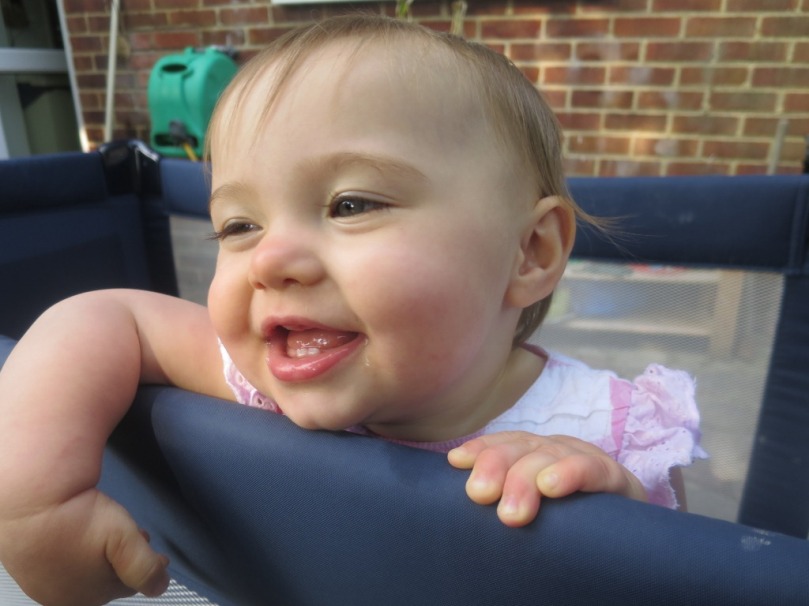
But it’s all worth it to see that smile every day!