
AS, Children and Play

As a kid with Asperger’s Syndrome, albeit undiagnosed, I never understood how to play with others.

At playschool I’d wander straight through the middle of the toy farm the other kids had carefully set out, trampling the animals underfoot and kicking apart the barns without realising it, and unable to comprehend why they were cross with me.

When I tried to play with my brother, I couldn’t get into the fantasy the way he could – the toys were plastic, or wooden or cloth, and had no existence beyond my own control. I cared for them as objects, not as independent beings. They didn’t have feelings – they didn’t mind being thrown against the wall or stuffed under the sofa. Just so long as no one else touched them.

Because I didn’t share. What was mine was mine, and what was yours was yours until it was either mine, or I broke it so you couldn’t have it. As a young child, it’s safe to say I was an asshat.

And I didn’t know how to mix with my peers. We used to go camping almost every weekend, and every weekend we’d be sent to play with the other kids on the campsite. My brother would take it in his stride, marching up to complete strangers and joining them in football or climbing trees or riding bikes – I’d hide behind him and never know what to say or do.

When I tried to be funny, I came across as spiteful; when I wanted to be cool, I was condescending; and playfulness always turned into physical domination where my clumsiness and misunderstanding of appropriate behaviour turned me into a one-man wrecking ball – and that’s when it wasn’t deliberate. When it was, it was much worse. No wonder I couldn’t make any friends!

At eleven months old, Izzie loves playing with the other kids – and I am finding it like pulling teeth.

Every time she crawls towards another child, I watch her like a hawk and get so tense I’m lucky I don’t drive my fingernails through my palms. I see other parents just dump their kids and let them get on with it, but I perch on the edge of my seat ready to pull them apart at the slightest sign of aggression from either side. It’s the most uncomfortable thing I’ve experienced as a dad.

‘Why’s she doing that?’ I think as she pulls a brick out of another child’s hand. ‘Now why’s she doing that?’ I wonder as she passes it back. I’m fine when she plays by herself, but the second she starts to move towards another toddler I cringe and hope she stops before she reaches them because I don’t understand why she wants to play with them.

It’s my problem, I know. You’re supposed to let kids figure out the social rules for themselves, with a little guidance. I’m not going to stop her playing with other children, but damn I wish it was easier.

I’m terrified the other kids will hurt her. I’m terrified they’ll make her cry and she’ll sit there screaming and grow up to be a recluse like me. But more than that, I’m terrified she’ll do something to the other child, and she’s too young to understand the consequences of her actions, but everyone will look at me, and judge me, and realise what a bad dad I am, raising a little tearaway. And I’m worried they’re right, and a dad with AS won’t be able to provide for his child’s social education.

And the thing is, it’s not an idle fear – Izzie’s bloody strong for a toddler. While I was bathing her this evening she rammed her finger so far up my nose it took five pieces of toilet paper to staunch the flow of blood. What if she hits another child? Pulls their hair? Scratches them? Oh God, what would I do then?

The thing with autism is that you like to control your life. You minimise your exposure to stressful, unpredictable social situations in order to protect yourself. Izzie playing by herself in the lounge I can cope with fine as I understand it and can control the variables – the moment you introduce a second child, all control and predictability goes out the window.

But unfortunately, for Izzie’s sake, I have to expose myself to increasingly stressful, unpredictable social situations so she can learn to function as a socially active neurotypical child. I can’t allow my own hang-ups to hold her back.

I just need to learn how to relax when my little girl is learning how to play with others – or at the very least make sure my fingernails are cut so short I can’t do myself any serious damage!

Autistic Building Blocks

There’s an episode of Scrubs in which Dr Cox’s infant son has a playdate with a rival’s child. After seeing the other boy’s precision with building blocks, Dr Cox states that kids of that age shouldn’t be able to do that, leading him to suspect the boy has autism. And of course, since Dr Cox is like House, only with a larger ego, he’s absolutely right.

Far be it from me to take facts about autism from a TV show, particularly one that perpetuates the myth you can restart a stopped heart with a defibrillator (shocking revelation: you can’t!), but it’s lingered in the back of my mind for years. So when Izzie started playing with building blocks a few weeks ago, I watched her very carefully.

Actually, that’s not what happened. I was meant to watch her. Instead, as an autistic guy myself, every time she started to play with them I couldn’t resist the opportunity to shoulder her aside, organise the blocks by colour and shape and build towers all around the lounge. To my annoyance, Izzie kept knocking them over and mucking up my neat piles and throwing the bricks into her ball pit. I started to design stronger towers, pyramids, all kinds of defensive structures to protect my colour-coded edifices. Then, after about a fortnight of this, I realised I was getting obsessive over a baby’s building blocks and really ought to let Izzie play with them. Then I watched her.

Mostly she was destructive with them, smashing them together, bashing them against the furniture, throwing them at the wall, and stuffing them into her mouth. Just like a baby. Phew.

But then she started to play with them differently. Starting a couple of weeks back, she would empty them out of her trolley one at a time onto the carpet and then very carefully put them all back in again. After a few days of this, she decided that was too easy. From then on she’d wheel the trolley over to the coffee table, and one by one she’d put the blocks on top. Once she was done, she’d take them down and put them back in the trolley, walk over to her toy box and repeat the process. Stacking, unstacking, loading, unloading like a particularly conscientious warehouseman.

I consoled myself that she wasn’t able to make towers out of them yet. That would be the time to worry.

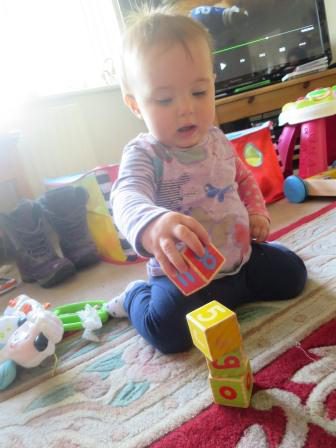
Two days ago she managed to stack two on top of each other. By yesterday, her towers were up to three blocks. Today, she managed five. And that’s when alarm bells started to ring.

I mean, they weren’t very good towers – they were wonky and multicoloured and would fall over if you walked too heavily across the carpet – but they were towers nonetheless. Were these the skills Dr Cox was talking about, those abilities with bricks a non-autistic child shouldn’t possess?

It says on the Baby Centre website that at 15 months she should be able to start putting one block on top of another, and by 18 months might be up to towers of three blocks.

Izzie is ten months old.

IMG_1252
That’s the wrong colour, dumb ass!

So without any further evidence, I started panicking that ohmygod she’s autistic.

After a few minutes of reassuring myself that it’s okay, she’s happy and if she has autism, that’s just the way things are, I’m autistic, Lizzie’s autistic, and we’re fine, everyone has problems, neurotypical, Aspie or otherwise, I decided it might be an idea to research early signs of autism.

And Izzie has NONE of them.

Now of course, not every child with autism is going to have all the signs, and even if a child has many of them, it doesn’t mean they’re autistic, but for anybody who’s curious, these early signs of autism are:

  • Lack of eye contact (I never made eye contact as a child; I sometimes have to look away, the amount that Izzie stares at me!);
  • Failing to imitate social cues, like smiling back at you (Izzie smiles so much, I’m sure her face must hurt);
  • Not babbling to themselves or making noises to get your attention (Izzie is by far the noisiest person in my life);
  • Failure to respond to their name (Izzie comes when called, and if I say, ‘Where’s mummy?’ she looks right at Lizzie);
  • Not using gestures to point things out or respond to your gestures (Izzie’s favourite activity is pointing);
  • Disinterest in physical contact like cuddling or being picked up (if you don’t pick Izzie up, she climbs up your legs!);
  • Doesn’t want to play with others (Izzie is currently loving rolling balls to me and getting me to roll them back);
  • Repetitive interests, movements or behaviours (Izzie does seem a little preoccupied with food…);
  • Delayed motor development i.e. rolling, sitting, crawling, standing (Izzie rolls, sits, crawls, stands, swims, climbs and throws).

Conclusion: Izzie doesn’t have any of the classic signs of autism.

So why is she so advanced when it comes to building blocks if not autism? Who knows? Maybe she’s just really really freaking intelligent.

AS, Anxiety and Baby Safety

It is rare to meet someone with AS who doesn’t have some kind of anxiety problem, and yet anxiety is not part of Asperger’s Syndrome. Rather, it seems the symptoms of Asperger’s – the social confusion, difficulties with understanding, need for routine and inability to cope with change – often lead us into situations we can’t cope with and encourage others to tease us, humiliate us and bully us, and it is a lifetime of such occurrences, repeatedly falling on our arses, that causes the anxiety.

Even then, some of us can be bigger worriers than others.

It turns out that I have a reputation amongst the NCT crowd of being something of a worrier and rather overprotective (shocking, I know!). As I’ve said before, in order to cope with our anxieties, people with Asperger’s plan their lives to avoid risk and the unpredictable. Having a baby means that you don’t just have to plan to keep yourself safe – you have to think of the baby too. And your anxieties about yourself pale into insignificance alongside your need to protect your baby.

Now eight-and-a-half months old, Izzie has reached that stage where she wants to be involved with everything. And by everything, I mean EVERYTHING. She wants to know what you’re doing, what your partner’s doing, what the dog’s doing, what the cat’s doing, what the people out the window are doing, what’s behind that sofa, what’s in that cupboard, can I open this drawer, why can’t I wear that hat, your glasses would look better if I bent them, what happens if I empty out your bag, and everything in between. And keeping her safe has become a nightmare.

The house is starting to resemble a fortress. There are barred gates across every doorway, a wooden fence blocking access to the TV, a hexagonal playpen that looks like a cage-fighting arena taking up half the lounge, and foam corner protectors uglying up most of the furniture. We’ve put down a soft mat as the floor was (probably) too hard, and I’ve even relented about bumpers and put protectors around each slat of the cot because she keeps falling and cracking her head against the bars. Every single night.

But it’s all to no avail. She’s determined to stand and walk before she’s ready, which means she falls often and falls hard. Worse, she doesn’t seem to care – if she’s standing up against the sofa and wants to get to the other, she throws herself down like an unemployed stuntman so she can crawl; if she has a toy, she thrashes it about until she’s knocked herself almost senseless; and within a few seconds of putting her in her cot you’ll hear an awful, heavy thud as she drives her head into the wood, deliberately and repeatedly, as if that’s how the cool kids get to sleep these days.

I’ve had to come to the conclusion that it’s impossible to safeguard her entirely. I can chase her around the room as she waddles about, and catch her if she falls backwards – I can’t stop those face-planting forward falls that squish her nose and knock her teeth back into her gums. Nor can I stop her crawling over her wooden blocks, getting her fingers caught when she bashes two toys together, headbutting my knees or suddenly slamming her face into my forehead – no matter what precautions you take, she’s got you.

I was sitting on the sofa the other day when the lamp started sliding across the sideboard all by itself. Did we have a ghost? I jumped up to find Izzie had pulled herself to her feet, squeezed into the gap down the side of the dresser, reached up to the top and, even though it was out of sight, found the lead with her fingertips and was slowly preparing to pull the whole, heavy ceramic base of the lamp down on her head. This is just one example out of a hundred. Unless we have no phones, lights, chairs, sideboards, tables, floors, people in the room – anything, in fact – we will never eliminate risk.

All of this means the bruise above her eye the size and shape of a thumbprint has been joined by two on her temple the size of peanuts and one right in the middle of her forehead as big as an egg. And she’s into scratching herself too. We take her out in public, all black and blue and red, I’m terrified we’re going to get arrested for using her as a football. ‘It happened when she fell,’ I tell family and friends, and even I think I sound guilty.

The same is true of weaning. I freaking hate feeding her these days. Before, it was milk – pure, wholesome, liquidy milk. Now, it’s all kinds of food, food with bits, with lumps, with chunks. It’s bread, it’s meat, it’s pasta, it’s fruit. So at least once a meal she’ll laugh, or try to talk, or simply swallow something too big, and she’ll start to choke. Totally normal, apparently, totally natural, since she’s learning new textures and tastes, but as her face turns purple and her eyes bulge and tears spurt out of them, I have to fight down the panic because I don’t want to alarm her any more than she already is. So I’m a nervous wreck before we even begin, waiting for that unexpected moment she’ll suddenly start choking, and – something particularly hard for me – there is nothing I can do to prevent it. We can’t keep her on yoghurt and soup all her life, but good gosh I wish we could!

It’s a hard reality to accept but one that I guess all parents eventually have to – we cannot protect our children from the world or from themselves. We can try our best to ensure they’re kept safe, in a protected environment that minimises the risk factors, and be there to pick them back up, but ultimately they’re going to get bumps and bruises, fall out of trees, start dating that boy you don’t like just to piss you off – the trick is not to make a big deal out of it and hope that the damage is never too great. Otherwise you’ll make them neurotic and yourself a basket case, or worse – you’ll turn them into you.

AS, Parenting and Mental Exhaustion

Now that Izzie is crawling, standing, climbing and talking (albeit gibberish), people keep telling me how this is the best, most exciting, and most rewarding time of raising a baby. Those first months where she slept and cuddled and needed, needed, needed were boring, challenging, the hardest slog, but now that she’s interactive and starting to give something back, you can enjoy it. Now it gets interesting.

I have to admit, I feel the opposite.

It’s my belief that Asperger’s Syndrome is at root a problem with information processing. We have no problem taking in vast quantities of information, but our brains are so structured that we compartmentalize this data. It’s in trying to interpret it – to work out how it relates to everything else and what it all means – that we struggle.

I can explain it much better using an orange.

Imagine that each piece of information that goes into making a concept, activity or understanding about the world is a single segment of an orange. A neurotypical person only needs to see one segment, or at the very most two or three, in order to realise they’re parts of an orange, and since they know what an orange looks like, they can construct the orange – the concept, the understanding – without needing to find the rest of the segments or even really thinking about it.

Not so if you have Asperger’s.

You get a piece of information – a segment – and you store it in one part of your mind. Then you find another piece, and even though it relates to the first and is part of the same orange, you don’t have the faculties to realise this, so you store it in a totally different part of your mind. And you keep going like that, and even when you have all the pieces, and you’ve seen an orange before, you can’t work out what it’s meant to look like, so you cram these segments together, trying to work out how they fit, and throwing some things out, and adding bits that aren’t supposed to be there, and ultimately making something you’re happy with but that, to anybody else, looks nothing like an orange.

Thus, in order to compensate for our deficits and function on a daily basis, people with Asperger’s Syndrome have to expend huge amounts of mental energy. What comes naturally to so many neurotypical people, we have to consciously process, and like a computer, we only have a limited amount of processing power.

This is why socialising is so exhausting. Interpreting what people are saying, how they’re saying it, what they mean, in what way they mean it, what you should say, what you shouldn’t say, when you should say it, is your voice too loud, too quiet, do they understand you, are you standing too close, are you making too much eye-contact or not enough, what’s the relationship between this person and that person, how are you coming across, and what does it all mean, while trying not to get distracted by music, other conversations, traffic noise, light bulbs, their deodorant, the way the sun is reflecting off someone’s forehead, and the fact their DVD collection isn’t alphabetized, is excruciating. It’s no wonder we so often become overwhelmed and suffer burnout. And why we need extended down time to recover.

So how does this relate to being a dad?

I liken it to the old people’s home I used to work in. Those upstairs were frail and grumpy, but were compos mentis and had simple needs – toileting, bathing, dressing, eating and sleeping. After working seventeen straight hours without a break, I’d be physically exhausted but mentally quite alert. Other than latent old-fashioned racism (‘That dark girl has stolen my pearls.’ ‘You’re wearing them, Gladys.’), it was a breeze.

Downstairs, behind code-locked doors, were the Alzheimer’s and dementia residents. Most of them were able-bodied, and so working with them wasn’t nearly as physically tiring as working upstairs. Mentally, however, it was like being hit with a crowbar.

You’d have a suddenly-naked ninety-year-old man charge at you with his willy in his hand, turn around to find a woman trying to remove non-existent make-up with cutlery. You’d try to console a former naval officer sobbing over a cat that had been dead for fifty years, before bathing a woman who screamed at the top of her lungs all day long. You ever tried shaving a man who’s spitting at you? Fighting off the advances of a woman who thinks you’re her long lost lover back from the dead?

I’d go home after a shift downstairs and my back wouldn’t ache, my feet wouldn’t hurt, and I’d be capable of running a marathon, but good golly, my brain would be mush. Trying to process the assault of noise, colour, emotion, attempts at communication – it left me useless for the whole night and into the next day.

And that’s how it is with Izzie.

When she was little, it was physically demanding but mentally easy – she spent half the time asleep and the rest of it feeding or pooping. Her needs were simple, her sounds were few and explicable, it was easy to know what she wanted and to cater to that. It was like she was an extension of myself and I loved it, because I was good at it and it worked.

Now, however, she has morphed into a person, entire of herself and completely separate from me. Since my problems revolve around interactivity, having a suddenly very interactive child is something I’m struggling with. She’s become incredibly complicated. It’s like I’m behind those code-locked doors again, downstairs in the dark.

These days, Izzie is in near-constant motion from six in the morning till gone seven at night. Instead of cuddles and sleep, she’s climbing on the furniture, chasing after the dog, throwing tantrums if you take the TV remote off her, fighting you when you change her nappy. Mealtimes are complicated affairs where you try to get enough nutrients and fluid into her while getting it spat and flung back into your face. You can’t take your eyes off her for thirty seconds or she’s unplugging the telephone or ripping the pages out of your favourite book. And no matter what you do, it seems to be wrong.

She’s learning at an astronomical rate, discovering new textures, tastes, sounds, skills, vocalizations, facial expressions. She laughs, she shouts, she reaches for you, she pulls your hair, and you spend all day right there with her, trying to keep up. And every new texture, taste, sound, skill, vocalization and facial expression, I’m trying to interpret it, trying to process it, trying not to get left behind. Am I doing it right, how do I keep her safe, what does she want, what does she need, why’s she doing that, is this right, what should I do, has she eaten enough, I’ve got to catch her if she falls, what rules should I make for this, and that, and the other, and what does it all mean?

And that’s before we factor in visits from family and friends, health visitors, nursery nurses, social workers, care coordinators and support workers, and the everyday trivia of shopping, cooking, cleaning, writing, working, which create a whole bunch of processing issues of their own.

Mentally, I’m mush.

This interactive stage, before babies can express themselves but after they have a need to do so, is by far the hardest part of parenting I’ve experienced. Lizzie is loving it, but I can’t help counting down the hours until Izzie goes to bed, and that’s making me feel like a crap dad, especially as I keep being told that this is meant to be such an amazing period. By the time I’ve got Izzie down, I’m not fit for anything in the evening but staring numbly into space, my brain trying to make oranges out of everything I’ve seen and done. Throw in a touch of SAD and I can feel the Black Dog circling ever closer to me again.

I have an adorable daughter and I seem to be doing a good job of raising her. Physically, it’s easier than ever. But oh my gosh I’m finding it mentally exhausting at the moment.

Perhaps this is just something I’ll have to get used to.

Asperger’s, Parenting and Unexpected Change

As is well-covered in the literature of autism, people with Asperger’s have a love of routines and struggle to cope with change. What I’ve been realising lately is that this bald statement covers up the nuances of what this means in practice, particularly when you’re the parent of a seven-month old.

And it can affect two people with AS in opposite ways.

I cannot handle change in terms of things being added. I need time to process and accept things that are coming up. Ever since I was a kid, I needed plenty of notice – at least a week – to get my head around a visit from relatives, a trip out somewhere, or anything out of the ordinary. If not, I tend to moan, kick up a fuss, say some nasty things I don’t really mean, and then go along with it anyway. But I don’t have much of a problem with things being cancelled anymore – indeed, the principal emotion is relief I don’t have to go through the effort of painting on my ‘public’ face and holding onto a fake smile for however many hours. I would be a hermit if I could get away with it.

Lizzie suffers the opposite extreme: she can’t handle change when it’s things being removed. She is mostly fine with things being added to the routine, especially if she’s the one doing the adding, but if something is cancelled her first response is to throw a tantrum. I liken it to a person walking along a road and finding a brick wall blocking their path. While other people would try to find a way around it, or else turn back, Lizzie bashes her head against it until one of them gives – sometimes the wall, but most often the head. Actually, scratch that – most often the heads of those around her.

Babies, as some of you are well aware and others can easily imagine, are unpredictable. Not only that, the world becomes unpredictable when you have them. Visitors arrive with little or no notice, longheld plans need to be dropped without warning, and you have to rush off to the doctor out of the blue. It’s impossible to say which of us struggles the most with the changes having a baby has brought to our lives, but I can guarantee that I suffer the most.

Now, when I say ‘suffer’, I’m not being melodramatic. I’m not talking about the discomfort I feel at friends, relatives and healthcare professionals clamouring for our time or pitching up on our doorstep unannounced. Nor am I talking about the disruption that sudden trips to the shops for some vital knick-knack cause to my quiet, ordered life. Fact is, the baby’s needs come first. I have accepted that. My needs, as an autistic individual, are immaterial next to hers. I have made that choice.

Unfortunately, Lizzie is either unwilling or, by dint of her condition, unable to make that choice. And so I genuinely suffer.

Like before Christmas when Izzie had a cold and I hadn’t slept for two days. Sunday morning I was so tired I couldn’t see straight, my back ached, I was covered in snot and dribble, and my throat felt like I’d been swallowing razor blades. I hadn’t had the chance to drink, eat, go to the bathroom, since the night before. When Lizzie arose, well-rested, and made herself some breakfast, I asked her to please look after the baby for an hour to give me a rest. But she had planned to go shopping, and, unable to alter her plans, she toddled off for more than three hours of non-essential retail therapy. I suffered.

Or like a couple of weeks ago when I got a migraine about teatime. Lizzie had planned to go out, so out she went. I couldn’t open my eyes more than slits as the light burned, I kept seeing spots of light dancing in front of my face, and my head throbbed with every beat of my heart like somebody was burying an axe in my skull. Every time I bent forward, it felt like my brain was being forced out of my eye-sockets. But I duly bathed the baby, gritting my teeth and shouting in pain whenever it became too much; hissed as I dried the baby; roared as I dressed her in nappy and sleepsuit; cried out as I placed her as gently as I could into the cot; snarled as I sang her to sleep. And then I collapsed, nauseous, into bed. I suffered.

Or the other week in the storms – our village turns into an island during heavy rain, and three years back I wrote off my car by driving into floodwaters (the single-most butt-puckering moment of my life!). So although we’d planned to take the baby to town, I refused point blank to expose her to the risk of getting stuck down some country lane surrounded by cows pretending to be ducks. The sensible thing. Unless you have autism and can’t change plans, in which case you kick off like a wild animal, say some truly awful things, and then go out anyway sans partner and baby. It was only later she admitted I was right, it had been too wet and downright risky to go out in that weather, with or without the baby.

Now, as this is mostly a positive, light-hearted blog, I’d like to say that whenever this happens I smile wryly, roll my eyes, say, ‘That’s Lizzie!’ to hoots of canned laughter, accept that it’s just her autism, and forgive and forget.

But nor is this a fairy tale.

There is a lingering resentment bubbling away under the surface as my needs, and Izzie’s needs, repeatedly come second to Lizzie’s inability to alter her plans for the greater good. Whether she can help it or not doesn’t matter – the resentment is there.

I have heard it said before that partnering a person with Asperger’s Syndrome is a form of abuse – not for the Aspie but the poor neurotypical saddled with their unreasonable behaviour. As someone with AS, I disagree with that, but let me be clear – people with Asperger’s can be cold, insensitive, selfish pricks at times. That’s the reality hiding behind the innocuous words, ‘people with Asperger’s have a love of routines and struggle to cope with change’.

Asperger’s, parenting and social care

The provision of social care for adults at the more functional end of the autism spectrum has always been somewhat spotty. If you’re at the lower end – with classic or Kanner’s autism – there’s plenty of help and support, but those of us with Asperger’s Syndrome face a lottery.

You see, as far as care services are concerned, AS falls between the Mental Health Team and the Learning Disabilities Team. It is not a mental health disorder, but then nor is it really a learning disability – it’s a developmental disorder. Nevertheless, autism tends to be within the Learning Disabilities Team’s remit – but they only get funding to deal with the lower end of the spectrum. In terms of care, then, if you have Asperger’s Syndrome there’s nothing the care services can provide.

You are, however, assigned a social worker – well, sometimes. But herein lies another problem. The team to which you are first assigned is the team you’re stuck with. I was first assigned to the Mental Health Team long before I was diagnosed with Asperger’s; as soon as I was diagnosed, I was discharged by the psychologists, psychiatrists and counsellors, but kept the social worker from the team. And as I said before, Asperger’s isn’t a mental health problem and most social workers I’ve met are gobsmacked when they meet me to find I’m not Rain Man. Different end of the spectrum, guys. Thanks for joining us.

The job of the social worker is to give the service user (i.e. me) access to services pertaining to their condition. Since, as I said, there are no services for adults with Asperger’s, this access takes the form of money that can be used to buy support from private care agencies. I was deemed to require six hours of support each week, so they decided to fund me for three, and I pay for the other three. Thus three times a week, for two hours at a time, I have support workers come in to make sure I’m carrying out my activities of daily living – changing my clothes, cooking, cleaning, etc., and to help me with paperwork, budgeting and the various minutiae of modern life I’m thoroughly incapable of coping with.

This is the way it has been for around seven years now. However, things have changed lately because of the arrival of my little bundle of giggles and poop, otherwise known as Izzie. As regular followers of my blog will know, my partner Lizzie (yes, I know it rhymes and in hindsight it’s quite confusing) has struggled with the demands of motherhood. Like me, she has six hours of support each week, and also has a social worker from Mental Health. Since things were so tough over the first six months, we asked for additional hours just to help us out until we managed to find our feet again. Here is the response we received, paraphrased and dramatized:

‘We’re adult mental health social workers. Neither of you has a mental illness. We’re not even sure why we’ve been assigned to you. Unfortunately, you fall down the cracks between Mental Health and Learning Disabilities.’

But it’s not our fault what we have doesn’t fit into your organisational structure. What we’re asking for is additional funding for more hours for assistance. Because at the rate we’re going, we’ll end up with mental health issues.

‘Well, here’s the problem. We don’t deal with children – we only deal with adults.’

But we are adults. Adults who are asking for help.

‘The thing is, before the baby arrived you were both stable on six hours a week. The disruption in your lives has been caused by the baby. Therefore, if you need extra help because of the baby, the baby will have to fund it.’

I’m not sure I understand.

‘Being a parent is not a mental health problem. If you want any assistance, Izzie will have to get a social worker, and be assigned funding from Child Services.’

I see. So will you refer us?

‘I can give you their number…’

To cut a long story short, we applied to get a social worker for Izzie, to get us extra help as her parents, but as she’s at no risk of abuse or neglect, we were turned down. So, no help there.

Another avenue explored was the Perinatal Mental Health Team. Lizzie was assessed by them, and they concluded her difficulties were caused by her autism, not by postpartum depression, and since autism isn’t a mental health problem, they can’t provide any assistance. So if her autism is causing the problem, who can we go to for help with that? Apparently, nobody.

You can now perhaps understand something of our quandary. We have autism, and despite the joys of the past six months, it’s been a real struggle. We are not the same as every other parent, even though I like to pretend we are, but we’re too high-functioning to get any help from public services, too attentive to Izzie’s needs to get access to child services, and not suffering enough mentally to get extra funding.

To add insult to injury, we have just been summarily dropped by the one piece of free support we were receiving. Since I work Tuesday afternoons in a charity shop, and Lizzie struggles to cope at home on her own with the baby, we had an outreach worker from the local children’s centre who would come out and sit with them for an hour. It was useful and we were grateful for it.

We didn’t hear from the outreach worker after the festive period until she texted on Monday 11th asking to come out either Wednesday afternoon, Thursday morning or Friday morning. Since Wednesday afternoon Lizzie was out with her mother, Thursday morning she takes Izzie to baby group (which is beneficial for mother and baby both), and Friday morning we have swimming classes (which cost £110 a term), we said we were busy. Besides, wasn’t the whole purpose of her visits to sit with Lizzie on Tuesday afternoons?

So she texted us again Tuesday just gone to tell us that they are closing our case because we have ‘disengaged from the process’ and failed to make ourselves available and haven’t kept in touch and if we ever want any help from the children’s centre again we will have to get Izzie a social worker and be referred.

This has left us both feeling perplexed and upset, principally because we have no idea which ‘process’ we are supposed to have disengaged from, but also because we don’t understand why we should have cancelled a Thursday morning Mother and Baby group or Friday morning swimming lesson when the whole reason she was coming was to sit with Lizzie for an hour on Tuesday afternoons? Furthermore, the wonderful invention called the telephone could have resolved whatever issues they had with us – what’s all this text message crap?

They clearly have no idea about autism. We like routines and we cannot abide change, so we make plans and stick to them – disruptions to our timetable make us agitated, anxious and insecure. When plans change you feel small and scared, but you can’t rationalise it away because there’s nothing you’re actually afraid of. It’s simply a general, all-pervading fear that all is not right with the world, a feeling of danger and fright when there’s nothing coming for us – just shadows in the dark. That’s why we don’t change plans at the drop of a hat. If people understood that, it might make things easier.

It reminds me of the time before my breakdown, before my diagnosis, when I was climbing the walls and my thoughts were tearing me apart. I was referred to a psychiatrist under the mental health team. But I wasn’t opening the post – I hadn’t for six months –  so when they sent out the appointment by letter, I didn’t open it and I therefore missed it. So they discharged me with the stipulation that if I was referred again I would go to the back of the queue. I only discovered this months after my breakdown when I finally had the energy to face up to opening the huge box of post my parents had kindly collected from my flat. How different things might have been if someone had actually picked up a phone. And how switched-off to the realities of mental health do you have to be to send someone an appointment by post when it said in the referral that he doesn’t open it?

I honestly think that, going forward, we’ll be better off as a family without the interventions of any of these social workers, care providers or so-called experts. The other day, when Lizzie was feeding Izzie during a support session, Izzie choked. We’ve just started her on food with a coarser texture, and choking is par for the course during weaning. The support worker even said that it was entirely innocent, normal, there wasn’t too much on the spoon or too much in her mouth, it was just one of those things. But she still felt the need to report it to her manager, and have it logged that on this day, at this time, during weaning our baby choked. Everybody is just looking for you to fail, and covering their arses in case you do, and that’s not an environment in which I want to raise my child.

Ending on a positive note, the past couple of weeks Lizzie has been so much better, it’s like she’s a different person. She’s far more attentive to Izzie’s needs, supports me more than she ever has, and is suddenly settling into the role of motherhood. And I have finally made peace with the fact that bedtimes and overnight is my domain, because Lizzie will never be capable of getting up in the night. We have different roles to play and given how Izzie is far ahead of the curve in almost every respect, we’re playing them damn well!

It’s just a shame it’s been such a struggle to get here.

Five Months of Autistic Parenting, Part 3

Having Asperger’s Syndrome means you struggle to say the ‘right’ thing, misinterpret what other people are saying, fail to give due diligence to the feelings of others, and don’t appreciate that people have different needs. It also makes you rather self-centred. Mostly I can use my intellect to overcome my natural shortcomings in these areas, but the more tired I become, the harder it is to do that.

Having two tired new parents with Asperger’s in the same house with a five-month-old baby is a recipe for disaster.

This morning, for example – Lizzie is spending the day in Southampton shopping with a friend and she’s taking Izzie with her. Since I’m in desperate need of a break, I’ve been looking forward to today – for once there are no support workers, social workers or family members coming over, no urgent writing deadlines, no charity shop, no cooking, so it’s all mine, yes, all mine (he says, rubbing his hands together with a maniacal grin). I can soak in the bath with a book, make my model that has sat untouched for five months, go to the local coffee shop in the village and watch the world go by. Or I can mooch about in my underwear and watch rubbish TV. My day. Bliss.

And Lizzie would know that if she’d been listening and considering my needs.

So I’ve been up since five, fed the dog, the cat and the chickens – not to mention the baby – and I’m just waiting for Lizzie to hurry up and go when she says, ‘Oh, by the way, I want you to mow the lawn today.’

The lawn takes two hours to mow because we have a rubbish mower and a massive lawn. I have to empty the grass collecting box around twenty-six times during mowing. And it’s raining.

So I said, ‘No. Not a chance in hell. I’d rather poke out my eyeballs. You want me to do chores while you’re out on a jolly? How dare you even suggest that? This is my day.’

In hindsight, a simple, ‘No, I’d rather not,’ would probably have sufficed. Yes, I overreacted. And then she overreacted to my overreaction. And that’s how it tends to go at the moment. If we were less tired, we’d probably be able to rein ourselves in, realise the other person wasn’t being belligerent or deliberately insensitive, they just hadn’t realised their partner had been looking forward to a day off. But we flip out instead.

That is, unfortunately, part and parcel of having autism, and only to be expected.

What is not so obvious is why, as a result of my Asperger’s, I find it so difficult to entrust the care of my baby to others.

It would make life so much easier, and would have done over the past five months, to have babysitters. Lizzie has a remarkable ability to go out and then not think about home, or babies, or really much of anything (miaow!). I, however, find it nigh impossible to switch off.

The autistic brain is very susceptible to obsession – I’m using up my ‘day off’ writing about the baby! But this could also be the result of the fact that the autistic brain is also so structured that your thoughts can go round and round and round, growing bigger and more frantic with each circuit. Since Izzie was born, I haven’t rested, haven’t dropped my guard for even a moment – I am a dad, and that means constant vigilance, care and concern. After years of learning that people let you down, it’s very difficult to trust anyone else with the most precious thing in my life.

This goes for Lizzie too. As I have mentioned in previous posts, thanks to difficulties with Theory of Mind – that is, understanding how other people think – I struggle to comprehend why people would do things in a different way to me (because clearly my way is the best, which is why I’m President of Earth). I therefore find it very hard to step back – I want to take over, because Izzie is my baby and I know what she wants and I’m the best at doing it so back the hell away. This has inevitably led to friction between me and Lizzie and I realise now that I’m a total control freak.

But that’s because control keeps me safe. I’ve cleverly structured my life to avoid stressful situations and thus remain asymptomatic. If I go out to a social situation, I drive so I can leave any time it becomes too much. I sit on the end of tables so I can slip out unnoticed. I actively shun noisy and crowded environments. And so if I let others take over, I can’t ensure Izzie’s safety. I can’t be certain she’s getting what she needs, which is me, because I know best.

You see? Even I can see that I need to let go, step back, have a break, learn to trust others, and stop worrying so much when I’m not with her. But can I?

Perhaps the biggest obstacle to this is, again, my autism. I’ve always struggled to understand relationships – how to form then, how to keep them, what they mean – and I’ve only ever managed to have one friend/partner at a time. If I have a second friend, or a friend other than my partner, I feel as though I am somehow betraying the people I care about. If I have a friend, then it means Lizzie isn’t enough, and how can I say that? Of course, Lizzie has plenty of friends and I don’t feel she’s betraying me, but I resist any overtures of friendship because I don’t want to betray her.

The same is true of Izzie. If I let someone look after her, I feel I’m somehow betraying her, letting her down. I’m failing her as a dad. People tell me to stop trying to be perfect, because I’m only human, but that is like an admission of failure. Why can’t I be both?

That’s the biggest lesson I have to learn from five months of autistic parenting – I have to learn how to let go and relax. If I’m not careful, my ten-month review of autistic parenting will describe how I don’t let Izzie out of my sight and I haven’t left the house for weeks. Or it’ll just be gibberish.

Five Months of Autistic Parenting, Part 2

Because you act in a way that is normal for you, it can sometimes be easy to forget you have Asperger’s Syndrome. That is, until someone points out that your way of doing things is perhaps not strictly conventional.

I figured that most of our struggles as new parents had to do with us being new parents, because you’re meant to suffer, aren’t you? That was how I explained it to my autism support coordinator yesterday. We’re no different to any other parent.

‘Except that most of them don’t have difficulties with communicating, understanding relationships and processing information,’ she replied. ‘You do.’

Touche.

As the stress and tiredness of having five unrelenting months of childcare have caught up with us, Lizzie and me have increasingly argued about our roles and responsibilities. That goes with the territory, of course – when you’re looking after a baby, there’s far less time and energy to invest in your relationship beyond occasional back rubs and I-love-yous – but I’ve come to realise that our difficulties have a distinctly autistic flavour. Because we’re not the same as every other parent, and that’s worth remembering.

In my last post I wrote about how the little idiosyncrasies of my condition affected my life as a dad. This post and the next (because it’s a big topic) are about how the larger underlying issues of Asperger’s have affected my relationship as a parent.

Probably the biggest thing I’ve struggled with throughout the past five months is the issue of fairness. Since people with Asperger’s can have very logical, systematic and pedantic ways of seeing the world, rules and routines are very important to us. Unfortunately, our understanding of fairness as a black-and-white, unbending entity does not relate to how fairness actually works in real life. And I have erroneously applied my logical yet unreasonable idea of fairness to mine and Lizzie’s roles as parents.

If Lizzie goes out for six hours on a jolly with her friends, for example, leaving me to look after the baby, I consider it only fair that the next day I get six hours to myself while Lizzie looks after the baby. If I put the baby to bed one night, I think it only fair that Lizzie does it the next night. And if I change a poopy nappy, it’s her turn to change the next. It’s logical, it makes sense, and it’s undeniably fair.

Apparently, however, this is not how parenting and relationships are done and I have been waiting in vain for a fairer distribution of duties. I said in an earlier post (It’s Not A Competition) that we each give what we can give, and if I can give more than Lizzie can, that’s okay. Lately, however, I haven’t been living up to that enlightened thinking. I look at how much I do and how much she does, how many warm meals she eats compared to the number of my cold dinners, the amount of sleep she gets, the frequency with which she has time out with her friends leaving me at home alone with the baby, and it’s all started to seem rather unfair and one-sided. And part of our problems of late have undeniably resulted from my resentment of this state of affairs.

But as I said, apparently this turn-taking thing isn’t how parents are meant to behave. Thanks to our autistic ways of thinking, we have been living like flatmates who pass a baby between us – you look after her for a couple of hours while I do my own thing, then I’ll look after her for a couple of hours while you do your own thing, and so forth. I thought that was totally normal, but apparently not. Instead, we should be doing things together as a family and supporting one another instead of playing pass-the-parcel.

I have to here point out that I love spending time with Izzie, and in actual fact I wouldn’t mind if that was all I ever did. But I’ve become hung up on this issue of fairness, particularly in regard to the amount that Lizzie goes out. In recent weeks it has reached six days out of seven, for a minimum of three hours at a time, maximum of nine, sometimes with the baby but mostly without, day after day after day leaving me to look after Izzie by myself. I thought she was running away from her responsibilities as a mother, and that is how I addressed it, but the truth is that it had to do with her Asperger’s.

You see, Lizzie has never really had friends, but in the past couple of years has made around seven of them. Having AS, however, means she doesn’t know how to manage her relationships. She’s terrified of losing them, and thinks that if she says ‘No’ when someone invites her out, they won’t be her friend anymore. And she doesn’t want to include me in her plans because that would be asking permission, and she’s an adult who doesn’t need permission from anybody. So if seven friends invite her out in the week, she says yes to all seven, without thinking about the impact it is having on our relationship and family life.

The way forward, then, is teaching her that when you have other responsibilities to a child, a partner, a home, you’re allowed to say no, and that if they’re true friends, the friendship will survive. Her support workers are trying to get her to limit her time out without the baby and spend more time in the home, because they feel that the balance needs to be redressed – though, when I ask them if ‘unbalanced’ is a euphemism for ‘unfair’, they strongly deny it.

So we have been doing things differently recently. We have spent more time doing things as a family, not just in the home but going out together too. Some of the things Lizzie would have done with friends, like painting a plate at a cafe, she has done with me, the baby on my lap. This weekend we’re all going to a Christmas market. And when Lizzie gets invites she asks me if I mind her going out, which isn’t asking permission but checking in with me as her significant other, which makes me feel more appreciated than before.

And life is so much better. If it hadn’t been pointed out to me that we were doing things separately that we should have been doing together, I don’t think we’d have figured that one out for ourselves. If people hadn’t told me that ‘fairness’ is not the criteria by which you divide up the responsibilities of parenthood, we might have continued passing her between us and inadvertently made her feel like an unwanted burden, which couldn’t be further from the truth. Sometimes you need other people to point out to you what you can’t see for yourself, and we’re lucky enough in our lives to have those people around us.

Five Months of Autistic Parenting, Part 1

Five months ago I started this blog with the question: what happens when a guy and a girl with Asperger’s Syndrome have a baby? I can answer that very simply: we have a gosh-darned gorgeous daughter. Beautiful, inquisitive, intelligent, happy and healthy. And it’s not just me that says that – health visitors, midwives, nurses, doctors, childcare specialists, social workers and swimming teachers all agree, and they have no reason to suck up to me so it must be true. Yay.

But of course, that’s only a fraction of the answer. How has our autism affected our parenting thus far? How has it affected our relationship? How have we compensated for or overcome our foibles and idiosyncrasies? What have we learned? These are the real meat of the answer, and I’ll do my best to cook them for you.

In this post, I’ll cover the small, humorous parts of autistic parenting. The next post will detail the larger, more serious problems of parenting with Asperger’s. So hang on in there if that’s what you’re looking for.

Firstly, I have to mention the mobile over Izzie’s cot because it drives me freaking insane. Why? Because you have to turn the mechanism ten-and-a-half times to wind it up fully. What kind of sadist designed that? Why can’t it be ten? Why ten-and-a-half? I’d even accept it if it went up to eleven (insert This Is Spinal Tap reference here). But leaving it with a half is plain belligerence. It’s practically warmongering. (For future designers, I would accept fifteen as well – multiples of five are always good).

This same sadist also made it run out of steam one solitary note from the end of its repetitive tune. Yes, one note. I lie awake listening to that simple tune on the baby monitor, round and round, knowing that soon it’ll stop short and leave me with a horrible sense of incompleteness. It’s like watching a firework shoot up into the sky and then splutter out without so much as a ‘fzzzzt‘.

The play mat bugs me too. All the tunes it plays are almost nursery rhymes, but not quite. Whether for copyright reasons or simple hatred of children, they’ve changed the last line of each one so you’re singing along and suddenly – boom – you can’t finish it! So Incy Wincy Spider never gets to climb up the spout again, the little boy who lives down the drain never gets his bag of black wool, and Frere Jacques doesn’t end with a ding, dang, dong. So annoying.

The monitor is a pain in the ass too. The first sound the baby makes switches it on, and then you’re treated to ten seconds of the microphone trying to pick up whatever white noise it can find. So, if the baby coughs, you don’t hear her cough – you hear the monitor come on, ten seconds of humming, buzzing static, and then it switches off again. She coughs again, the microphone comes back on. So you lie in bed listening to the monitor switching on and off without once hearing any baby noises. It drives me crazy.

But infinitely worse is when you can hear noise through it, specifically screaming. Izzie screams so loud, I imagine the neighbours wake up thinking, ‘Whose bloody baby is that?’ And when I say ‘neighbours’, I mean ‘the people in the next village’. It’s bad because I can hear Izzie screaming through the wall and I can hear her screaming in my ear through the monitor, so I get it in stereo.

And if that wasn’t bad enough, there’s a slight lag between the microphone picking up the sound and the speaker relaying it, so the screams are slightly out of sync. If you want to make a noise so unholy it could summon the devil, come to my bedroom around eight pm. Bring cake.

In truth, I’m not sure whether it’s my autism that makes these things bug me or if it would bug every parent. Certainly, my autism makes me pedantic and pernickety – I like completion, efficiency, accuracy, things working as they should and doing so logically – and whoever designs these things for babies seems to enjoy torturing parents like me. Grrrr.

Probably more directly related to autism is my dislike of slimy stuff. Autism is often accompanied by sensory issues, including a strong liking or disliking of particular textures, temperatures, smells, sights and sounds. One Easter at Sunday School when I was about eight we had to do egg-blowing, and I absolutely hated it – disgusting, squidgy raw egg dripping out the hole in the bottom of the shell. Yuck. The teacher lady, knowing I didn’t like mud, grass stains, getting dirty, told me I wasn’t like other boys – in hindsight she might have been suggesting I was gay. But she was right – I cannot stand slimy stuff.

Which means changing Izzie’s poopy nappies, especially when the crap has spilled out and soaked into her vest and top and trousers and I have to slip it off over her head and then there’s faeces in her hair, is particularly difficult. And when I get it on my hands I run to the bathroom screaming to wash my skin in scalding water with antibacterial soap and a wire brush.

Worse, though, is feeding the baby her solids. I’m not sure why they’re referred to as solids because, as everybody knows, baby food is sludge. Watery, slimy, smelly sludge that stains everything it comes into contact with.

Since babies learn about the world by watching our reactions, I’ve been told we have to act as though their food tastes lovely and there’s nothing we’d like to be doing more than feeding them this gunk, or else it might put them off. Now imagine you’re someone who is horrified by the feeling of sludge and who squeals if he gets mud on his Wellington boots. Yeah.

I spoon that gloopy, dripping, phlegm-like goo into Izzie’s mouth, force a smile onto my mouth as she dribbles it onto her hands then smears it over her face, try not to react as she grabs my forearm with her cold, slimy fingers and rubs that delightful substance into my skin. Mealtimes have become my least favourite activity by far – I’d rather clean out the cat litter, and that’s saying something.

And this fakery of enjoyment leads me onto the final and most profound observation on autistic parenting in this first part of the post. As someone with Asperger’s Syndrome, my life is one giant performance. My body language, facial expressions and tone of voice are not natural, but the result of study and conscious manipulation. I project confidence, contentment and cheerfulness when in truth I am filled with hidden insecurities and neuroses, discontentment and confusion, and I spend my life battling against my thoughts with a violence that nobody could ever guess at. How does this relate to parenting?

Since our babies look to us to learn how they’re supposed to react to new situations – should they be afraid, relaxed, excited, upset? – we have to act as though we know what we’re doing and everything’s fine and dandy. Well, having had a lifetime of practice hiding (masking) my problems, I’m an expert at making Izzie feel safe and secure. I might be terrified of setting foot outside my own front door, but Izzie will never see that, so she won’t grow up infected by my fear of the outside world.

So my autism is really a double-edged sword. Without it, I probably wouldn’t be a reclusive, hysterical pillock; with it, I’m able to pretend that I’m not a reclusive, hysterical pillock. What kind of parent does this make me?

The best that I can be.

Asperger’s, Emotions and Parenthood

There is a persistent myth that people with Asperger’s Syndrome don’t feel emotions. It’s a myth because, if anything, I think many of us feel emotions more strongly than neurotypicals – it just doesn’t look like it.

I liken emotions in autism to a case of arrested development. Our emotional development suddenly stops while our bodies and cognitive abilities continue to grow. Unfortunately, it usually gets stuck on the ‘teenage’ setting, meaning we don’t understand what we feel, but we feel it all so intensely – the manic highs and the desperate lows – that we become overwhelmed and cease to function. Imagine being stuck as a hormonal fourteen-year-old your whole life – doesn’t bear thinking about, does it?

Since our emotions can confuse, unsettle, and even scare us, we embrace routines, predictability, systematic thinking and mental reasoning. We live in our minds and try to keep our nasty, unpleasant feelings pushed down deep where they can’t harm us. Many resort to antidepressants to keep our feelings at bay. And when our emotions do get the better of us, and we can’t cope, we seek out solitude and experience them alone. The emotionally unresponsive Aspie, approaching situations from the head and not the heart, is therefore in many ways a defence mechanism against our dangerous unbridled passions.

At least, that’s how I see it.

Yet even knowing this, I did wonder why I didn’t feel more when Izzie was born. The father across from us in the Transitional Care Unit was always crying when he was hugging his newborn. ‘I love him so much, I just love him so much,’ he kept saying, until even his missus told him he was being pathetic. I just couldn’t relate to those feelings.

I was told, before Izzie was born, that the first time you hold your baby in your arms it’s special, the love is instantaneous, you’re overwhelmed with emotion, and yada, yada, yada. I’ve mentioned before that when I first met my baby I was pretty dazed and distracted by the whole ordeal of ambulances, operating theatres and incubators and it took me a good four hours to really start feeling the love. But I never got that emotional rush, that powerful knock-you-on-your-ass thrill of being a parent.

Until now.

This is going to sound really saccharine and namby-pamby, but the past few days I’ve been almost overwhelmed by this incredible feeling of love. I feel like I want to cry all the time. When the baby sleeps I feel this surge of emotion well up in my chest, and I watch her for hours because she’s perfect in every way. When I went to work in the charity shop yesterday, I missed her horribly – I was only gone three hours. And when customers asked about her, I showed them a picture and could have cried with pride. I can’t believe she’s only been here nineteen weeks. It feels like she was always with us, just waiting to be born to make us all complete.

See? It’s so horribly sweet and sickening I want to disown myself. Part of me wonders if it’s because I’ve reduced my caffeine intake and started a diet to knock off the twenty pounds I’ve put on in the last nineteen weeks, mostly through chocolate, chocolate and more chocolate; another part wonders if it’s because I haven’t had a good night’s sleep for almost five months; whereas in truth, it’s probably because I’m more relaxed about being a dad these days. The fumbling, panicked hell of the first couple of months, and the laboured, mind-sapping slog of the next two, have given way to a quiet confidence and acceptance of the new routine. And that allows me to see her and enjoy her for what she really is: an angel in our midst.

Actually, that’s going a little too far. She’s suddenly discovered she can squeak like R2-D2, so every time she’s displeased with something, which is often, she treats us to a sound even dolphins wouldn’t enjoy. It’s a high-pitched, screeching whine, somewhere between a dial-up modem and that awful sound you used to get when you picked up the phone only to hear a fax machine on the other end (for those of you too young to remember dial-up modems and fax machines, ask your parents what they were, and know that I hate you).

But my emotional responses to the good things far outweigh my feelings towards the bad. In fact, right now the emotional impact of the good things is utterly disproportionate to their size. Izzie rolled from her back to her stomach for the first time yesterday and me and Lizzie were leaping around the room like idiots, and even though today she’s doing it like a pro, we still get excited every time. This morning when she was laughing unstoppably as I blew raspberries on her belly, I could have been in heaven. And a few minutes ago when I went to check on her in her cot and she opened her eyes, smiled at me, and went immediately back to sleep, I could have stayed in that moment forever.

I am choked with emotion at the moment. I am overwhelmed. But not that anyone would know it.

People with Asperger’s do feel emotions just as strongly or more so than ‘regular’ people. We just don’t make such a big song and dance about it, is all…

See what I mean? Perfect.