Five Months of Autistic Parenting, Part 1

Five months ago I started this blog with the question: what happens when a guy and a girl with Asperger’s Syndrome have a baby? I can answer that very simply: we have a gosh-darned gorgeous daughter. Beautiful, inquisitive, intelligent, happy and healthy. And it’s not just me that says that – health visitors, midwives, nurses, doctors, childcare specialists, social workers and swimming teachers all agree, and they have no reason to suck up to me so it must be true. Yay.

But of course, that’s only a fraction of the answer. How has our autism affected our parenting thus far? How has it affected our relationship? How have we compensated for or overcome our foibles and idiosyncrasies? What have we learned? These are the real meat of the answer, and I’ll do my best to cook them for you.

In this post, I’ll cover the small, humorous parts of autistic parenting. The next post will detail the larger, more serious problems of parenting with Asperger’s. So hang on in there if that’s what you’re looking for.

Firstly, I have to mention the mobile over Izzie’s cot because it drives me freaking insane. Why? Because you have to turn the mechanism ten-and-a-half times to wind it up fully. What kind of sadist designed that? Why can’t it be ten? Why ten-and-a-half? I’d even accept it if it went up to eleven (insert This Is Spinal Tap reference here). But leaving it with a half is plain belligerence. It’s practically warmongering. (For future designers, I would accept fifteen as well – multiples of five are always good).

This same sadist also made it run out of steam one solitary note from the end of its repetitive tune. Yes, one note. I lie awake listening to that simple tune on the baby monitor, round and round, knowing that soon it’ll stop short and leave me with a horrible sense of incompleteness. It’s like watching a firework shoot up into the sky and then splutter out without so much as a ‘fzzzzt‘.

The play mat bugs me too. All the tunes it plays are almost nursery rhymes, but not quite. Whether for copyright reasons or simple hatred of children, they’ve changed the last line of each one so you’re singing along and suddenly – boom – you can’t finish it! So Incy Wincy Spider never gets to climb up the spout again, the little boy who lives down the drain never gets his bag of black wool, and Frere Jacques doesn’t end with a ding, dang, dong. So annoying.

The monitor is a pain in the ass too. The first sound the baby makes switches it on, and then you’re treated to ten seconds of the microphone trying to pick up whatever white noise it can find. So, if the baby coughs, you don’t hear her cough – you hear the monitor come on, ten seconds of humming, buzzing static, and then it switches off again. She coughs again, the microphone comes back on. So you lie in bed listening to the monitor switching on and off without once hearing any baby noises. It drives me crazy.

But infinitely worse is when you can hear noise through it, specifically screaming. Izzie screams so loud, I imagine the neighbours wake up thinking, ‘Whose bloody baby is that?’ And when I say ‘neighbours’, I mean ‘the people in the next village’. It’s bad because I can hear Izzie screaming through the wall and I can hear her screaming in my ear through the monitor, so I get it in stereo.

And if that wasn’t bad enough, there’s a slight lag between the microphone picking up the sound and the speaker relaying it, so the screams are slightly out of sync. If you want to make a noise so unholy it could summon the devil, come to my bedroom around eight pm. Bring cake.

In truth, I’m not sure whether it’s my autism that makes these things bug me or if it would bug every parent. Certainly, my autism makes me pedantic and pernickety – I like completion, efficiency, accuracy, things working as they should and doing so logically – and whoever designs these things for babies seems to enjoy torturing parents like me. Grrrr.

Probably more directly related to autism is my dislike of slimy stuff. Autism is often accompanied by sensory issues, including a strong liking or disliking of particular textures, temperatures, smells, sights and sounds. One Easter at Sunday School when I was about eight we had to do egg-blowing, and I absolutely hated it – disgusting, squidgy raw egg dripping out the hole in the bottom of the shell. Yuck. The teacher lady, knowing I didn’t like mud, grass stains, getting dirty, told me I wasn’t like other boys – in hindsight she might have been suggesting I was gay. But she was right – I cannot stand slimy stuff.

Which means changing Izzie’s poopy nappies, especially when the crap has spilled out and soaked into her vest and top and trousers and I have to slip it off over her head and then there’s faeces in her hair, is particularly difficult. And when I get it on my hands I run to the bathroom screaming to wash my skin in scalding water with antibacterial soap and a wire brush.

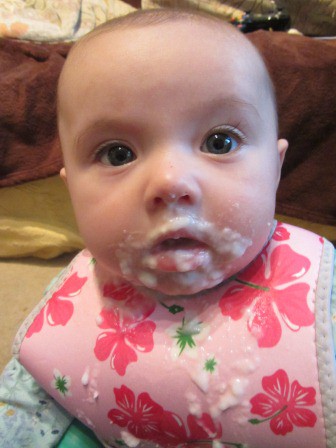
Worse, though, is feeding the baby her solids. I’m not sure why they’re referred to as solids because, as everybody knows, baby food is sludge. Watery, slimy, smelly sludge that stains everything it comes into contact with.

Since babies learn about the world by watching our reactions, I’ve been told we have to act as though their food tastes lovely and there’s nothing we’d like to be doing more than feeding them this gunk, or else it might put them off. Now imagine you’re someone who is horrified by the feeling of sludge and who squeals if he gets mud on his Wellington boots. Yeah.

I spoon that gloopy, dripping, phlegm-like goo into Izzie’s mouth, force a smile onto my mouth as she dribbles it onto her hands then smears it over her face, try not to react as she grabs my forearm with her cold, slimy fingers and rubs that delightful substance into my skin. Mealtimes have become my least favourite activity by far – I’d rather clean out the cat litter, and that’s saying something.

And this fakery of enjoyment leads me onto the final and most profound observation on autistic parenting in this first part of the post. As someone with Asperger’s Syndrome, my life is one giant performance. My body language, facial expressions and tone of voice are not natural, but the result of study and conscious manipulation. I project confidence, contentment and cheerfulness when in truth I am filled with hidden insecurities and neuroses, discontentment and confusion, and I spend my life battling against my thoughts with a violence that nobody could ever guess at. How does this relate to parenting?

Since our babies look to us to learn how they’re supposed to react to new situations – should they be afraid, relaxed, excited, upset? – we have to act as though we know what we’re doing and everything’s fine and dandy. Well, having had a lifetime of practice hiding (masking) my problems, I’m an expert at making Izzie feel safe and secure. I might be terrified of setting foot outside my own front door, but Izzie will never see that, so she won’t grow up infected by my fear of the outside world.

So my autism is really a double-edged sword. Without it, I probably wouldn’t be a reclusive, hysterical pillock; with it, I’m able to pretend that I’m not a reclusive, hysterical pillock. What kind of parent does this make me?

The best that I can be.

Demon Child Update

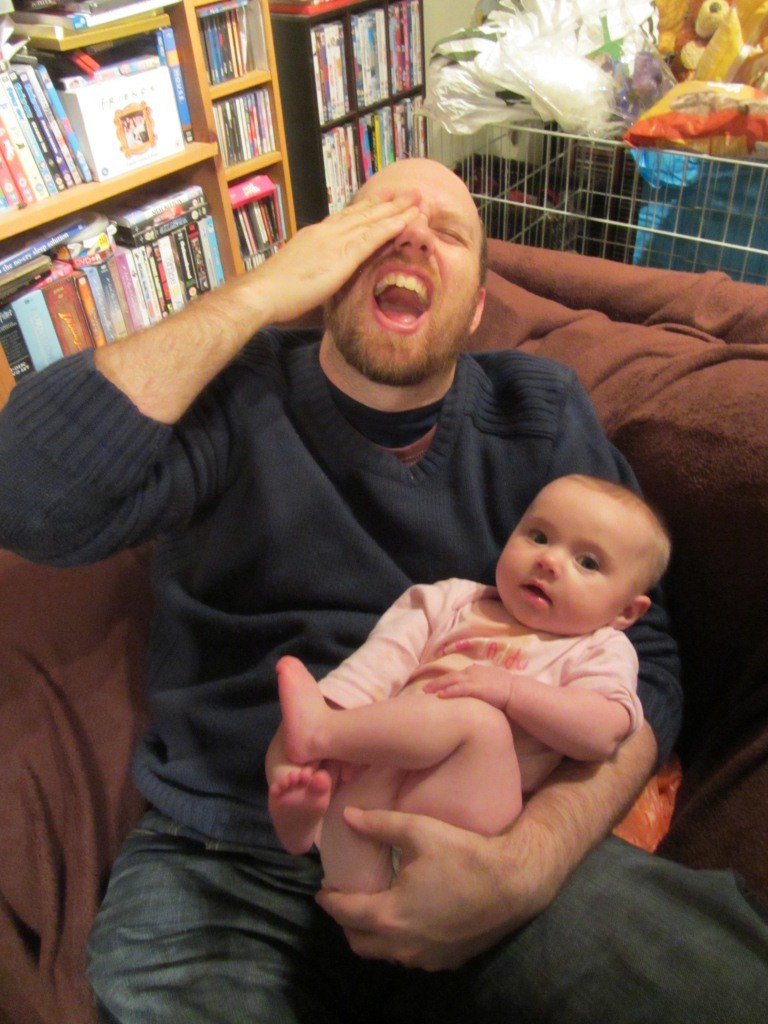
My five-months-and-three-day old baby:

IMG_5088
Caught ya!

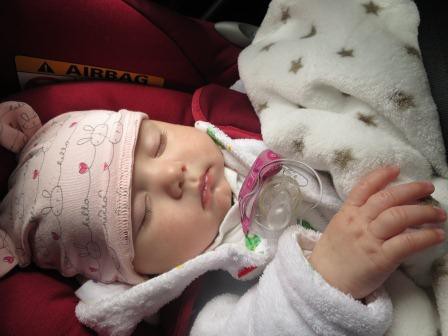
To hell with this crawling shit!

IMG_5091
I didn’t poke you in the eye! Not me! It’s a frame up! I’m innocent!


The World’s Worst Word

Top of the list of words that should be expunged from the English language is ‘should’. Unfortunately, in order to make that statement, I’ve had to use it, so perhaps banning it isn’t the right answer. To rephrase, then: I would greatly appreciate it if the word ‘should’ was avoided in any conversation about life, lifestyle, parenting, babies, child development, behaviour and relationships, because ‘should’ is the world’s worst word.

Implicit, and often explicit, within the word ‘should’ is that there is only one way of doing things, the right way, and therefore if people use that word at you, they are telling you that you are not only falling short of the ideal, you are doing things wrong. ‘You should leave her to cry,’ means: ‘A proper parent leaves their child to cry. This is the only way to respond to a baby that cries. By not leaving her to cry, you are not being a proper parent. You suck.’

Okay, maybe that’s my autism reading too much into it, but how much nicer would that same sentence be if you replaced ‘should’ with ‘could’? ‘You could leave her to cry,’ means: ‘there are many options available to parents, of which this is just one. I leave it to you to make the decision as to which option is right for your family.’ See? Much better.

‘Should’ also fills your life with pressure. ‘She should be drinking five bottles a day.’ Great, but what if she only wants four? Or those days that she wants six? What then? Should we be forcing milk into her, denying her it when she’s hungry? Instead of following your instincts and adapting to reality, you feel an obligation to try to squeeze reality into a ‘should’-shaped hole, and that doesn’t make life easy for anyone.

That horrible imperative also changes the power relationship between you and whichever person said it. ‘You should change the brand of milk she drinks,’ is another way of saying, ‘I don’t respect you. There is no point in us having a conversation as adults because you are a child who cannot be trusted to make decisions. Therefore, I must fill the role of your parent and tell you exactly what to do. Switch to Aptamil.’

‘But Aptamil and Cow & Gate are the same company with different coloured packaging.’

‘Shut up, imbecile. You are incapable of deciding what is best for your baby so I will take that choice away from you. You are the hydrant and I am the dog.’

You see what I’m saying? ‘Could’ means that we are equals, you are making a suggestion and you respect my ability to sort through the conflicting information and select an appropriate course of action. ‘Should’, on the other hand, means you’re the expert and I’m the dunce, and I should do what you say because you’re the Man, and I’m the poop he just stepped in.

So next time you’re giving someone advice, think about turning that first phoneme from a ‘sh’ to a ‘c’, unless you really are that arrogant that you think you know the best way to raise my baby.

Rant over.

Asperger’s, Emotions and Parenthood

There is a persistent myth that people with Asperger’s Syndrome don’t feel emotions. It’s a myth because, if anything, I think many of us feel emotions more strongly than neurotypicals – it just doesn’t look like it.

I liken emotions in autism to a case of arrested development. Our emotional development suddenly stops while our bodies and cognitive abilities continue to grow. Unfortunately, it usually gets stuck on the ‘teenage’ setting, meaning we don’t understand what we feel, but we feel it all so intensely – the manic highs and the desperate lows – that we become overwhelmed and cease to function. Imagine being stuck as a hormonal fourteen-year-old your whole life – doesn’t bear thinking about, does it?

Since our emotions can confuse, unsettle, and even scare us, we embrace routines, predictability, systematic thinking and mental reasoning. We live in our minds and try to keep our nasty, unpleasant feelings pushed down deep where they can’t harm us. Many resort to antidepressants to keep our feelings at bay. And when our emotions do get the better of us, and we can’t cope, we seek out solitude and experience them alone. The emotionally unresponsive Aspie, approaching situations from the head and not the heart, is therefore in many ways a defence mechanism against our dangerous unbridled passions.

At least, that’s how I see it.

Yet even knowing this, I did wonder why I didn’t feel more when Izzie was born. The father across from us in the Transitional Care Unit was always crying when he was hugging his newborn. ‘I love him so much, I just love him so much,’ he kept saying, until even his missus told him he was being pathetic. I just couldn’t relate to those feelings.

I was told, before Izzie was born, that the first time you hold your baby in your arms it’s special, the love is instantaneous, you’re overwhelmed with emotion, and yada, yada, yada. I’ve mentioned before that when I first met my baby I was pretty dazed and distracted by the whole ordeal of ambulances, operating theatres and incubators and it took me a good four hours to really start feeling the love. But I never got that emotional rush, that powerful knock-you-on-your-ass thrill of being a parent.

Until now.

This is going to sound really saccharine and namby-pamby, but the past few days I’ve been almost overwhelmed by this incredible feeling of love. I feel like I want to cry all the time. When the baby sleeps I feel this surge of emotion well up in my chest, and I watch her for hours because she’s perfect in every way. When I went to work in the charity shop yesterday, I missed her horribly – I was only gone three hours. And when customers asked about her, I showed them a picture and could have cried with pride. I can’t believe she’s only been here nineteen weeks. It feels like she was always with us, just waiting to be born to make us all complete.

See? It’s so horribly sweet and sickening I want to disown myself. Part of me wonders if it’s because I’ve reduced my caffeine intake and started a diet to knock off the twenty pounds I’ve put on in the last nineteen weeks, mostly through chocolate, chocolate and more chocolate; another part wonders if it’s because I haven’t had a good night’s sleep for almost five months; whereas in truth, it’s probably because I’m more relaxed about being a dad these days. The fumbling, panicked hell of the first couple of months, and the laboured, mind-sapping slog of the next two, have given way to a quiet confidence and acceptance of the new routine. And that allows me to see her and enjoy her for what she really is: an angel in our midst.

Actually, that’s going a little too far. She’s suddenly discovered she can squeak like R2-D2, so every time she’s displeased with something, which is often, she treats us to a sound even dolphins wouldn’t enjoy. It’s a high-pitched, screeching whine, somewhere between a dial-up modem and that awful sound you used to get when you picked up the phone only to hear a fax machine on the other end (for those of you too young to remember dial-up modems and fax machines, ask your parents what they were, and know that I hate you).

But my emotional responses to the good things far outweigh my feelings towards the bad. In fact, right now the emotional impact of the good things is utterly disproportionate to their size. Izzie rolled from her back to her stomach for the first time yesterday and me and Lizzie were leaping around the room like idiots, and even though today she’s doing it like a pro, we still get excited every time. This morning when she was laughing unstoppably as I blew raspberries on her belly, I could have been in heaven. And a few minutes ago when I went to check on her in her cot and she opened her eyes, smiled at me, and went immediately back to sleep, I could have stayed in that moment forever.

I am choked with emotion at the moment. I am overwhelmed. But not that anyone would know it.

People with Asperger’s do feel emotions just as strongly or more so than ‘regular’ people. We just don’t make such a big song and dance about it, is all…

See what I mean? Perfect.

Random Thoughts

It’s my birthday next week. Lizzie keeps asking me what I want. Apparently ‘a day to myself’ isn’t an appropriate gift.

Whenever I sneeze, Izzie bursts into tears in absolute terror. So when she’s in her chair, cot, or with Lizzie, I rush out of the room if I feel the urge. But what do I do when she’s asleep in my lap and I feel a sneeze coming on?

Check out my new i-phone, bitches!

Izzie is fascinated with my face. If she’s not twisting my ears, tugging my awesome beard, or pulling my glasses off and flinging them on the floor, she’s pushing her fingers as far up my nostrils as she can manage. As cute as she is, it’s rather unpleasant.

Izzie is so innocent and uncomplicated, her face is a succession of emoticons. When she finds something funny, she laughs; if she’s happy, she smiles; sad, her bottom lip sticks out and her eyes fill with tears; confused, she frowns and twists her mouth; tired, she yawns and rubs her eyes; surprised, her mouth falls open and her eyes go wide. They could use her on those caricature cards they give to autistic people to explain what different emotional states look like.

Where do all our muslins disappear to?

When I fart these days, it smells exactly like the baby’s poop. I know for a fact we’re not eating the same thing, so what’s that all about?

When babies cry, it’s out of need, frustration and annoyance. They’re not really sad, despite the tears. When they’re genuinely sad – like when they wake from a bad dream or their dad sneezes – their crying looks and sounds completely different.

People keep asking what Izzie’s getting for Christmas. She’ll be six months old – she can have the wrapping paper from whatever I unwrap, and the box it came in if she’s lucky.

The first song she heard after she was born, playing on the radio in the operating theatre, was Phil Collins’ Can’t Hurry Love. If they’d waited a few minutes before yanking her out, it would have been Ellie Goulding’s version of Your Song, which would probably have been more appropriate. But then, they were hurrying, love.

Why do they have radios playing in operating theatres?

Not sure how much actually made it to your stomach there.

All-terrain buggies should be renamed ‘heavy, big-wheeled, wide wheel-base buggies’, because other than being incredibly heavy and too wide to go down shop aisles, that seems to be the only difference. The only genuinely all-terrain buggy is called a sling.

Apparently, the middle knuckle of my right index finger is more appealing than a teething ring.

Whenever I walk down the street these days I pay inordinate amounts of attention to other people’s babies, and conclude that, yes, mine is the best. People say I’m biased, and I am. But that doesn’t mean I’m wrong.

She woke me up the other morning rhythmically banging her feet against the cot’s headboard. The fact she was put to bed facing the other way doesn’t seem to concern her.

Right now, when she burps, we cheer and tell her well done. In a couple of years we’ll tell her off for being so rude!

Izzie is terrified of missing things. She refuses to fall asleep in the afternoon as though worried in case something exciting is just around the corner. You can see her eyes drooping, but she refuses to give in, whereupon she goes past the point of tiredness into frenzy mode. That’s where she’s super tired, hyper alert, and has completely forgotten how to get to sleep. Tip: it’s not by pinwheeling your arms while shouting and going red in the face.

They need to build statues to honour whoever invented the dummy.

Now that Izzie is going to bed around 8pm, Lizzie and I keep sitting on the sofa, staring at each other, and wondering just what the hell we used to do in the evenings.

What is going on with that little cough thing that babies do for attention?

All my clothes seem to be covered in crusty white stains. It looks particularly dodgy on my black dressing gown. At least I know it’s puke, not that that makes it much better.

That stuff about having to be careful when changing a boy because they pee when the nappy comes off is only half right. If my experience with my daughter is anything to go by, all babies pee halfway through the nappy change, soaking themselves, their clothes, the clean nappy, you, and the carpet all at the same time.

Pesky bib!
Pesky bib!

How is it that dribble bibs are terrible at catching milk, milk bibs are terrible at catching dribble, and food bibs seem incapable of catching anything?

In the battle between the cot in the nursery and the Moses Basket on a rocker by the bed, the Moses Basket wins hands down because a) it’s right beside the bed, and b) it rocks. Whenever Izzie used to stir, I could lean over, pop her dummy back in, and rock her to sleep with my foot, all without getting out of bed or even really out from under the covers. Now I have to get up, go next door, put the dummy in, try to soothe her without rocking, and when she’s quiet I retreat to bed only for the monitor to kick in with grizzles around fifteen seconds later, forcing me to repeat the whole thing five or six times. And that’s a problem at three in the morning.

Izzie keeps doing phantom poops. She makes a noise, I feel the guff, the smell is awful, so I wait a couple of minutes, sniff her bottom to confirm that yes, it stinks, and pat the nappy to confirm that yes, there’s something in there, but by the time I open the nappy the poop has mysteriously vanished. Spooky.

Why, when I use the tympanic thermometer, does it always read 35.4 degrees? Am I not using it right?

And lastly, when I was doing night feeds every night around 3am, I could handle it. Now that Izzie sleeps through to around five-thirty or six in the morning two nights out of three, those 3am feeds every third night are absolute killers that I struggle to recover from. How does more sleep make you feel less awake? Or is it because I check her every couple of hours to make sure she’s still alive?

Support for Parents With Autism

This is a long one, so brace yourselves.

There’s plenty of support for parents with autism. There’s also a total lack of support for parents with autism. Weirdly contradictory, I know, but read on and I’ll explain.

While Lizzie was pregnant with Izzie, we received plenty of support on account of our autism. They gave us a consultant at the hospital, sent us to a nutritionist, referred us to the ‘special’ community midwives and introduced us to our future health visitors. We also had an outreach worker from a local children’s charity who visited us every few weeks to make sure we didn’t need anything extra and were up to speed on the processes of labour, birth, and what comes next. Pretty nifty.

The ‘special’ midwives visited us every few weeks in the safety of our own home, and gave us extra time to explain things and iron out any problems. The team was so good that when Lizzie was sent home from hospital because they didn’t believe she was in labour, three community midwives turned up when the emergency shout went out, and two of them accompanied Lizzie in the ambulance.

We had meetings involving social workers, the local autism charity and representatives of the local council to offer their help and support, too. The unborn baby was assigned a social worker and our competence was assessed (and found to be fine). We were given a fake baby to look after for a few days and attended both NHS and NCT courses on pregnancy, childbirth and breastfeeding. The midwife team could support us for 28 days after birth; the health visitors could start from 11; and they’d see us every single day if they had to. Promises were made, support was offered, and our hands were going to be held right through the pregnancy and birth and into the future.

But it hasn’t worked out like that.

The main problem we had before the birth was getting Lizzie ready for her two nights in hospital. As a medically high-risk individual, she and the baby had to remain under observation for 48-hours. Trouble is, they wouldn’t allow anyone to stay with her overnight – visiting hours ended at 8pm and partners had to be gone by midnight, not to return before 10am – and as a highly anxious person with autism, a fear of hospitals and difficulties adjusting to new situations, Lizzie was terrified of being alone, particularly with a new baby.

Various people contacted the maternity unit on our behalf, and we were even given a tour of the birthing suite, postnatal ward, Special Care Unit, Neonatal Intensive Care Unit (NICU), and Transitional Care Unit (TCU) – all of which we unfortunately got to use – but they wouldn’t budge an inch: despite Lizzie not spending a night by herself for years, having six hours of support from the autism charity each week and a hell of a lot more from family, friends, and me, and struggling to communicate when stressed or with strangers, both of which she was going to be, they would not make any exceptions for anyone. The best we got was that the hospital would try to give her a side room on the postnatal ward, or a place in the eight-bed TCU, depending on space and circumstance. So she’d just have to grin and bear it.

As I have mentioned before, the labour and birth were a bit of an ordeal. Lizzie lost almost three litres of blood, the baby spent the first two days in an incubator on NICU and the next two in the special care unit, and then another three on TCU. I would like to say that the midwives and nurses and healthcare assistants were great, and they were, but one deep problem overshadowed that whole week: where was our special dispensation for being autistic?

‘Ah,’ I hear you say. ‘Why should you get extra attention for having autism? Never happened in my day. The midwives and nurses should have been able to support perfectly well.’

And yes, they should. But there are a couple of problems with that.

Staffing is the first issue. They don’t have the time to provide the extra support a person with autism needs. On the Postnatal Ward one night there was one midwife to cover 25 beds – so presuming one baby per child, that’s one person to care for fifty people. And Lizzie was in a side room. Did the midwife have the time to check on Lizzie, explain things to a greater depth, make sure Lizzie understood, and, more importantly, that she had understood Izzie? Of course she didn’t.

Things weren’t any better on TCU. You’d think that with eight beds supported by one midwife and one healthcare assistant, you’d be seen when there was a problem. But one night, it was ten o’clock, the staff had changed over at seven, we hadn’t seen anyone for four hours and my taxi (also named ‘Dad’) was due at eleven. We were worried about Izzie as she was jaundiced and not going to the toilet, and I was worried about Lizzie, who was freaking out, and I’d buzzed three times already, so I went to find someone. It turned out the two staff were feeding two sets of twins, and they told me to wait my turn. Hardly supportive of two desperate and terrified new parents, particularly if they both have autism.

Another issue is therefore understanding. I don’t know if they’ve had training in autism and Asperger’s – they should have done as a result of the Autism Act – but I had to explain to every one of them what it was and how it affected people. They all said the same thing – ‘Oh, if she needs anything, all she has to do is ring the buzzer.’ Even without a three hour wait, the simple fact is that Lizzie isn’t capable of asking for help. She shuts down when there’s a problem, goes into herself and stops communicating. And she pretends she understands things, or thinks she understands them, when she doesn’t. I watched midwives ask if she was okay and she smiled and they walked off when I knew there was actually something wrong. And I watched as people explained things to her and she nodded intelligently and then afterwards said to me, ‘What did any of that mean?’ This is why she needed someone who knew her to advocate for her, to talk to people on her behalf as the support workers and social workers had been doing. But they still wouldn’t let me stay.

Now, imagine you’re a twenty-nine year girl – perhaps not the easiest of things. Imagine you hate hospitals and have had to have counselling from various sources to face up to the fact that you have to spend two nights away from home. You’ll be away from your partner and your regular support network, and in addition, you’ll have the responsibility of a newborn baby that you have to look after alone, without your partner backing you up.

Now imagine that you have the baby, only it’s a terrifying nineteen hour ordeal involving ambulances, blood, screaming and pain, a spinal injection, episiotomy, failed ventouse and forceps delivery. Imagine you then haemorrhage and have to have two blood transfusions, while the baby is rushed off to Intensive Care in an incubator. Imagine that instead of the two days you’ve prepared for, you have no idea how long you’ll have to stay. Imagine that they put you in a side room and ignore you for eight hours at a time while you plod back and forth to NICU, where your baby is being fed through a tube in her nose.

Now imagine you get transferred to TCU after four days, and are handed your baby and expected to get on with it. They’re too busy to sit with you and show you how to breastfeed, so they give you advice and leave. Now that the baby’s not being fed through the nose, she’s desperately hungry, and won’t stop screaming and sucking on your breast even though there’s nothing in them.

Imagine she’s been feeding for five hours, and you’re weak, and sore, and tired, and you haven’t recovered from the blood loss, and you’re in a strange place with strange people and nobody is responding when you buzz. And then they tell your partner, the one who has been standing beside you all day, supporting you, giving you strength, that he has to leave and come back almost eleven hours later.

Now imagine that you have autism.

I think that warrants a little special dispensation.

People with autism don’t like change, and with a different midwife or nurse every few hours, and no consistency from one day to the next, hospitals aren’t designed to be easy for us. With the additional problems with communication, understanding and anxiety, people with Asperger’s Syndrome and other forms of autism really need someone to advocate for them in hospitals. Ideally, a family member or partner should be allowed to stay with them to act as go-between. Hell, I’d have slept in a chair – I even asked to – if it meant I could stay and support Lizzie. It would free up nurses and midwives, provide far better care for new mothers, and be less cruel on people who have just been through a traumatic experience.

But they don’t make exceptions for anyone, apparently.

Once we were eventually out of hospital, we had great support from the midwives and health visitors. Until, unfortunately, a few weeks ago it was decided that as our village sits on the border between Hampshire and Dorset, all the people formerly looked after by Dorset health visitors (like us) must be transferred over to Hampshire health visitors. So the Dorset health visitors have washed their hands of us, but Hampshire haven’t picked us up yet. After seeing the health visitor every week since the birth, we’ve not been seen now for a month. I spoke to Hampshire and they said they’d be happy to see us, two towns over, in a year. So I rang Dorset to say that doesn’t sound right and they told me to speak to Hampshire. Again, for people who don’t respond well to change, to have support and then take it away seems like calculated cruelty.

So all in all, there are great support services out there for expectant parents with autism, and some great support services for parents with autism, but don’t expect to get much support inside hospital, because it all ends at the door. Equally, the provision of services in the community is terribly inconsistent and seems to be dependent on postcode and not need. I guess it’s lucky we’re doing so well, and nowadays don’t really need that much support, but for people further down the autism spectrum, I dread to think what could happen.

Mother-Baby Groups

Lizzie is regularly taking Izzie to mother-baby groups, and for my sins I have accompanied her to a few. I have to say, hats off to her, because it allows the baby to socialise with other babies/become overstimulated/pick up and incubate enough germs to start her own chemical weapons factory. But this is a good thing, apparently.

I say hats off to Lizzie because if it were down to me, Izzie would never set foot in one – or bottom, as the case may be – since I’ve discovered that I cannot stand mother-baby groups.

I thought that I was into babies because I loved Izzie so much, but the truth is that I’m into my baby, not babies per se, so my tolerance for and liking of the screaming, crying, vomiting, farting, pooping, dribbly offspring of other people is not the same as my tolerance for and liking of the screaming, crying, vomiting, farting, pooping, dribbly issue of my own loins. And when there are ten of them crying all at once, it’s damn hard not to tap out and say, ‘That’s me done, my ears are bleeding and my blood-pressure’s so high I can feel my heart beating in my eye-sockets!’

But that’s not the only problem with them. As someone with Asperger’s Syndrome, I struggle with social situations at the best of times, but good golly gosh, mother-baby groups are hard work. They can be very cliquey, there’s a competition to see whose child is most advanced for their age, and everyone acts like the world’s greatest mother, making it really difficult to ask questions like, ‘How do I get her bogies out of her nose when her nostrils are so small?’ and, ‘Is it normal to have this dreadful fear of inadequacy and the constant spectre of your shortcomings as a parent?’ Because everyone seems to pretend they’re the living embodiment of Mother Nature, and we won’t condescend to talk to you because you’re clearly a beginner in this parenting game.

Being the only adult with a penis, you tend to stick out like a sore thumb too, and whenever I step into one of those groups, I feel my identity slowly sucked from my body and replaced with breastfuls of oestrogen. But that’s not my main issue with these groups, nor is it simply because they’re full of women – it’s because they’re full of mothers.

When you have a child, people stop seeing you as a person and start to see you as that thing that carries the cute baby around and takes it away again when it starts to cry or needs changing. ‘How’s the baby? Where’s the baby? Look at the baby! Ahhh.’ This transition from ‘individual’ to ‘baby’s plus-one’ can be particularly difficult and contribute to postnatal depression. When you’re coping with a momentous lifestyle change – marriage, divorce, coming out, changing career, abandoning the dye-job and letting it go grey – you need the support of the people around you who know you and see you as you to get through it. They remind you who you really are, what really matters, and smooth over the rough edges of your new identity.

But when you have a baby, everyone you know switches their attention to the little one, so not only has your life changed dramatically, your emotional support structure abandons you to focus in on the very thing that’s brought about the change. Frankly, it can be a bummer.

So, you go to mother-baby groups hoping to meet like-minded souls who know exactly what’s it’s like to be seen as nothing more than ‘mother’, people crying out for conversation about something other than nappies, and breastfeeding, and the day-to-day slog of childcare.

Then you get there.

Here’s a typical conversation at a mother-baby group:

‘Baby, baby, baby, I’m a mother, baby, baby.’

‘Ah, baby, baby, baby, I’m a mother too, baby, baby, baby.’

‘Breastfeeding, nappies, weaning, baby, baby, did you know I’m a mother, baby.’

‘Nappies, nappies, baby, I’m a mother, men just don’t understand.’

And so on, and so forth.

The only other topic of conversation is where they’ll meet up during the week to discuss being mothers some more. It’s like they’ve become Stepford Wives, or something – the thing that made them human has been sucked out and they’ve turned into boring child-rearing robots. For crying out loud, ladies, you’re people as well as mothers! You have other dimensions! There is a whole wide world out there filled with art, literature, politics, entertainment, sport, work, relationships, hope, dreams, joy, love – why on earth don’t you lift your eyes from your child for half a minute to see it?

Of course, I’m being facetious – I’m exaggerating. But it’s to prove a point. This morning I walked along the beach with the dog for ninety minutes. Every so often I’d pass a couple of women pushing their babies in prams, because it seems that young mothers love to go out in pairs, walk side-by-side, and completely block the promenade for everyone else. I understand it – nobody wants to stay in all day every day with their baby, and when the weather is nice, a walk along the beach in the sun with a friend is exactly what the doctor ordered.

But here’s the rub: as I passed these people – I must have met six such pairs today – I’d catch snippets of their conversations, and every single one of them was talking about babies and mothering.

The babies are asleep. You’re walking in the sunshine with your friend. The sea is lapping lazily against the shore. The air feels great in your lungs. It’s time to be you. And you’re still  talking about babies!?

That’s the thing I struggle with. I guess you’ll say, ‘It’s a mother-baby group, of course they’ll talk about babies and being mothers,’ and you’d have a point. You could also say, ‘But you’re talking about babies and parenting,’ and yes I am, but I’m not the walking embodiment of fatherhood and I never pretended to be – and it’s my blog, so nah, nee, nah, nee, nah, nah!

I’m sure people who enjoy mother-baby groups, and enjoy being earth mothers, will think I’m a silly man, so what do I know, and that’s fine. But we didn’t erase our identities the moment our children were born, and we don’t cease to be adults with adult needs just because we look after children all day. True, it informs a great deal of how we think about things – a couple of people I know died from carbon monoxide poisoning the other day, a mother and her son, and all I could think about was how awful it would be to lose Lizze and Izzie in like manner – but we are not one-dimensional characters just because we’re parents.

With Izzie on my lap I talk about the science behind the new Matt Damon movie, or the latest atrocity on the news, the etymology of the word ‘halcyon’ and how rough Kate Moss looks in her latest advert, if the new Facebook promo is really using the Pixies’ Where Is My Mind? on piano, or why the band PVRIS isn’t better known. If I one day found that all I could talk about was nappies, weaning, feeding, teething, and babies, babies, babies – well, that would be the day I realised I needed to find a new interest, and fast, before I ceased to be a human being and became a robo-nanny. Actually, come to think of it, that sounds rather fun…

Stop Growing Up!

I must have a different concept of time to other people. ‘Can you believe she’s almost sixteen weeks old already?’ they say, as if it’s magically just happened on its own.

Yes, I can well believe it. I was there every day of the previous fifteen weeks.

A variation on this theme is, ‘I bet it feels like just yesterday she was born.’

Nope, it feels like she she was born 111 days ago. 111 long, hard, tiring but ultimately rewarding days. It feels like it was years ago, and I can barely remember my life before Izzie was born – it’s a grey blur where I had free time and sleep, like in a fairy tale.

Another old chestnut is, ‘Before you know it she’ll be eighteen and moving out.’

I’m not sure how she’ll be eighteen ‘before I know it’. I can’t imagine the upcoming hell of teething, toddling, talking and terrorising are going to slip by unnoticed. Nor can we get through eighteen birthdays, eighteen Christmasses, a million holidays, school trips, sports days, parent-teacher evenings, pimples, boyfriends and ‘the talk’ without being made aware, every step of the way, of the passage of time.

My whole life, time hasn’t passed for me as quickly as it seems to have done for others. Maybe it’s my Asperger’s Syndrome, the fact I pay attention to every little detail and don’t let anything past unless it’s been examined, interrogated, probed and analysed, every last ounce of information and experience wrung from it before it’s let go. At sixteen I felt I’d lived a lifetime, by twenty-five I was sure I’d lived three, and now, at thirty-five, I feel older than the dinosaurs.

So I’ve never understood how time can just fly by.

And yet, one piece of parenting advice has been ringing true of late: ‘Make the most of each moment because they grow so fast.’

Over the full range of eighteen years, the changes are going to be slow and steady and we can revel in them one by one. At this age, however – from about three months – the changes come thick and heavy and uncomfortably fast. I mean, yesterday Izzie had no idea her feet existed; today they’re the most exciting thing in the world and if she’s not staring at them or reaching for them, she’s stuffing them into her mouth.

The speed with which she’s come on in the past three weeks is incredible. She can now roll on her side…

.IMG_4772

..support her own weight (albeit with a steadying hand)…

IMG_4834

…hold her own bottle…

?????????????

…put giraffes in her mouth…

IMG_4857

…and she’s teething. Which means if she isn’t talking non-stop, she’s trying to cram everything she can get her hands on into her mouth, or, failing that, chewing on her hands themselves.

What you lookin' at!?
What you lookin’ at!?

What is more, her personality is developing daily. She’s a happy, inquisitive, strong-willed, hyperactive sod with quite a temper on her if you don’t understand what she wants and respond quickly enough for her liking. If you make eye-contact with her while she’s feeding, she smiles and tries to talk to you, causing her to spill her milk everywhere and start to choke. But if you’re holding her while talking to someone else, she gets grumpy that she’s being left out of the conversation.

And she wants entertaining now, too. Things that interested her a fortnight ago aren’t good enough anymore. A few random noises? No, perform for me, daddy! When I sang Eric Clapton’s ‘Tears In Heaven’ to her the other night, she thought it was the funniest thing she’d ever heard, which was a little disconcerting given what it’s about (look it up if you don’t know). Then yesterday, when we were playing, I said to her in my best French accent, ‘Ah, ma petite pomme de terre!’ and she burst into tears and wouldn’t stop crying for ten minutes. So, soft rock, good, French, bad. Good to know.

The truth is, we have to make the most of each moment, because if you’re looking the other way, you’ll miss a world of development going on in your own living room. Right now, you have to embrace every moment or it’ll be gone forever, because they do indeed grow up fast.

So fast, in fact, that I’m actually feeling nostalgic about how she was a month ago – that baby that seemed to sleep a lot more, and struggled against us less. The baby that wasn’t quite as wilful as the one we’ve got now, because believe you me, she is going to be quite a handful – as stubborn and fiery-tempered as both of her parents. Or ‘determined’ and ‘passionate’, to put a positive spin on things.

In all honesty, part of this nostalgia comes from the fact that I’m scared of the future. It’s selfish and stupid, but I’ve been so darned good at this baby thing, I don’t want her to move on to the next phase. Lizzie takes her to baby groups and to parties and out swimming, and as Izzie grows up she’s going to love those things more and more. As someone with Asperger’s Syndrome, I really struggle going to things like that, and while Lizzie has this innate understanding of toddlers and children, I never have, even as a child. As Izzie grows and becomes less like a baby, more like a toddler, and turns to her mum for the ‘fun’ things, I’m terrified of being left behind.

Of course, my relationship with Izzie will always be different from Lizzie’s relationship with her. I’m just paranoid that as she becomes more complex, I’ll struggle to relate to her or understand her as I do now, and that would break my heart.

But then, I think that in this society, we’re programmed to believe that change wrought by time is universally bad. You lose your hair, your teeth, and your bladder control; standards drop everywhere you look; kids run around like rootless, feckless waifs; and you don’t understand the world you live in anymore.

Clearly, given the numbers who tell you to cherish every moment, plenty of people feel as though their children ‘slipped through their fingers’, to paraphrase the song from Mamma Mia that made all our mums cry. But instead of focusing on what we lose, let’s look at what we gain over time – experience, confidence, a deeper understanding of ourselves and richer, more fulfilling relationships.

The only way of surviving both life and parenthood with a modicum of happiness is to embrace the passage of time, not resist it. Instead of wanting Izzie to stop growing, instead of holding on and resenting that we have to change, I should let go, enjoy every individual moment as a single thread in a lifelong tapestry of such moments. I will not be losing anything as Izzie develops because our relationship will grow, and both of us with it. Tomorrow, I will not be who I am today, and that will be a result of my changing relationship with my daughter. We’ll be different together. And that, my friends, is life.

Travels With Baby, Part 2: The Experience

If you imagine going on holiday with a baby is horrendously difficult, you’d be absolutely right. You’d also be quite spectacularly wrong. So work that one out.

By way of introduction, we went glamping on the Isle of Wight from Monday to Friday. Of course, you can call it glamping all you want, but a ‘canvas cottage’ is still a tent in a field buffeted by September winds and rattled by the first rains of autumn. Once your clothes are wet, they stay wet, the bed is made of foam on the floor, and at night the temperature drops to around twelve degrees.

I'm happy in my hat, daddy!
That’s okay, I’m warm enough, daddy!

As I have mentioned in a previous post (Out and About With Baby), the anxiety that goes hand-in-hand with Asperger’s Syndrome means just going to the shops by myself is a major ordeal. However, this doesn’t preclude the possibility of going away – since going out’s already so stressful, the anxiety from a holiday is a difference of kind rather than intensity, and if you’re going to struggle anyway, it makes a pleasant change doing it somewhere other than home.

For a similar reason, since looking after a baby is already so difficult, holidaying with one isn’t that much harder. At home your life revolves around sterilising bottles, making up feeds, changing nappies, and ensuring the little one is wearing clean clothes, is the right temperature, and you have enough spares of everything to stock your own branch of Mothercare. On holiday, the same applies. The main difference is that instead of popping to the supermarket, attending mother-and-baby groups, walking the dog or heading into town for a coffee, on holiday you’re visiting a stately home, taking part in an axe-throwing competition, playing crazy golf or searching for somewhere that does gluten-free cream teas (not common, I can tell you!).

Of course, there are other difficulties specific to travelling with a three-month-old. You leave home with the car piled up to the roof because you don’t know what the weather’s going to be like or how the baby will develop – one day she’s happy with the carry cot/pram, but the next she spends the whole day doing stomach crunches as she tries to sit up and you need to use the pushchair instead, or else she’ll have abs to die for. In addition to the travel system base unit, carry cot, pushchair and car seat, sunhoods and raincovers, parasol and umbrella, you have to add the steriliser, bottle warmer, changing bag, extras with which to refill the changing bag, baby’s suitcase containing warm weather and cold weather outfits, your partner’s suitcase, your backpack, a couple of rucksacks of food, drink, formula, a paperback (like you’ll ever find time to read it!), 6-way adapter plug, phone charger, Glo-egg. I have no idea how people can go away with two kids because we maxed out the available space with one.

Then there’s the fact you’re out and about for most of the day. When we go away, Lizzie and I tend to burn the candle at both ends, so to speak – Monday to Friday, and we checked out Alum Bay, Freshwater Bay and Ventnor, played crazy golf at Shanklin, enjoyed the arcades at Sandown, explored the WWII ruins at Culver Down, saw the windmill at Bembridge, walked the beaches at Whitecliff Bay and Ryde, visited Osborne House, East Cowes and Cowes, scoffed tasters at the Garlic Farm, shopped at Arreton Barns and Newport, navigated a hedge maze in Godshill, and still found time to go swimming twice with the baby, win a pub quiz and have a meal out. Such a heavy schedule means you need your sleep at night, and if the baby sleeps through as she started doing a few days before she went, then all is good.

Except the baby doesn’t sleep through. Because the routine has been altered, she alters with it. She knows things are different so she behaves differently. She doesn’t get tired when she usually does, doesn’t want to miss things, becomes overstimulated by all the sights and sounds and smells – ‘look, daddy, Queen Victoria’s bed, and a gold chandelier, and what sort of wax are they using to clean these marvellous wooden floors?’ So she keeps going, gets over-tired and grumpy, crashes suddenly early evening, and wakes at two am and five am. So holidaying with a baby means you’re horribly tired, and when you get home you really need another holiday.

Then there are the smaller practical considerations. Playing crazy golf, for example, is exceedingly awkward when you keep having to move the pushchair down staircases, over speed bumps and around lighthouses and windmills. You can’t play air hockey in an arcade with just the two of you, and nobody to watch the baby. Every time you get out of the car you have to debate whether to use the carry cot, pushchair, car seat or sling. And all the while, the clock is ticking between feeds, so you keep part of your brain focused on where you’ll be and whether there will be a cafe there where you can warm the bottle.

I think one of the hardest things about holidaying with a baby is that when she’s having an unsettled day, you’re stuck with her. At home you’d put her in her Moses Basket, rock her to sleep, perhaps go for a walk, put on some music or the television, and when all else fails you can take turns with your partner, allowing one of you a few moments of respite. On the last day we left the campsite at half ten and the ferry wasn’t until after seven. Izzie spent the whole day grizzling, crying, having mini-tantrums and demanding constant stimulation. This culminated in an utter refusal to sit in her car seat, and endless screaming when she did. Every time I tried to put her in the car seat she would straighten out and go stiff as a board, so I’d have to try and get her to bend at the waist, force her bottom into the seat, and hold her there with one hand while I attempted to put her straps on with the other. She might only be three months old but she knows what she wants and what she doesn’t, and boy is she strong!

But it’s not all bad. Going away with a baby didn’t stop us from doing most of the things we’d normally have done without her, and her smiles and chuckles made up for just about all the tears and screaming and inconveniences. Her fascination with every trivial, insignificant detail is a wonder to see and makes you look at things with new eyes. And you get to feel like a proper grown-up.

But not too adult to pass up a sundae that's bigger than your head!
But not too grown-up to pass on a sundae that’s bigger than your head!

All in all, going on holiday with a baby is hard work, but so is everything when you have a baby. It’s a slightly different experience from holidaying as a couple – you’re more focused on the baby and her welfare than on the things you’re actually doing – but by taking you away from the everyday grind, you can enjoy one another’s company and bond as a family without the usual stresses of home. That said, I’m in no hurry to repeat the experience unless it comes with a guarantee of four nights of uninterrupted sleep!

Clean Hands and Dead Birds

Is it bad luck having a bird of prey die in your hands? Scratch that – of course it is. The bad luck is having a bird of prey die in your hands. Especially when you aren’t wearing gloves, it’s a wild animal that could have all kinds of illnesses, bacteria and bugs, and you have an eleven week old baby.

I opened the front door this evening to find a beautiful sparrowhawk sitting on the driveway. A young female by the look of it. Long toes, curved talons, mean yellow eyes, hooked beak. But it had a tear right across its face.

I crouched beside it and it fell onto its side, stretched out its wings, arched its back, spread its tail, tried to lift its head and balled its feet into tiny avian fists. At the time I figured it was trying to assess what was damaged; looking back, it was in its death throes.

I’ve always been sensitive to the suffering of animals. I can’t watch nature shows because I find it heartbreaking when things die. I can often relate better to animals than I can to people. This is actually quite a common thing for people with Asperger’s Syndrome, which I think stems from our difficulties with Theory of Mind. People are complicated, extremely so, and their lives and deaths, thoughts and feelings, are imbued with so much meaning, symbolic and literal, that it’s impossible to understand even one iota of what it means to be another person.

Animals are simpler. While humans have many layers – intellectual, emotional, moral, spiritual – and live in the future and the past, the spaces between thoughts and reality, animals live on instinct in the moment. They feel affection, hunger, fear, the need to protect their children, the will to keep living – things common to all of us, but distilled to their purest, most absolute form. You don’t need to second guess why an animal does something, or if it has an ulterior motive in wagging its tail, or what it really means when it says ‘miaow’. It means I can understand, and empathise with, animals in a way I often can’t with humans. And so a suffering animal is a call to action.

In my time I’ve rescued a litter of baby hedgehogs and two pigeons, one of which I put in a shoebox but sadly died and the other I took to the vet after finding it hanging from a tree wrapped in fishing line. If I’m walking in the rain and spot a snail on the pavement in a location it’s liable to be stepped on, I pick it up and relocate it to the nearest bush. And even though I accept that nature is cruel and animals eat one another – I’m not a vegetarian, in case you were wondering, though I have every sympathy for people with the strength to pass up a bacon sarnie – I must admit to freeing butterflies from spider webs.

All of which is a long preamble to the revelation that I decided to take the sparrowhawk into the garden, find it a box, feed it if I was able or otherwise allow nature to take its course – I couldn’t leave it struggling on the driveway where any of the local cats could torture it for fun. So I bent down, gently picked it up, and it was dead before I even straightened up.

I figure it flew into a window or wall and critically injured itself. When I picked it up, thinking I was a predator and in its weakened state, it died of shock. It was like switching off a light – instant. I knew it was dead. There’s something about holding things when they die – I’ve had dogs put down – you can feel the transition from a living, breathing being to an inert thing. You’re suddenly holding an object where a moment before you were holding a friend, and some intangible essence has left. It’s not simply that it isn’t moving anymore, it undergoes a complete change, from a fellow traveller on life’s highway to something no different from a table, and it happens in an instant. I’m not religious, but certainly when things die it’s as though an energy that we can feel through some deep-hidden sensory organ has departed – almost as though there is such a thing as a soul. But I digress…

I put the dead bird on the garden table and suddenly realised I had touched a dead wild animal. And in that moment, I started to itch all over as I pictured whatever fleas or mites could have been living in its feathers (I’m still itchy now hours later in bed thanks to my mind’s overactive paranoia manifesting phantom bugs all over me). Worse, what if it had diseases? I have a baby, what have I done?

I soaked my hands in scalding water, washed them in three types of antibacterial soap, and I’m still afraid to touch the baby. I’m sure I can’t do her any harm, but I keep wondering ‘what if, what if?’

In hindsight, as a dad with a young baby I probably should have left that poor beautiful sparrowhawk to its fate. But if I did that, I wouldn’t be me. And as Izzie grows up, I want her to see her dad isn’t afraid of getting his hands dirty helping those in need. Because if we teach our kids to look the other way in the face of suffering, then what the hell kind of world are we making?