The Autistic Elephant in the Room

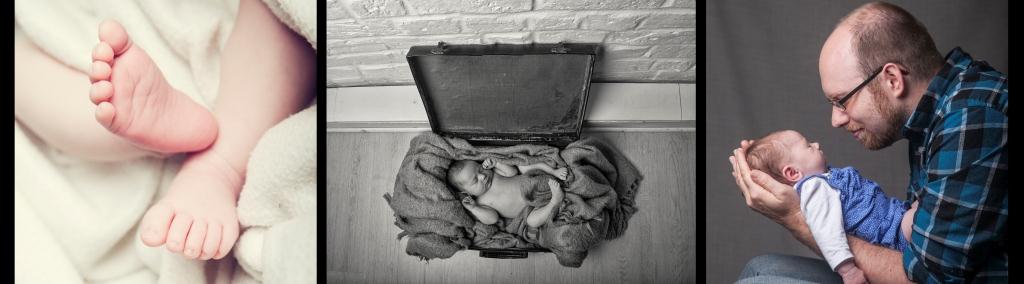
When you look at your baby it’s impossible not to wonder about inheritance. My daughter has her mother’s eyes, ears, nose, lips, hair and fingers. The only thing she seems to have inherited from the Drew family’s genetic legacy is the bum chin that I don’t even have. And despite being less than a month old, she still has more hair than me.

Luckily, her behaviour is more equally shared between us: she slurps her milk like her daddy, spills it down herself like her mummy, and is as noisy and uncoordinated as the both of us. I imagine the incontinence must come from elsewhere.

When you have autism, and so does your partner, the question of what your children might inherit from you takes on additional weight. While Lizzie and I were trying for a baby we were often asked if we were worried our child might be autistic. Whilst there’s no convincing evidence that autism runs in families – around one in twenty people with autism have siblings on the spectrum – anecdotally, many of us with Asperger’s can see autistic traits in at least one of our parents. So what if we create an autistic child?

As an individual, autism infuses the whole of my being. It is who I am, and my ways of thinking and feeling are inseparable from my condition. The same is true of Lizzie. I love her in spite of her autism, and because of it. We would not have achieved the things we have, in the ways we have, if we did not have Asperger’s Syndrome.

So would I want Izzie to be autistic? That’s an impossible question to answer. If I say no, it does a disservice to all the people I know with autism who would not be who they are without it. If I say yes, I am setting her up for a lifelong struggle in addition to the regular trials and tribulations that come with being human. In truth, whether she has it or not, it doesn’t matter at all. Aspergic or neurotypical, she will be uniquely herself and I will love her just the same and be there to support her regardless.

And yet I keep watching her for signs. You can’t tell below six months, apparently, but I thought the other day, ‘She makes good eye contact, she can’t be autistic.’ We gave her a bath for the first time last week. She sat in silence until we wet her head when she absolutely screamed the house down; I cannot abide anybody touching my head. But she loved her second bath. It’s just too early to tell.

I think it’s only natural for parents to want to wrap their children in cotton wool. Knowing the life I have led, spending a quarter of a century bouncing from misdiagnosis to misdiagnosis, doped up to the eyeballs on various mood stabilising and antidepressant medications, and suffering several breakdowns to boot, my family didn’t want me to have children. There was too much risk the child would be autistic. How would I cope? What if Social Services took her away? What if, what if, what if?

Deep down, I probably don’t want Izzie to have autism: I know firsthand just how hard it can be. But as I said to my parents, by protecting me from the bad things in life they’re also protecting me from the good. If I didn’t have a child, my life would be easier, but emptier; avoiding the risk of things going wrong means you avoid every opportunity to better your situation. And I wouldn’t change having Izzie for the world.

I have to remember this going forward. As a parent, I’d rather Izzie had an easier life and thus didn’t have autism. But perhaps autism would open up opportunities for her that she’d never have without it. It is not for me to say who she ought to become. I just have to make sure that, whatever issues Izzie might face in her life, she knows that her dad is behind her all the way.
Bursting the Baby Bubble

Despite my best efforts to forestall it – ignoring my diary, avoiding the newspaper and keeping the calendar on last month – time is marching inexorably onwards. Izzie has been registered and is now a member of a wider community to which I must soon return, and although I’m still swimming against the current, I can’t delay the inevitable much longer.

For the past week I’ve lived a wonderfully wholesome routine. I rise around 7.30 and prepare a bottle, and while Lizzie feeds Izzie I feed the animals, make breakfast, and have my sacred first coffee of the day. Then I load up the car and take Izzie and Ozzie for a walk in the forest. When I return, I sort out a few things, have lunch, deal with visitors, have a nap, and then all of us go for a walk around the village, which is the closest thing to heaven I can imagine.

After dinner I prepare the night feeds, Lizzie has a bath and goes to bed, I work on this blog or watch something while cuddling the baby, and head upstairs around 22.30. It generally takes till midnight to settle Izzie, with a couple of nappy changes and feeds overnight lasting around an hour each. This is my routine, and I love it.

People with Asperger’s Syndrome live by routines and struggle to cope with change. This is to be expected, given our rigid thinking and the difficulties we have processing new information, but Temple Grandin has an alternate theory. A remarkable woman with autism who designs slaughter houses, she believes that those of us on the spectrum are like prey animals with an overactive nervous system no longer useful in modern life. If a cow hears a sudden noise, it could be natural but it could be a predator, so it reacts. If it sees something new, it could be nothing or it could be the cause of its death, so it avoids it. The cow is happiest doing its usual thing of chewing cud and pooping pats because that keeps it safe.

People with autism are those cows. When we encounter anything new, different, unexpected, it sets off a fight or flight response disproportionate to the reality. Our bodies are flooded with adrenalin, increasing our stress levels and making it even more difficult to think clearly and cope with the situation. Hence we structure our lives to keep the unknown to a minimum and avoid stressful encounters.

Unfortunately, people with AS are also highly susceptible to forming obsessions, and when these combine with our love of routines and aversion to change, we can lose ourselves in a ‘perfect storm’ of self-imposed dissociative isolation.

I am in a baby bubble and I don’t want to come out.

Ten years ago I was part of a crew of fifty that sailed a tall ship across the Atlantic from the Canary Islands to the Caribbean. Those four weeks were some of the best of my life. Not because I was popular – I was unanimously voted the person most likely to be thrown overboard and they even printed me out a certificate that said as much – but because time was divided into a rigid, unchanging rotation of the watch system and the whole world existed in a space less than two-hundred feet long and thirty feet wide. I knew where I was meant to be, what I was meant to do, and who I was meant to do it with. I ate, worked, slept, in a fixed, tireless routine. And it suited me just fine.

As we neared our goal, after eighteen days with nothing between us and the horizon but whales, dolphins, flying fish and the occasional distant tanker, the rest of the crew looked forward to seeing land again. But I was so happy in my perfect bubble i wished there was no such thing as land and we could keep sailing forever. That first sight of Barbados, an ugly smudge between sea and sky, broke my heart.

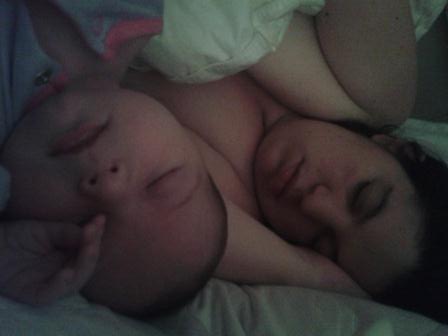
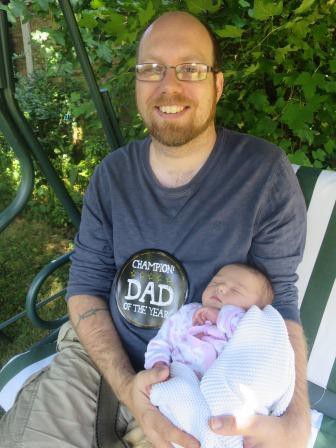
The past three weeks my life has revolved around being the best dad and partner I can be. Even as I write this, Izzie is asleep in my arms with her mouth wide open, ‘catching flies’. The outside world has ceased to exist. I haven’t worked, paid any bills or checked my bank balance; I haven’t opened my post or returned my library books, and my emails remain unanswered. My life has become routine and obsession.

But there are smudges appearing on the horizon. If you lock the world out it has an insistent way of banging on the door until you have to let it in. I’m lucky in that I’m a (starving) writer so can work from home; if I had a regular job I’d have been back last week. But I can’t bring myself to send off another chapter to the publisher, another article to a magazine, write something that isn’t about Izzie and Lizzie and me. Not yet.

My baby bubble is going to burst and the real world is going to come flooding back in. But for today, at least, I have all that I need right here.

?????????????
I mean, why would I want anything other than these two darlings?

Three Weeks of Growth

Izzie is three weeks old. Before she discharged us, our midwife warned us about Day 21. Apparently, new mums are the most fertile they’ll ever be today. Not realising this, many women go for their six-week check to discover that there is another bundle of poopy joy on the way. So we had a lecture about women’s fertility that ended with the catchy refrain: ‘contraception, contraception, contraception!’

Can you imagine? You’re just starting to get the hang of buttoning up sleepsuits without attaching the leg poppers to the stomach poppers and you’re back to morning sickness, mood swings and hair-thinning financial worries. Just as you’re weaning one child you’ll be trying to get the other to breastfeed.

I told the midwife she had nothing to worry about in that regard. Energy is at a premium right now and when I get into bed, the last thing I want to do is waste any. Besides, last time I looked down there, in the operating theatre, it was a car crash: I’ll probably need counselling before I have the guts to go anywhere near it again!

The midwife letting us go is both gratifying and butt-clenchingly uncomfortable. As people with ‘special needs’ we had a special midwife, although she was more used to dealing with alcoholics, drug addicts and battered wives than a couple with Asperger’s Syndrome. She was meant to stay twenty-eight days but we’re doing so well she decided we didn’t need the additional safety net. I must admit, I loved that safety net.

Lizzie says that it’s real now, though why she thought it wasn’t real before is anybody’s guess. She says she doesn’t feel like a mum. I know what she means. I have no idea what a ‘dad’ is supposed to feel like, but I expected it to be different than this.

Despite the fact I should know better, I have a weakness for believing external stimuli can cause personal growth. When I was at middle school, ten years old, I’d see the bigger kids walking towards secondary school and think, ‘When I’m that age I’ll be confident and able to cope.’ But when I grew up it was harder still – age is no indication of capability. The same with travelling: I thought if I walked down the street in some out-of-the-way town in a rainforest or desert I’d somehow be taller, and cooler, and better looking. Instead, I was the same old me, only more sunburned and slightly malnourished.

I slipped into that trap with parenthood. I thought I’d become a different person, that as soon as I saw Izzie it would be like flicking a switch and suddenly I’d be mature and wise and capable. Instead, on first seeing my daughter I thought she looked like someone had left a blue sock in a white wash. Then I wondered why she looked Mongolian. I think if I’ve changed, it has taken place over the past nine months and in such incremental stages I didn’t notice it.

I don’t feel wise or capable or mature – when Izzie’s asleep I use her arms to do the YMCA dance – but I guess we must be doing something right.

Lizzie got upset when the midwife left. It being day 21, I told her there’s a sure fire way to have her back in our lives for the next nine or so months. Judging by Lizzie’s response to that suggestion, she’s not that keen to see the midwife again!

Post Traumatic Birth Disorder

All prospective parents are prepared for a number of things: the labour will be hard, the birth will be insane, the mum will be sore and hormonal for a long time to come, and the first few weeks will be a whirlwind of nappies, feeding, screaming and sleeplessness. With a few perks, of course, like being able to say you’re a parent and getting to use a new parking space at the supermarket. Or, if you’re really lucky, that moment the baby pees on your partner and not you.

Nobody prepares you for the psychological aftershocks of the birth itself. Now that we’re starting to get used to parenting – that is, we’ve realised we’ll always have at least one too few hands for every task – we have time to process what happened that day. And I think I preferred it when we were too busy to think.

Every time Lizzie goes to the toilet she has a flashback to the labour. It started 6am when she woke in agony and started vomiting. I ran her a hot bath but it did little to help. We went to hospital, were sent home because they thought she wasn’t in enough pain to really be in labour, and Lizzie sat in another bath and vomited some more. She had a bloody show, started to shiver, and still the hospital told us she wasn’t in labour yet – these were just pre-labour ‘twinges’. Then she started to bleed.

There was no answer from the delivery suite, no answer from antenatal, no answer from the birthing unit, no answer from the community midwives’ office or mobile, no answer from the back-up hospital and no midwife at the local surgery, so I rang for an ambulance.

The single-crewed paramedic panicked the second he saw her, called for backup because birth was ‘imminent’, apparently, and within minutes there were three paramedics, three midwives and two grandmothers crowding around the tub. Lizzie was six centimetres dilated, so they piled her and the midwives into an ambulance and set off with blue lights flashing. This was four hours after being sent home from Maternity, and less than an hour since the hospital had told us they weren’t even contractions.

For Lizzie, this was the worst of the ordeal, and now the bathroom stirs unpleasant associations of pain, blood and fear. She isn’t really bothered about the public nudity, but then pregnancy and prudishness don’t go together. Trouble is, she can’t exactly avoid the bathroom.

For me, I have a single image that haunts me: my beautiful angel Izzie lying alone in an incubator in Neonatal ICU, hooked up to all kinds of monitors, a drip in her arm and a feeding tube up her nose. She got stuck in the birth canal for two hours as she was back-to-back.

Downstairs, Lizzie was recovering from haemorrhaging on the operating table after a failed ventouse and forceps birth. I spent the rest of the night and next day bouncing between the two. At the time I simply did what I needed to do and put one foot in front of the other for forty-three hours. But now, when people ask about the birth, I come to the moment when Izzie went into the incubator and I can’t go any further. I can’t talk about the four days in ICU; the three days in Transitional Care; the day I cried because my girls weren’t coming home; the day Lizzie begged me to stay but they still made me leave at midnight.

So how do we get past these thoughts and feelings? For Lizzie I guess we need to fill the bathroom with happy memories to replace the bad, such as baby bathtimes, or else it’s as good an excuse as any to get a new bathroom suite. And as for me? I just need to hold my daughter as much as I can and assure her she’ll never be alone again.

It’s not a competition

It should be obvious that parenting isn’t a competition. If it was, there would be medals, awards ceremonies and prize money. But there’s no extra credit for how long you can go without sleep, there are no special mentions for martyrdom, and if you’re the dad, give up now because there’s no way you can […]

Baby Steps

When I was travelling through the wilderness of New Zealand I developed a simple mantra: step, step, step. Soaked to the skin in never-ending rain, tramping uphill towards a mountain pass that didn’t get any closer, with nothing but a cold cabin & faulty gas burner waiting for me, it was too much to think of the end goal. Or the middle goal. Or even the next hundred yards. I could only focus on lifting my foot, moving it forward, placing it down, step, step, step.

Raising a baby is all about the steps. My partner Lizzie thinks it’s about getting through the day, but to me that’s far too long term. Don’t think of reaching bedtime, don’t think of the next three hours. Live in the moment.

As I write this, Izzie is cuddled in my arms with hiccups, looking at me in a confused, mesmerising fashion. When the hiccups finish, will I need to change a nappy, feed her, burp her, settle her to sleep? It doesn’t matter. Right now I’m holding her as she hiccups and that’s good enough.

When the authorities learned that two people with AS were expecting, they assigned the unborn baby a social worker and set about testing our capability to raise a child. How would we meet its social and emotional needs? What would we do if it was eight years old and being bullied, or twelve and struggling to make friends? What sort of things did we witness as children (a particularly leading question, I thought: I witnessed some truly awful McDonald’s adverts, but I’m not sure that counts)?

My answer was that no prospective parent can possibly know what they’ll do so far in the future. We were learning about breastfeeding, nappies, burping, not studying dating advice for teenagers. Like any parent we’ll sort out the baby thing first, then the toddler thing when it arrives, then each stage in turn. And when the baby is being bullied at eight, we’ll have eight years of parenting experience, and be better capable of answering that question than if I made something up now.

They ultimately discharged us, with a view to checking in every so often to make sure we’re hitting the social and emotional milestones, whatever those are. Sometimes I think we know too much, and put undue pressure on parents and children, Aspie or otherwise, to fit into a model of what is deemed ‘normal’. But right now, I’m just thinking of step, step, step.

(And the next step was a nappy change, in case you were wondering!)