
AS, Babies and Multitasking

When you have AS, you don’t process information the same as other people. We have rigid, systematic ways of thinking that give us excellent rote memory, but that hinder our ability to combine different pieces of data to create a larger whole or easily shift from one thought sequence to another. Sounds complex? Let me explain.

If you imagine each sensory input, thought or piece of knowledge as a sheet of paper, and the autistic brain as a giant filing cabinet, it goes some way to understanding how we operate. Every sheet of paper needs to be analysed, categorised, related to other sheets of paper and then filed in its relevant folder in the relevant drawer before we are done with it. It seems great in theory, but in practice? Bloody exhausting.

Processing information in this manner takes both time and huge expenditure of mental energy. Sometimes people with AS can seem a little slow when you’re talking to them, but they’re not – they’re just busily interpreting all those little nuances of social interaction that neurotypicals do automatically. Sometimes you can say something to an Aspie, and it’ll be minutes, hours or even days before they get back to you, because that’s how long it can take to work through everything you’ve said, figure out what it all means, and create an appropriate response. And if you give me a list of instructions, you can bet your bottom dollar that I’ll focus so intently on the first step to make sure I understand it that I’ll switch off from everything you say thereafter.

This is because we can only think about one thing at a time. With a mind like a filing cabinet, every detail is separated and stored in an individual folder. If we’re thinking in a certain way about a certain thing – say, file Z284 in Drawer C (the book we’re reading) – then how on earth can we suddenly start thinking about something else – file B827 in Drawer F (the gas bill), for example? So we focus on the first file, and the others cease to exist – at least until they come knocking on the door.

And when we try to do too many things at once, or switch from thinking about one thing to thinking about another, we often screw up our whole filing system. We open a drawer, take out a file, study the page; then we open another drawer, take out another file, look at it; open a third; and before we know it, all the drawers are open, we’ve got files all over the place, we can’t work out what goes where and can’t put anything away or let anything go, our thoughts spiral round and round and, unless we manage to stop this process, we go into what is affectionately called an ‘autistic meltdown’. That’s what it’s like having a filing cabinet for a brain (and that’s without mentioning how, because our thoughts are separated into different files, we focus on the details and miss the ‘bigger picture’ – we see trees instead of forests – but that is by the by).

Anyway, ‘what does all of this have to do with babies?’ I hear you ask. Simple. My house is a tip.

Actually, that’s putting it mildly. My house is, at current, a shithole. I know this because both of Lizzie’s parents have separately described it as a ‘disgrace’ and said that they would be embarrassed to have people over. Ouch!

To be fair, I don’t really notice the mess most of the time. We’ve been blaming it on having a baby – how can anyone have a baby and a tidy house? – but I’ve stumbled unannounced into two houses in the past fortnight who have kids the same age as Izzie, and their houses are freaking immaculate: toys put away, the sideboards clear of stained coffee mugs, no dishes in the sink, clothes hung up instead of strewn over the backs of chairs, everything in its place. Where in God’s name do they find the time or the energy to do that? What makes us so different?

The answer, which has been eluding me for so long, is horrifyingly obvious: they don’t have autism; we do.

To have a tidy house and a baby, you have to be able to multitask. You have to be able to keep one eye, or part of your brain, on the baby and the other on the washing, the ironing, the cleaning. And that’s not something I’m capable of doing.

When I look after the baby, I look after the baby. That’s my job, that’s my focus, and that’s what I do. When I tidy, I tidy. I can’t do both at the same time. So I leave the tidying to the evening, after Izzie’s gone to bed, by which time I’m exhausted and tend to flop down on the sofa or, to be entirely honest, obsess over random things like making lists of all the WWE wrestlers from my teens who are now dead, or researching the million-and-one rebuttals to 9/11 conspiracy theories, or writing 10,000 word treatises on why Jack the Ripper was not Arthur Sickert (take that, Patricia Cornwell!) – you know, useful, productive things like that.

Raising a baby as a person with autism is surprisingly mentally taxing. There is so much information to process, so many sensory inputs and new experiences to file away, my brain is constantly distracted. I used to go to bed between midnight and two every night, getting around six hours sleep – now, I’m lucky to be able to function past ten. That’s how draining it is.

I’m not entirely sure how to rectify this situation. I mean, the house is mostly clean – it gets hoovered, the sides are anti-bacced and we’re still sterilising the baby’s bottles; bleach down the toilets, dog poo picked up, nappy bin emptied regularly, rubbish put out – it’s just got stuff everywhere. And until I can figure out a way of thinking about two things at once without tying my thoughts into knots, that’s the way it’s going to remain.
IMG_1791
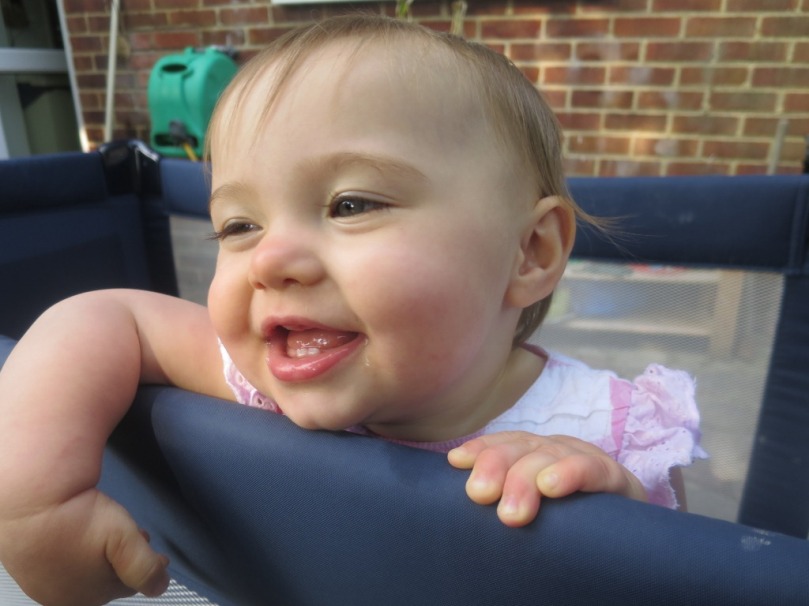
But it’s all worth it to see that smile every day!

AS, Children and Play

As a kid with Asperger’s Syndrome, albeit undiagnosed, I never understood how to play with others.

At playschool I’d wander straight through the middle of the toy farm the other kids had carefully set out, trampling the animals underfoot and kicking apart the barns without realising it, and unable to comprehend why they were cross with me.

When I tried to play with my brother, I couldn’t get into the fantasy the way he could – the toys were plastic, or wooden or cloth, and had no existence beyond my own control. I cared for them as objects, not as independent beings. They didn’t have feelings – they didn’t mind being thrown against the wall or stuffed under the sofa. Just so long as no one else touched them.

Because I didn’t share. What was mine was mine, and what was yours was yours until it was either mine, or I broke it so you couldn’t have it. As a young child, it’s safe to say I was an asshat.

And I didn’t know how to mix with my peers. We used to go camping almost every weekend, and every weekend we’d be sent to play with the other kids on the campsite. My brother would take it in his stride, marching up to complete strangers and joining them in football or climbing trees or riding bikes – I’d hide behind him and never know what to say or do.

When I tried to be funny, I came across as spiteful; when I wanted to be cool, I was condescending; and playfulness always turned into physical domination where my clumsiness and misunderstanding of appropriate behaviour turned me into a one-man wrecking ball – and that’s when it wasn’t deliberate. When it was, it was much worse. No wonder I couldn’t make any friends!

At eleven months old, Izzie loves playing with the other kids – and I am finding it like pulling teeth.

Every time she crawls towards another child, I watch her like a hawk and get so tense I’m lucky I don’t drive my fingernails through my palms. I see other parents just dump their kids and let them get on with it, but I perch on the edge of my seat ready to pull them apart at the slightest sign of aggression from either side. It’s the most uncomfortable thing I’ve experienced as a dad.

‘Why’s she doing that?’ I think as she pulls a brick out of another child’s hand. ‘Now why’s she doing that?’ I wonder as she passes it back. I’m fine when she plays by herself, but the second she starts to move towards another toddler I cringe and hope she stops before she reaches them because I don’t understand why she wants to play with them.

It’s my problem, I know. You’re supposed to let kids figure out the social rules for themselves, with a little guidance. I’m not going to stop her playing with other children, but damn I wish it was easier.

I’m terrified the other kids will hurt her. I’m terrified they’ll make her cry and she’ll sit there screaming and grow up to be a recluse like me. But more than that, I’m terrified she’ll do something to the other child, and she’s too young to understand the consequences of her actions, but everyone will look at me, and judge me, and realise what a bad dad I am, raising a little tearaway. And I’m worried they’re right, and a dad with AS won’t be able to provide for his child’s social education.

And the thing is, it’s not an idle fear – Izzie’s bloody strong for a toddler. While I was bathing her this evening she rammed her finger so far up my nose it took five pieces of toilet paper to staunch the flow of blood. What if she hits another child? Pulls their hair? Scratches them? Oh God, what would I do then?

The thing with autism is that you like to control your life. You minimise your exposure to stressful, unpredictable social situations in order to protect yourself. Izzie playing by herself in the lounge I can cope with fine as I understand it and can control the variables – the moment you introduce a second child, all control and predictability goes out the window.

But unfortunately, for Izzie’s sake, I have to expose myself to increasingly stressful, unpredictable social situations so she can learn to function as a socially active neurotypical child. I can’t allow my own hang-ups to hold her back.

I just need to learn how to relax when my little girl is learning how to play with others – or at the very least make sure my fingernails are cut so short I can’t do myself any serious damage!

Autistic Building Blocks

There’s an episode of Scrubs in which Dr Cox’s infant son has a playdate with a rival’s child. After seeing the other boy’s precision with building blocks, Dr Cox states that kids of that age shouldn’t be able to do that, leading him to suspect the boy has autism. And of course, since Dr Cox is like House, only with a larger ego, he’s absolutely right.

Far be it from me to take facts about autism from a TV show, particularly one that perpetuates the myth you can restart a stopped heart with a defibrillator (shocking revelation: you can’t!), but it’s lingered in the back of my mind for years. So when Izzie started playing with building blocks a few weeks ago, I watched her very carefully.

Actually, that’s not what happened. I was meant to watch her. Instead, as an autistic guy myself, every time she started to play with them I couldn’t resist the opportunity to shoulder her aside, organise the blocks by colour and shape and build towers all around the lounge. To my annoyance, Izzie kept knocking them over and mucking up my neat piles and throwing the bricks into her ball pit. I started to design stronger towers, pyramids, all kinds of defensive structures to protect my colour-coded edifices. Then, after about a fortnight of this, I realised I was getting obsessive over a baby’s building blocks and really ought to let Izzie play with them. Then I watched her.

Mostly she was destructive with them, smashing them together, bashing them against the furniture, throwing them at the wall, and stuffing them into her mouth. Just like a baby. Phew.

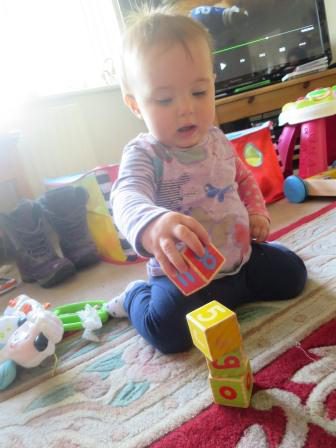
But then she started to play with them differently. Starting a couple of weeks back, she would empty them out of her trolley one at a time onto the carpet and then very carefully put them all back in again. After a few days of this, she decided that was too easy. From then on she’d wheel the trolley over to the coffee table, and one by one she’d put the blocks on top. Once she was done, she’d take them down and put them back in the trolley, walk over to her toy box and repeat the process. Stacking, unstacking, loading, unloading like a particularly conscientious warehouseman.

I consoled myself that she wasn’t able to make towers out of them yet. That would be the time to worry.

Two days ago she managed to stack two on top of each other. By yesterday, her towers were up to three blocks. Today, she managed five. And that’s when alarm bells started to ring.

I mean, they weren’t very good towers – they were wonky and multicoloured and would fall over if you walked too heavily across the carpet – but they were towers nonetheless. Were these the skills Dr Cox was talking about, those abilities with bricks a non-autistic child shouldn’t possess?

It says on the Baby Centre website that at 15 months she should be able to start putting one block on top of another, and by 18 months might be up to towers of three blocks.

Izzie is ten months old.

IMG_1252
That’s the wrong colour, dumb ass!

So without any further evidence, I started panicking that ohmygod she’s autistic.

After a few minutes of reassuring myself that it’s okay, she’s happy and if she has autism, that’s just the way things are, I’m autistic, Lizzie’s autistic, and we’re fine, everyone has problems, neurotypical, Aspie or otherwise, I decided it might be an idea to research early signs of autism.

And Izzie has NONE of them.

Now of course, not every child with autism is going to have all the signs, and even if a child has many of them, it doesn’t mean they’re autistic, but for anybody who’s curious, these early signs of autism are:

  • Lack of eye contact (I never made eye contact as a child; I sometimes have to look away, the amount that Izzie stares at me!);
  • Failing to imitate social cues, like smiling back at you (Izzie smiles so much, I’m sure her face must hurt);
  • Not babbling to themselves or making noises to get your attention (Izzie is by far the noisiest person in my life);
  • Failure to respond to their name (Izzie comes when called, and if I say, ‘Where’s mummy?’ she looks right at Lizzie);
  • Not using gestures to point things out or respond to your gestures (Izzie’s favourite activity is pointing);
  • Disinterest in physical contact like cuddling or being picked up (if you don’t pick Izzie up, she climbs up your legs!);
  • Doesn’t want to play with others (Izzie is currently loving rolling balls to me and getting me to roll them back);
  • Repetitive interests, movements or behaviours (Izzie does seem a little preoccupied with food…);
  • Delayed motor development i.e. rolling, sitting, crawling, standing (Izzie rolls, sits, crawls, stands, swims, climbs and throws).

Conclusion: Izzie doesn’t have any of the classic signs of autism.

So why is she so advanced when it comes to building blocks if not autism? Who knows? Maybe she’s just really really freaking intelligent.

Afraid of Number 2, Part 3

Irrespective of whether you are religious, spiritual, agnostic or atheist, having your first child is an act of faith.

No matter how much you learn or how well you prepare, no first time parent knows what they’re getting themselves into. You don’t know if you’ll make a good parent, or how you’ll cope with the lack of sleep, or the crying, or the screaming, or if your relationship will survive the stress. You don’t know what it’s going to be like changing nappies, or feeding, or bathing, or dressing, or being entirely responsible for another life in its physical, emotional and developmental needs. It’s the equivalent of being led blindfold to the edge of a cliff and then jumping off and trusting you’ll survive the fall. It’s not rational at all.

So why do we do it? Unless we play fast and loose with contraception, we do it because we’re driven to do it, without rhyme or reason. We do it because a couple of billion years of evolution have programmed it into our DNA to ensure our genetic legacy. And we do it because our hearts are crying out for completion, for something more to love.

Having a second child is nothing like that. It’s not such a leap into the unknown as you pretty much already know what it is to have and raise a baby. You know how your lives have changed, how your relationship has altered, and therefore how a second baby is likely to affect this fledgling family dynamic. As a result, discussions about a second baby are less to do with the heart than they are with the head.

‘I want Izzie to grow up with a sibling so she has someone to play with, learns to share, and won’t be lonely. I think an age gap of two to three years is best – with Izzie at pre-school there’ll be less disruption, and they’re close enough in age to get along. And I’m better with toddlers, you’re better with babies, so you can look after the new baby while I look after Izzie. It’s the perfect division of labour.’

So says my partner Lizzie. It all sounds very logical, and rational, and clinical, but logic had nothing to do with why I had Izzie. I had Izzie because my entire being was crying out to become a dad. There was a gap in my heart that I knew only a baby could fill.

Izzie filled it. It might change in the future, but right now I feel complete. My heart is whole. I don’t feel the pressing need to have a baby that I did before. So surely, then, it wouldn’t be right to have another baby purely because I can justify it intellectually?

And there are other considerations. As I wrote yesterday, Izzie was our miracle baby, a gift from the gods. How ungrateful would we be to take that miracle and demand another? And the journey to her birth was so long, and moving, and life-changing that how could a second baby possibly compete?

‘This is our daughter Izzie. After years of fertility treatment and events conspiring as though Nature itself determined that we should become parents, we were gifted with her presence. And this is our son Gregory.’

[pregnant pause]

‘We thought Izzie might like a playmate.’

Now I know that our children aren’t meant to compete, and I know that every child is a miracle (No, says the biologist, it’s a natural process resulting from the coming together of two gametes), but Izzie has set the bar pretty darned high. Even the reason for having a second baby – for Izzie’s personal development – means even before it’s born it’s in her shadow, not desired or considered in its own right the way Izzie was. And that’s just wrong.

It’s wrong to Izzie too. I love her so much and we’re so close, I feel like having another baby would be something of a betrayal. It’s like saying to her, ‘You’re great, and all, but we need more. And you can’t provide it. So there. Sucks to be you.’

And, in all honesty, I am afraid of having a second baby. My heart is full. People say that you always worry you won’t love the second child as much as the first, and then it arrives and your heart grows to fit all the love you feel and you don’t know what you were worrying about. You discover your capacity for love is boundless, and blah, blah, bollocks.

But what if you don’t? What if you discover that, heaven forfend, you have a limited capacity for love, and wouldn’t you know it, you’ve just hit your limit? Do not pass Go. Do not collect £200. Go to the back of the class.

I have specific reasons for my doubts. Because of my Asperger’s, I’ve always struggled to manage feelings and relationships. If I had a friend, I couldn’t be friends with anyone else because not only would it be a betrayal (I know it’s not, but I can’t help feeling it is), I couldn’t find the mental space to consider the needs of more than one person at a time. And when I have a partner, like I do now, the very thought of wanting to spend time with anyone else just makes me feel dirty. This is a lifetime pattern of behaviour. I’m a U2 kind of guy (one-love, one-life).

I loved the fish until we got the chickens; I loved the chickens until we got the cat; I loved the cat until we got the dog; and I loved the dog until we got Izzie. What if, by having another baby, I transfer my love to it and can no longer care about Izzie or manage to consider her needs in such a way that I go from being a good dad to merely an adequate one? I don’t want to turn my attention and my heart away from her towards anything else and let her down. The very thought of it is heartbreaking.

This is all a very long-winded way of saying I’m afraid of having a second child. I’m afraid I don’t have enough love to encompass two children. I’m afraid that my relationship with my daughter will irrevocably change. And I’m afraid if I’m spread so thin I’ll lose my ability to be a good, caring, attentive dad.

So in a way, I guess having a second child is a leap of faith. You’re not sure you’re going to love it – you don’t feel that you can – but you have it anyway, trusting that it’ll come good in the end. I said before that you can’t live your life imprisoned by fear, or else you deny yourself the chance of something good, and perhaps this is one of those things.

But not right now. Right now, I don’t feel the desire for a second baby, not on its own terms. My heart isn’t crying out for something to love. And until it does, I can’t even think about bringing another child into this world.

It’s explaining this to Lizzie that’s the hard part.

Afraid of Number 2, Part 2

My route to fatherhood wasn’t the usual one. The thing with watching your girlfriend undergoing IUI with donor sperm to get pregnant with a baby you don’t particularly want is that over time you come to accept that, for better or worse and with no input from you, there’s going to be a baby in your future. And that does weird things to both your head and your heart.

Because Lizzie so wanted a baby – because her very being ached for it – I wanted it to work. For her. I read books on babies, pregnancy, parenting and babies conceived by donor sperm so I could support her through every stage of her becoming a parent. I injected her every afternoon with hormones, drove her thirty miles to watch her have probes inserted into unmentionable areas to scan her ovaries, then thirty miles back listening to her excitement that we’d seen a follicle or heartache that we hadn’t.

Then, after a couple of years adjusting to this weird set of circumstances, I sat in the room and held her hand as she underwent insemination with the seed of a man she’d never met and was never likely to (which means a virgin can get pregnant – take that, God!). After which, I treated her like a queen – albeit a queen that needed her court jester to help her with two suppositories a day. Definitely think I got the shitty end of this arrangement…

Two weeks later came the agonising – ‘Is that blood? No, that’s not blood, it’s just – oh God, please don’t be blood. Oh Christ, it’s blood. But maybe – no. It’s gone. That little follicle we watched grow and grow on the ultrasound screen, that we nurtured and spoke to and treated as though it was an actual baby, has gone. And those two weeks we’ve spent thinking and hoping you might be pregnant – they’re over.’

The strangest thing – I was just as heartbroken as Lizzie. I don’t think anybody who hasn’t undergone fertility treatment can understand what it’s like when it doesn’t work. It feels like a miscarriage because you’ve seen the egg, you’ve seen the sperm, you’ve seen them meet. It’s not just a period – it’s the loss of a baby, a dream.

People who knew what was happening said, ‘So? It took me/my partner a year to get pregnant.’ But that is not the same thing. When you’re trying for a baby naturally, a period means you simply try again – an upcoming month of sex, cuddling and romance, yay! When you’re having IUI, it means another month without sex. Another month of injections, three-hour round trips to the clinic every couple of days, scans, pressure, insemination, suppositories. It’s cold, clinical and the most unromantic thing you can imagine.

Also, you’re acutely aware of the fact that you only have enough money for three attempts. As Lizzie couldn’t grow follicles without injections, and wouldn’t ovulate without a different injection, and was using donor sperm, each failure dramatically reduced the possibility of her ever having a baby. So it’s completely different from trying for a baby naturally.

On the second attempt, on the way to the insemination, I drove my car into flood waters and screwed the engine. Looking back, I wonder if, subconsciously, I did it deliberately as a result of the stress of the whole shebang. But we were towed out of the flood, made it to the hospital, and Lizzie was promptly inseminated again.

This, similarly, didn’t work, but we were more prepared for failure this time and we knew we still had one shot.

It really was third time lucky. The follicle grew beautifully; the hormone-induced mood swings were almost non-existent; and the insemination went so well, we were almost guaranteed a healthy, happy baby. So when the blood came again, we pretended it wasn’t a period for the longest time, until we had to face the devastating truth – there would be no baby in our future.

After having spent three years getting my head around having to raise a baby, the fact that suddenly there wasn’t going to be one knocked me for six. Over the years, I had grown not just to accept my impending parenthood, but desire it, not in my head but in my heart. I was as desperate to be a dad as Lizzie was to be a mum.

But we’d run out of money. That third miscarriage/period was the most painful experience of my life.

On the other hand, I’d run out of reasons why I didn’t want to be a father. After a lot of soul-searching, I realised they were all based on fear – that I wouldn’t be good enough, I’d mess the kid up, I wouldn’t be able to cope, it wouldn’t like me, it’d be autistic. But then I thought: what if I was able to cope? What if I was good enough? By wrapping myself in cotton wool and avoiding the possibility of bad things happening to me, I was denying myself the possibility of good things – great things – happening too.

If you deny yourself the possibilities in life, then you’re not living and you might as well be dead. And what had all my self-protection got me? Life still found a way to intrude, time and time again.

It was like a spiritual awakening. I realised I needed to give up control and learn to embrace a little chaos and random chance – not an easy admission for someone with Asperger’s Syndrome. Suddenly, I had faith in myself and life. So I decided to leave the issue of my parenting in the lap of the gods – we would stop using contraception, and if I was meant to be a father, Lizzie would become pregnant.

Not that I expected much. We’d learnt during the fertility treatment that Lizzie ovulated without drugs about twice a year. She also didn’t form a thick enough wall of the uterus to enable the egg to implant without suppositories. And on three occasions, viably-proven sperm had been implanted right on top of the egg and failed to fertilise it.

The odds of Lizzie growing a follicle, the follicle getting big enough to mature an egg, the egg being released, us having sex at exactly the right time, the sperm penetrating the egg and the egg implanting, were so astronomically small that we figured we’d be in for a long, hard slog. So, in the meantime, we’d get a puppy and live our lives as normal. If a baby came along then great, but if not, we had to get on with our lives.

Lizzie was pregnant within two months.

I knew from the second of that first positive pregnancy test that everything would be fine, Lizzie would carry it to term, and it would all work out okay – I’d trusted in the Universe to tell me if I should be a dad and the Universe had answered with a massive, emphatic yes! There was no chance whatsoever we’d be given such a gift only for it to be taken away.

I’m not a religious person, but everything that happened seems as though it was meant to be, as though somebody wanted me to be a dad and took our little family on a journey of pain and spiritual growth in order to make that happen. And as soon as we were both ready and willing and trusted to fate, we were handed our longed-for baby.

Izzie is a miracle. I truly believe that. She is a gift from heaven we had no right to expect.

But now Lizzie wants another…

Continued tomorrow…


Afraid of Number 2, Part 1

No, this isn’t a post about poop – I’ve done enough of those. And I’m not afraid of poop anymore – I’ve changed so many nappies now that I’m the poop master. Well, maybe not the master – after changing Izzie and washing my hands, I quite often look down half an hour later and think, ‘Why on earth is there poop on my knuckle?’ – so maybe I’m more like the poop first mate. Or at least the poop deck hand. But that’s by the by.

Instead, this post is about baby number two.

With the little sprocket now being nine months old, the same amount of time she was in the womb, the subject of repopulating said womb has been raised. Actually, it was first raised when Izzie was five weeks old and her mother informed me she was desperate to be pregnant again. So in truth, the subject is not now being raised so much as I’m being beaten repeatedly over the head with it.

Trouble is, it’s an entirely cerebral conversation – how much of an age gap do you want between the kids, do we wait until the first child is at preschool or go for it as quickly as possible, how many kids do you want in total? This has prompted Lizzie to suggest we start trying for a second baby in October. Rather, she has tried to suggest it – I have recently developed a serious medical condition where I go deaf whenever the subject is broached. Shame.

People seem to think that second babies will be easier than the first, and I guess that’s true in the same way that the fire that sweeps through the ruins of your house after it’s been knocked down by a tornado isn’t that bad because you’ve already lost everything anyway. But don’t forget that alongside the new baby you have a toddler. As hard as it is with one, it’s going to be exponentially harder with two. It’s like a man hanging off a cliff with a brick in his hand suddenly deciding he wants to hold a second brick in his other hand and hang on by his teeth – it’s doable, I suppose, but good golly gosh you’re making things difficult for yourself.

And I’m not sure I’m capable of planning my reproductive future with anything even approaching logic. ‘How many children do you want?’ asks Lizzie. How could I possibly know the answer to that? I have no idea what our lives would be like with two kids, let alone three, four, five. It’s a totally abstract concept. It’s like asking how many hairs I’d like in my eyebrows – um, a hundred? A thousand? I don’t have a freaking clue.

This could be because I’ve never given the possibility of a second child a moment’s thought. Bizarrely for someone who has taken hold of this parenting thing like a drowning man a lifeline, I spent all of my life up to fifteen months prior to Izzie’s birth not wanting kids – gritty, snotty, smelly little things that would take up my time, my energy and my money. But something happened to change all that.

Around four years ago, Lizzie’s mum asked when we were going to make her a grandmother. Cheers for that. I told her that I didn’t want kids because I always thought I’m too selfish for kids, I never wanted to pass on my depressive mindset to another generation or inflict my bullshit onto anyone else, and I wouldn’t be a good role model, not to mention that it’s a shitty, overpopulated world filled with misery, despair and an aching sense of ennui, and what possible right, or rhyme, or reason did I have playing God and bringing a little person into it? Frankly, the thought of a little version of me running around, blaming me for forcing it into life, was the worst hell I could imagine.

Her response was: ‘Well, that doesn’t stop Lizzie having children.’ And before I knew it, donor sperm had been imported from Denmark and some random fellow named Jan was going to impregnate my significant other.

It was, without a doubt, a game-changer. But since Lizzie acquires pets like a successful zoo then leaves me to look after them, I figured it would be something like that – I would help her raise the unholy affront to nature, but without any responsibility for deciding upon its future or blame for giving it faulty genes. In short, I would be uncle dad, mummy’s partner, and nothing more. Hardly ideal, but it was that or leave. And truth be told, I was looking forward to the Facebook update – ‘My girlfriend’s pregnant.’ ‘Wow, congratulations, you’re going to be a dad.’ ‘I never said I was going to be a dad. I said my girlfriend’s pregnant.’ Ouch…

So we embarked upon a journey of IUI treatment (intra-uterine-insemination) involving blood tests, internal and external ultrasounds, dye injected into fallopian tubes, hormone therapy that turned Lizzie into a snarling, vicious animal, daily injections, suppositories and counselling. We watched follicles grow day by day on her ovaries but never get large enough to pop. She became a medical object that had to be scanned and poked and prodded and studied, month after month after month. Not good times, for sure.

But then, amazingly, one of the follicles grew. And it kept growing. And it reached the right size. So we gave her an injection to release the egg, and a day later Jan came out of the freezer and his seed was separated from his juice (the womb is designed for sperm; semen irritates it), and he was placed into a long transparent tube and off he went.

Then something strange happened. I discovered in that sterile, unromantic hospital room that somewhere between watching the follicle grow on the ultrasound screen and repeatedly injecting hormones into Lizzie’s belly, her journey had become my journey. And good gosh I hoped that Dane’s alien sperm knocked up my girlfriend…

Continued tomorrow…

Don’t panic! It’s just a tummy bug.

I’ve mentioned vomit before on this blog, and it’s always been described rather casually. ‘Ha-ha, she threw up over me,’ and suchlike. ‘What a great dad I am: I get puked on and take it in my stride. Yay me!’

Those were purer, more innocent times, the halcyon days before the fall. The fact is, I had no idea what vomiting truly was. The couple of tablespoons of white, milk-like up-chuck, even when tinged with mucus, are nothing – nothing – compared to the end-of-the-world style vomiting of a stomach bug. And having now experienced that, I will never be casual about vomit again.

When Izzie woke crying at four o’clock Thursday morning, her bed sopping wet with sick, my instincts told me something was wrong. She’s not a sicky baby and vomiting overnight is certainly unusual for her. It was, however, just the beginning.

I picked her up, made her some milk, fed it to her, sat her down, and watched as the Gates of Hell opened and spewed forth an ocean of vomit. In all honesty, it was frightening seeing so much liquid propelled so widely from something so small. It formed puddles in her lap and on the carpet, was so bad that even Lizzie got up (unheard of before half-seven) to help change clothing and bedding and mop it off the floor.

After settling Izzie onto newly-clean sheets, I spent the next two hours on the internet becoming an expert on all aspects of childhood vomiting. The main stipulation of the sites I visited was: don’t panic! It’s only vomit. Keep her hydrated, be gentle with her belly, and stop being such a wuss.

Now, being an overprotective (read: hypochondriac) dad, I’ve had to develop a hard and fast rule on baby illness so I don’t turn her into a medical guinea pig that gets rushed to the doctor every two minutes: if she’s happy, playful and eating, and has no obvious signs of illness such as a temperature, blood coming from her ears, or buboes, she’s probably okay. So in the morning when Izzie seemed bright and breezy, we got on as normal. Lots of water to rehydrate her, and oodles of bland milky porridge and a banana to settle her empty stomach.

Slightly neurotic about her dying of thirst, and the ensuing inquest where we’re deemed to have been neglectful parents followed by a media witch hunt that hounds us out of the country, I sat her on my lap on the sofa to give her a top-up of milk. And two minutes later, with a little feminine toss of her head, she exploded all over me.

When I say exploded, I mean that stuff just flew everywhere. I was wearing T-shirt, shirt, trousers, boxer shorts and socks, and the only thing I didn’t have to change were my glasses. The last time I was covered in hot, smelly sick, I was nine years old, wearing blue and white striped pyjamas, and I remember feeling unclean and ashamed. In an instant, I was that child again and unable to move.

I shouted for help, which is what I’d done as a nine-year-old. Unfortunately, Lizzie chose that moment to have one of her autistic episodes – overwhelmed by the knowledge that she couldn’t go to baby group and would have to change her plans, she became angry and overwhelmed, so had to go and have a time-out to calm down. Gee, thanks, honey. It’s not like it’s soaking through to my skin and dripping from my fingertips!

Luckily there was a support worker present, who definitely earned her pay and saw more of me than she probably liked as I peeled off soiled clothing layer by layer then dealt with the baby in just my underwear.

Water was the order of the day. Sips of water, the websites say. No food for about six hours, then small amounts of bland stuff to settle her.

Izzie didn’t act ill, not at all – she was playing with her toys, standing against the furniture and getting up to her usual high-jinks. So mid-afternoon, when she was clearly hungry, I gave her the blandest porridge in the cupboard, which went down a treat, followed by fromage frais and then half a biscotti. She seemed happy as Larry, so I made some milk, sat her on my lap on the sofa and –

Instead of describing in graphic detail what I’ve already covered before (explosion, ‘help!’, oh god it’s so warm and smelly), minus Lizzie’s time-out but including the ‘assistance’ of Ozzie the dog in clearing up, here’s a picture of Izzie with bunny ears:

IMG_0856
Cute

While I was changing into my third set of clothes for the day, Lizzie’s cousin texted us to say her little one had had a similar thing earlier in the week, a 24-hour vomiting bug. Provided you can endure and make sure she drinks plenty, it passes. So armed with this knowledge, we tried to force dioralyte down her throat to rehydrate her (see above about hypochondria), which was a horrible failure, switched back to water, which was a success, and put her to bed.

Today, she seems much better (touch wood), but since the three vomiting episodes were triggered by milk, we’ve avoided risking giving her anything but water. I’ve discovered from my research that babies can develop lactose intolerance from tummy bugs like viral gastroenteritis, meaning milk makes them vomit and you need to give them lactose-free milk for up to four weeks until the gut recovers. Gosh darn it, why do babies always get ill on four-day weekends and bank holidays?

What I’ve learnt from this experience is just how frightening it can be for a parent when their baby keeps vomiting. I mean, at one point I seriously expected her head to rotate three-sixty degrees and Latin phrases to start bursting from her lips. You think it’s going to go on forever, that every drop of water or morsel of food will come back with added force. But it passes. Thank God it passes!

It’s also an eye-opener how vulnerable you can feel when covered in someone else’s vomit. Forget waterboarding, try a baby with a vomiting bug! But on the plus side, there are far fewer poopy nappies to deal with.

One thing’s for certain: I will never be nonchalant about sick ever again!

AS, Anxiety and Baby Safety

It is rare to meet someone with AS who doesn’t have some kind of anxiety problem, and yet anxiety is not part of Asperger’s Syndrome. Rather, it seems the symptoms of Asperger’s – the social confusion, difficulties with understanding, need for routine and inability to cope with change – often lead us into situations we can’t cope with and encourage others to tease us, humiliate us and bully us, and it is a lifetime of such occurrences, repeatedly falling on our arses, that causes the anxiety.

Even then, some of us can be bigger worriers than others.

It turns out that I have a reputation amongst the NCT crowd of being something of a worrier and rather overprotective (shocking, I know!). As I’ve said before, in order to cope with our anxieties, people with Asperger’s plan their lives to avoid risk and the unpredictable. Having a baby means that you don’t just have to plan to keep yourself safe – you have to think of the baby too. And your anxieties about yourself pale into insignificance alongside your need to protect your baby.

Now eight-and-a-half months old, Izzie has reached that stage where she wants to be involved with everything. And by everything, I mean EVERYTHING. She wants to know what you’re doing, what your partner’s doing, what the dog’s doing, what the cat’s doing, what the people out the window are doing, what’s behind that sofa, what’s in that cupboard, can I open this drawer, why can’t I wear that hat, your glasses would look better if I bent them, what happens if I empty out your bag, and everything in between. And keeping her safe has become a nightmare.

The house is starting to resemble a fortress. There are barred gates across every doorway, a wooden fence blocking access to the TV, a hexagonal playpen that looks like a cage-fighting arena taking up half the lounge, and foam corner protectors uglying up most of the furniture. We’ve put down a soft mat as the floor was (probably) too hard, and I’ve even relented about bumpers and put protectors around each slat of the cot because she keeps falling and cracking her head against the bars. Every single night.

But it’s all to no avail. She’s determined to stand and walk before she’s ready, which means she falls often and falls hard. Worse, she doesn’t seem to care – if she’s standing up against the sofa and wants to get to the other, she throws herself down like an unemployed stuntman so she can crawl; if she has a toy, she thrashes it about until she’s knocked herself almost senseless; and within a few seconds of putting her in her cot you’ll hear an awful, heavy thud as she drives her head into the wood, deliberately and repeatedly, as if that’s how the cool kids get to sleep these days.

I’ve had to come to the conclusion that it’s impossible to safeguard her entirely. I can chase her around the room as she waddles about, and catch her if she falls backwards – I can’t stop those face-planting forward falls that squish her nose and knock her teeth back into her gums. Nor can I stop her crawling over her wooden blocks, getting her fingers caught when she bashes two toys together, headbutting my knees or suddenly slamming her face into my forehead – no matter what precautions you take, she’s got you.

I was sitting on the sofa the other day when the lamp started sliding across the sideboard all by itself. Did we have a ghost? I jumped up to find Izzie had pulled herself to her feet, squeezed into the gap down the side of the dresser, reached up to the top and, even though it was out of sight, found the lead with her fingertips and was slowly preparing to pull the whole, heavy ceramic base of the lamp down on her head. This is just one example out of a hundred. Unless we have no phones, lights, chairs, sideboards, tables, floors, people in the room – anything, in fact – we will never eliminate risk.

All of this means the bruise above her eye the size and shape of a thumbprint has been joined by two on her temple the size of peanuts and one right in the middle of her forehead as big as an egg. And she’s into scratching herself too. We take her out in public, all black and blue and red, I’m terrified we’re going to get arrested for using her as a football. ‘It happened when she fell,’ I tell family and friends, and even I think I sound guilty.

The same is true of weaning. I freaking hate feeding her these days. Before, it was milk – pure, wholesome, liquidy milk. Now, it’s all kinds of food, food with bits, with lumps, with chunks. It’s bread, it’s meat, it’s pasta, it’s fruit. So at least once a meal she’ll laugh, or try to talk, or simply swallow something too big, and she’ll start to choke. Totally normal, apparently, totally natural, since she’s learning new textures and tastes, but as her face turns purple and her eyes bulge and tears spurt out of them, I have to fight down the panic because I don’t want to alarm her any more than she already is. So I’m a nervous wreck before we even begin, waiting for that unexpected moment she’ll suddenly start choking, and – something particularly hard for me – there is nothing I can do to prevent it. We can’t keep her on yoghurt and soup all her life, but good gosh I wish we could!

It’s a hard reality to accept but one that I guess all parents eventually have to – we cannot protect our children from the world or from themselves. We can try our best to ensure they’re kept safe, in a protected environment that minimises the risk factors, and be there to pick them back up, but ultimately they’re going to get bumps and bruises, fall out of trees, start dating that boy you don’t like just to piss you off – the trick is not to make a big deal out of it and hope that the damage is never too great. Otherwise you’ll make them neurotic and yourself a basket case, or worse – you’ll turn them into you.

AS, Parenting and Mental Exhaustion

Now that Izzie is crawling, standing, climbing and talking (albeit gibberish), people keep telling me how this is the best, most exciting, and most rewarding time of raising a baby. Those first months where she slept and cuddled and needed, needed, needed were boring, challenging, the hardest slog, but now that she’s interactive and starting to give something back, you can enjoy it. Now it gets interesting.

I have to admit, I feel the opposite.

It’s my belief that Asperger’s Syndrome is at root a problem with information processing. We have no problem taking in vast quantities of information, but our brains are so structured that we compartmentalize this data. It’s in trying to interpret it – to work out how it relates to everything else and what it all means – that we struggle.

I can explain it much better using an orange.

Imagine that each piece of information that goes into making a concept, activity or understanding about the world is a single segment of an orange. A neurotypical person only needs to see one segment, or at the very most two or three, in order to realise they’re parts of an orange, and since they know what an orange looks like, they can construct the orange – the concept, the understanding – without needing to find the rest of the segments or even really thinking about it.

Not so if you have Asperger’s.

You get a piece of information – a segment – and you store it in one part of your mind. Then you find another piece, and even though it relates to the first and is part of the same orange, you don’t have the faculties to realise this, so you store it in a totally different part of your mind. And you keep going like that, and even when you have all the pieces, and you’ve seen an orange before, you can’t work out what it’s meant to look like, so you cram these segments together, trying to work out how they fit, and throwing some things out, and adding bits that aren’t supposed to be there, and ultimately making something you’re happy with but that, to anybody else, looks nothing like an orange.

Thus, in order to compensate for our deficits and function on a daily basis, people with Asperger’s Syndrome have to expend huge amounts of mental energy. What comes naturally to so many neurotypical people, we have to consciously process, and like a computer, we only have a limited amount of processing power.

This is why socialising is so exhausting. Interpreting what people are saying, how they’re saying it, what they mean, in what way they mean it, what you should say, what you shouldn’t say, when you should say it, is your voice too loud, too quiet, do they understand you, are you standing too close, are you making too much eye-contact or not enough, what’s the relationship between this person and that person, how are you coming across, and what does it all mean, while trying not to get distracted by music, other conversations, traffic noise, light bulbs, their deodorant, the way the sun is reflecting off someone’s forehead, and the fact their DVD collection isn’t alphabetized, is excruciating. It’s no wonder we so often become overwhelmed and suffer burnout. And why we need extended down time to recover.

So how does this relate to being a dad?

I liken it to the old people’s home I used to work in. Those upstairs were frail and grumpy, but were compos mentis and had simple needs – toileting, bathing, dressing, eating and sleeping. After working seventeen straight hours without a break, I’d be physically exhausted but mentally quite alert. Other than latent old-fashioned racism (‘That dark girl has stolen my pearls.’ ‘You’re wearing them, Gladys.’), it was a breeze.

Downstairs, behind code-locked doors, were the Alzheimer’s and dementia residents. Most of them were able-bodied, and so working with them wasn’t nearly as physically tiring as working upstairs. Mentally, however, it was like being hit with a crowbar.

You’d have a suddenly-naked ninety-year-old man charge at you with his willy in his hand, turn around to find a woman trying to remove non-existent make-up with cutlery. You’d try to console a former naval officer sobbing over a cat that had been dead for fifty years, before bathing a woman who screamed at the top of her lungs all day long. You ever tried shaving a man who’s spitting at you? Fighting off the advances of a woman who thinks you’re her long lost lover back from the dead?

I’d go home after a shift downstairs and my back wouldn’t ache, my feet wouldn’t hurt, and I’d be capable of running a marathon, but good golly, my brain would be mush. Trying to process the assault of noise, colour, emotion, attempts at communication – it left me useless for the whole night and into the next day.

And that’s how it is with Izzie.

When she was little, it was physically demanding but mentally easy – she spent half the time asleep and the rest of it feeding or pooping. Her needs were simple, her sounds were few and explicable, it was easy to know what she wanted and to cater to that. It was like she was an extension of myself and I loved it, because I was good at it and it worked.

Now, however, she has morphed into a person, entire of herself and completely separate from me. Since my problems revolve around interactivity, having a suddenly very interactive child is something I’m struggling with. She’s become incredibly complicated. It’s like I’m behind those code-locked doors again, downstairs in the dark.

These days, Izzie is in near-constant motion from six in the morning till gone seven at night. Instead of cuddles and sleep, she’s climbing on the furniture, chasing after the dog, throwing tantrums if you take the TV remote off her, fighting you when you change her nappy. Mealtimes are complicated affairs where you try to get enough nutrients and fluid into her while getting it spat and flung back into your face. You can’t take your eyes off her for thirty seconds or she’s unplugging the telephone or ripping the pages out of your favourite book. And no matter what you do, it seems to be wrong.

She’s learning at an astronomical rate, discovering new textures, tastes, sounds, skills, vocalizations, facial expressions. She laughs, she shouts, she reaches for you, she pulls your hair, and you spend all day right there with her, trying to keep up. And every new texture, taste, sound, skill, vocalization and facial expression, I’m trying to interpret it, trying to process it, trying not to get left behind. Am I doing it right, how do I keep her safe, what does she want, what does she need, why’s she doing that, is this right, what should I do, has she eaten enough, I’ve got to catch her if she falls, what rules should I make for this, and that, and the other, and what does it all mean?

And that’s before we factor in visits from family and friends, health visitors, nursery nurses, social workers, care coordinators and support workers, and the everyday trivia of shopping, cooking, cleaning, writing, working, which create a whole bunch of processing issues of their own.

Mentally, I’m mush.

This interactive stage, before babies can express themselves but after they have a need to do so, is by far the hardest part of parenting I’ve experienced. Lizzie is loving it, but I can’t help counting down the hours until Izzie goes to bed, and that’s making me feel like a crap dad, especially as I keep being told that this is meant to be such an amazing period. By the time I’ve got Izzie down, I’m not fit for anything in the evening but staring numbly into space, my brain trying to make oranges out of everything I’ve seen and done. Throw in a touch of SAD and I can feel the Black Dog circling ever closer to me again.

I have an adorable daughter and I seem to be doing a good job of raising her. Physically, it’s easier than ever. But oh my gosh I’m finding it mentally exhausting at the moment.

Perhaps this is just something I’ll have to get used to.