The Key to a Happy Life

No expectations. None whatsoever.

Resentment, disappointment, annoyance, frustration, and a sense that everything in the world is unfair and fundamentally wrong, all stem from having expectations that it should be other rather than accepting what it really is. We spend far too much time looking at where we’ve come from, where we’re going, and where we think we should be, and not enough time living in the here and now and grasping what is right in front of us.

Having expectations when you’re a parent is fatal.

Last night, Lizzie went out to see the new James Bond film and have a pizza, leaving me looking after Izzie. ‘Great,’ I thought. ‘She’s been awake all day, she’s behaved like a gem, and I actually got more of her Sweet Potato Bake in her than on her, so she’ll be tired and contented. I’ll have her in bed by seven, cook some dinner, and have some much-needed time to myself. I’ll spend an hour on the Xbox and a couple of hours writing. Awesome. I’m looking forward to my evening.’

Fatal.

The fact it took me three hours to get her to sleep on Saturday and four hours on Sunday should have indicated that you can’t bank on a bedtime, but I somehow forgot this rudimentary aspect of parenting in the expectation of a restful evening. So when it took me from six till ten to get her to bed, trying milk, water, rocking, singing, reading aloud, dummy, teething gel, Calpol, cuddles, TV, hypnotism (which made her laugh), teddy bear, womb sounds, and ultimately she fell asleep from exhaustion, I was pissed. I mean, seriously pissed.

It was no fault of Izzie’s – she’s a baby – it was my fault. I hadn’t managed my expectations to fit reality, and the reality is that my time belongs to the baby, and any extra I get to myself is a bonus, not a given. Expecting you can have an independent existence in the first six months of a baby’s life is just barmy. Get on with what you can when you can, and accept that what you can’t you simply can’t. If I had no expectations of the evening, I wouldn’t have had a problem – I’d probably even have been happy.

I think that’s as good a lesson as any for life in general.

As a kid, I wanted to be a famous author. Everyone told me I would be, because that’s what you tell a four-year-old, and I accepted it because you believe everything an adult tells you. But as I grew older, they kept saying it. When I was ten, my grandfather told me that not only was I going to be an author, I was going to be one of the greatest authors in the world. When I was thirteen, my teacher told my parents I’d be on This Is Your Life one day. When I was seventeen another teacher told me I had a gift and it was my duty to share it with the world. Everyone – family, friends, educators, peers – thought I would go on to be the most successful thing ever to come out of the little town of Frimley, population 5,000.

I therefore lived my life with the unshakable expectation that I’d be a famous author at eighteen. I saw future me as a rich, successful author living in the city, attending movie premieres and society parties, frequenting all the best theatres, museums and art galleries the world had to offer. Essentially, all glitz, glamour and sophistication. Monaco, Cannes and Val D’Isere – that was going to be my life.

Skip eighteen years ahead and you find me a balding, pot-bellied autistic guy on antidepressants who lives in his partner’s house in a village on the edge of nowhere and has spent his life working in shops, office administration, domestic care and call centres. There’d be nothing wrong with it if it it wasn’t so far away from where I expected to be.

In my twenties, I couldn’t stand that my life didn’t match my plan for it. Why the hell wouldn’t anyone publish my novels? How could I possibly live the rest of my life an unknown? I was meant to be special, damn it – everyone said so. So why am I broke and alone? I spent my twenties writing novels and waiting for my life to begin.

It took me until my thirties to realise that my life had begun – and begun many years ago – it simply differed from my expected path. I still write my novels, still try to get them published, and sometimes I do feel as though the parade is passing me by, but I’m less discontented about the whole thing. I hope they get published, but I’m not suffering unduly because they’re not – it’s just the way my life has worked out. And there’s nothing wrong with my life.

The life I’m comparing it to – the successful me with the apartment in New York and the A-list friends – is nothing more than a fantasy. How can I feel bad that I’m not living the life of a person that never even existed anywhere but in my head? It’s like getting upset because the sky isn’t green – it never was nor could be green, so what’s the point of those tears?

My advice to anyone feeling they’ve not lived up to their potential is: don’t look at where you think you ought to be, look at where you are, because if it’s anything like my life, it’s not bad at all, just different. Disappointment comes from looking at the future and remembering the past, comparing your situation with what it was and how you think it should be. When I was eighteen, the thought of living in a little village, unknown, with a baby, and London a hundred miles away, was intolerable; at thirty-six, it’s pretty darn great. Live in the moment, appreciate the present for what it is – your life – and remember that those other lives you’re comparing yours to aren’t real.

So long as there’s air in our lungs, blood in our veins, and the sun is still up there somewhere, even if it’s hidden in cloud, we’re doing okay.

That’s the key to parenting, and to life itself: no expectations. Life and babies refuse to conform to preconceived notions. The sooner you can make peace with that, the happier you’ll be.
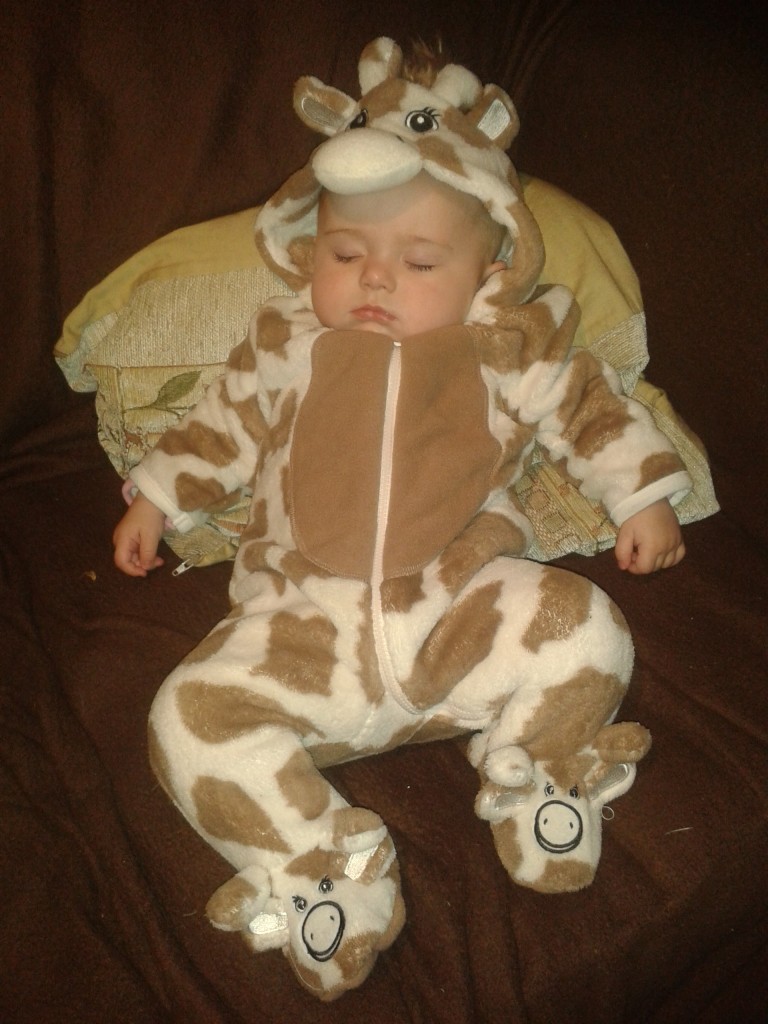
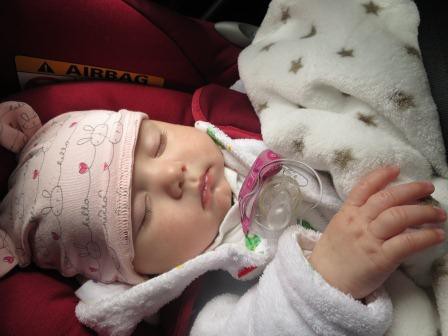
And if you're still not happy, here's Izzie asleep in a giraffe onesie to cheer you up!
And if you’re still not happy, here’s Izzie asleep in a giraffe onesie to cheer you up!

Asperger’s, Emotions and Parenthood

There is a persistent myth that people with Asperger’s Syndrome don’t feel emotions. It’s a myth because, if anything, I think many of us feel emotions more strongly than neurotypicals – it just doesn’t look like it.

I liken emotions in autism to a case of arrested development. Our emotional development suddenly stops while our bodies and cognitive abilities continue to grow. Unfortunately, it usually gets stuck on the ‘teenage’ setting, meaning we don’t understand what we feel, but we feel it all so intensely – the manic highs and the desperate lows – that we become overwhelmed and cease to function. Imagine being stuck as a hormonal fourteen-year-old your whole life – doesn’t bear thinking about, does it?

Since our emotions can confuse, unsettle, and even scare us, we embrace routines, predictability, systematic thinking and mental reasoning. We live in our minds and try to keep our nasty, unpleasant feelings pushed down deep where they can’t harm us. Many resort to antidepressants to keep our feelings at bay. And when our emotions do get the better of us, and we can’t cope, we seek out solitude and experience them alone. The emotionally unresponsive Aspie, approaching situations from the head and not the heart, is therefore in many ways a defence mechanism against our dangerous unbridled passions.

At least, that’s how I see it.

Yet even knowing this, I did wonder why I didn’t feel more when Izzie was born. The father across from us in the Transitional Care Unit was always crying when he was hugging his newborn. ‘I love him so much, I just love him so much,’ he kept saying, until even his missus told him he was being pathetic. I just couldn’t relate to those feelings.

I was told, before Izzie was born, that the first time you hold your baby in your arms it’s special, the love is instantaneous, you’re overwhelmed with emotion, and yada, yada, yada. I’ve mentioned before that when I first met my baby I was pretty dazed and distracted by the whole ordeal of ambulances, operating theatres and incubators and it took me a good four hours to really start feeling the love. But I never got that emotional rush, that powerful knock-you-on-your-ass thrill of being a parent.

Until now.

This is going to sound really saccharine and namby-pamby, but the past few days I’ve been almost overwhelmed by this incredible feeling of love. I feel like I want to cry all the time. When the baby sleeps I feel this surge of emotion well up in my chest, and I watch her for hours because she’s perfect in every way. When I went to work in the charity shop yesterday, I missed her horribly – I was only gone three hours. And when customers asked about her, I showed them a picture and could have cried with pride. I can’t believe she’s only been here nineteen weeks. It feels like she was always with us, just waiting to be born to make us all complete.

See? It’s so horribly sweet and sickening I want to disown myself. Part of me wonders if it’s because I’ve reduced my caffeine intake and started a diet to knock off the twenty pounds I’ve put on in the last nineteen weeks, mostly through chocolate, chocolate and more chocolate; another part wonders if it’s because I haven’t had a good night’s sleep for almost five months; whereas in truth, it’s probably because I’m more relaxed about being a dad these days. The fumbling, panicked hell of the first couple of months, and the laboured, mind-sapping slog of the next two, have given way to a quiet confidence and acceptance of the new routine. And that allows me to see her and enjoy her for what she really is: an angel in our midst.

Actually, that’s going a little too far. She’s suddenly discovered she can squeak like R2-D2, so every time she’s displeased with something, which is often, she treats us to a sound even dolphins wouldn’t enjoy. It’s a high-pitched, screeching whine, somewhere between a dial-up modem and that awful sound you used to get when you picked up the phone only to hear a fax machine on the other end (for those of you too young to remember dial-up modems and fax machines, ask your parents what they were, and know that I hate you).

But my emotional responses to the good things far outweigh my feelings towards the bad. In fact, right now the emotional impact of the good things is utterly disproportionate to their size. Izzie rolled from her back to her stomach for the first time yesterday and me and Lizzie were leaping around the room like idiots, and even though today she’s doing it like a pro, we still get excited every time. This morning when she was laughing unstoppably as I blew raspberries on her belly, I could have been in heaven. And a few minutes ago when I went to check on her in her cot and she opened her eyes, smiled at me, and went immediately back to sleep, I could have stayed in that moment forever.

I am choked with emotion at the moment. I am overwhelmed. But not that anyone would know it.

People with Asperger’s do feel emotions just as strongly or more so than ‘regular’ people. We just don’t make such a big song and dance about it, is all…

See what I mean? Perfect.

Random Thoughts

It’s my birthday next week. Lizzie keeps asking me what I want. Apparently ‘a day to myself’ isn’t an appropriate gift.

Whenever I sneeze, Izzie bursts into tears in absolute terror. So when she’s in her chair, cot, or with Lizzie, I rush out of the room if I feel the urge. But what do I do when she’s asleep in my lap and I feel a sneeze coming on?

Check out my new i-phone, bitches!

Izzie is fascinated with my face. If she’s not twisting my ears, tugging my awesome beard, or pulling my glasses off and flinging them on the floor, she’s pushing her fingers as far up my nostrils as she can manage. As cute as she is, it’s rather unpleasant.

Izzie is so innocent and uncomplicated, her face is a succession of emoticons. When she finds something funny, she laughs; if she’s happy, she smiles; sad, her bottom lip sticks out and her eyes fill with tears; confused, she frowns and twists her mouth; tired, she yawns and rubs her eyes; surprised, her mouth falls open and her eyes go wide. They could use her on those caricature cards they give to autistic people to explain what different emotional states look like.

Where do all our muslins disappear to?

When I fart these days, it smells exactly like the baby’s poop. I know for a fact we’re not eating the same thing, so what’s that all about?

When babies cry, it’s out of need, frustration and annoyance. They’re not really sad, despite the tears. When they’re genuinely sad – like when they wake from a bad dream or their dad sneezes – their crying looks and sounds completely different.

People keep asking what Izzie’s getting for Christmas. She’ll be six months old – she can have the wrapping paper from whatever I unwrap, and the box it came in if she’s lucky.

The first song she heard after she was born, playing on the radio in the operating theatre, was Phil Collins’ Can’t Hurry Love. If they’d waited a few minutes before yanking her out, it would have been Ellie Goulding’s version of Your Song, which would probably have been more appropriate. But then, they were hurrying, love.

Why do they have radios playing in operating theatres?

Not sure how much actually made it to your stomach there.

All-terrain buggies should be renamed ‘heavy, big-wheeled, wide wheel-base buggies’, because other than being incredibly heavy and too wide to go down shop aisles, that seems to be the only difference. The only genuinely all-terrain buggy is called a sling.

Apparently, the middle knuckle of my right index finger is more appealing than a teething ring.

Whenever I walk down the street these days I pay inordinate amounts of attention to other people’s babies, and conclude that, yes, mine is the best. People say I’m biased, and I am. But that doesn’t mean I’m wrong.

She woke me up the other morning rhythmically banging her feet against the cot’s headboard. The fact she was put to bed facing the other way doesn’t seem to concern her.

Right now, when she burps, we cheer and tell her well done. In a couple of years we’ll tell her off for being so rude!

Izzie is terrified of missing things. She refuses to fall asleep in the afternoon as though worried in case something exciting is just around the corner. You can see her eyes drooping, but she refuses to give in, whereupon she goes past the point of tiredness into frenzy mode. That’s where she’s super tired, hyper alert, and has completely forgotten how to get to sleep. Tip: it’s not by pinwheeling your arms while shouting and going red in the face.

They need to build statues to honour whoever invented the dummy.

Now that Izzie is going to bed around 8pm, Lizzie and I keep sitting on the sofa, staring at each other, and wondering just what the hell we used to do in the evenings.

What is going on with that little cough thing that babies do for attention?

All my clothes seem to be covered in crusty white stains. It looks particularly dodgy on my black dressing gown. At least I know it’s puke, not that that makes it much better.

That stuff about having to be careful when changing a boy because they pee when the nappy comes off is only half right. If my experience with my daughter is anything to go by, all babies pee halfway through the nappy change, soaking themselves, their clothes, the clean nappy, you, and the carpet all at the same time.

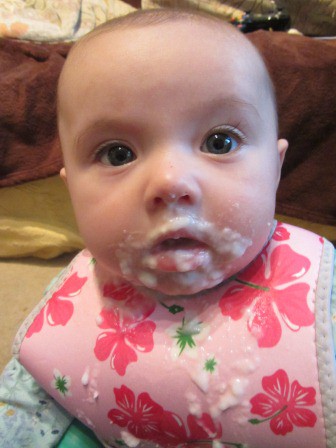
Pesky bib!
Pesky bib!

How is it that dribble bibs are terrible at catching milk, milk bibs are terrible at catching dribble, and food bibs seem incapable of catching anything?

In the battle between the cot in the nursery and the Moses Basket on a rocker by the bed, the Moses Basket wins hands down because a) it’s right beside the bed, and b) it rocks. Whenever Izzie used to stir, I could lean over, pop her dummy back in, and rock her to sleep with my foot, all without getting out of bed or even really out from under the covers. Now I have to get up, go next door, put the dummy in, try to soothe her without rocking, and when she’s quiet I retreat to bed only for the monitor to kick in with grizzles around fifteen seconds later, forcing me to repeat the whole thing five or six times. And that’s a problem at three in the morning.

Izzie keeps doing phantom poops. She makes a noise, I feel the guff, the smell is awful, so I wait a couple of minutes, sniff her bottom to confirm that yes, it stinks, and pat the nappy to confirm that yes, there’s something in there, but by the time I open the nappy the poop has mysteriously vanished. Spooky.

Why, when I use the tympanic thermometer, does it always read 35.4 degrees? Am I not using it right?

And lastly, when I was doing night feeds every night around 3am, I could handle it. Now that Izzie sleeps through to around five-thirty or six in the morning two nights out of three, those 3am feeds every third night are absolute killers that I struggle to recover from. How does more sleep make you feel less awake? Or is it because I check her every couple of hours to make sure she’s still alive?

Support for Parents With Autism

This is a long one, so brace yourselves.

There’s plenty of support for parents with autism. There’s also a total lack of support for parents with autism. Weirdly contradictory, I know, but read on and I’ll explain.

While Lizzie was pregnant with Izzie, we received plenty of support on account of our autism. They gave us a consultant at the hospital, sent us to a nutritionist, referred us to the ‘special’ community midwives and introduced us to our future health visitors. We also had an outreach worker from a local children’s charity who visited us every few weeks to make sure we didn’t need anything extra and were up to speed on the processes of labour, birth, and what comes next. Pretty nifty.

The ‘special’ midwives visited us every few weeks in the safety of our own home, and gave us extra time to explain things and iron out any problems. The team was so good that when Lizzie was sent home from hospital because they didn’t believe she was in labour, three community midwives turned up when the emergency shout went out, and two of them accompanied Lizzie in the ambulance.

We had meetings involving social workers, the local autism charity and representatives of the local council to offer their help and support, too. The unborn baby was assigned a social worker and our competence was assessed (and found to be fine). We were given a fake baby to look after for a few days and attended both NHS and NCT courses on pregnancy, childbirth and breastfeeding. The midwife team could support us for 28 days after birth; the health visitors could start from 11; and they’d see us every single day if they had to. Promises were made, support was offered, and our hands were going to be held right through the pregnancy and birth and into the future.

But it hasn’t worked out like that.

The main problem we had before the birth was getting Lizzie ready for her two nights in hospital. As a medically high-risk individual, she and the baby had to remain under observation for 48-hours. Trouble is, they wouldn’t allow anyone to stay with her overnight – visiting hours ended at 8pm and partners had to be gone by midnight, not to return before 10am – and as a highly anxious person with autism, a fear of hospitals and difficulties adjusting to new situations, Lizzie was terrified of being alone, particularly with a new baby.

Various people contacted the maternity unit on our behalf, and we were even given a tour of the birthing suite, postnatal ward, Special Care Unit, Neonatal Intensive Care Unit (NICU), and Transitional Care Unit (TCU) – all of which we unfortunately got to use – but they wouldn’t budge an inch: despite Lizzie not spending a night by herself for years, having six hours of support from the autism charity each week and a hell of a lot more from family, friends, and me, and struggling to communicate when stressed or with strangers, both of which she was going to be, they would not make any exceptions for anyone. The best we got was that the hospital would try to give her a side room on the postnatal ward, or a place in the eight-bed TCU, depending on space and circumstance. So she’d just have to grin and bear it.

As I have mentioned before, the labour and birth were a bit of an ordeal. Lizzie lost almost three litres of blood, the baby spent the first two days in an incubator on NICU and the next two in the special care unit, and then another three on TCU. I would like to say that the midwives and nurses and healthcare assistants were great, and they were, but one deep problem overshadowed that whole week: where was our special dispensation for being autistic?

‘Ah,’ I hear you say. ‘Why should you get extra attention for having autism? Never happened in my day. The midwives and nurses should have been able to support perfectly well.’

And yes, they should. But there are a couple of problems with that.

Staffing is the first issue. They don’t have the time to provide the extra support a person with autism needs. On the Postnatal Ward one night there was one midwife to cover 25 beds – so presuming one baby per child, that’s one person to care for fifty people. And Lizzie was in a side room. Did the midwife have the time to check on Lizzie, explain things to a greater depth, make sure Lizzie understood, and, more importantly, that she had understood Izzie? Of course she didn’t.

Things weren’t any better on TCU. You’d think that with eight beds supported by one midwife and one healthcare assistant, you’d be seen when there was a problem. But one night, it was ten o’clock, the staff had changed over at seven, we hadn’t seen anyone for four hours and my taxi (also named ‘Dad’) was due at eleven. We were worried about Izzie as she was jaundiced and not going to the toilet, and I was worried about Lizzie, who was freaking out, and I’d buzzed three times already, so I went to find someone. It turned out the two staff were feeding two sets of twins, and they told me to wait my turn. Hardly supportive of two desperate and terrified new parents, particularly if they both have autism.

Another issue is therefore understanding. I don’t know if they’ve had training in autism and Asperger’s – they should have done as a result of the Autism Act – but I had to explain to every one of them what it was and how it affected people. They all said the same thing – ‘Oh, if she needs anything, all she has to do is ring the buzzer.’ Even without a three hour wait, the simple fact is that Lizzie isn’t capable of asking for help. She shuts down when there’s a problem, goes into herself and stops communicating. And she pretends she understands things, or thinks she understands them, when she doesn’t. I watched midwives ask if she was okay and she smiled and they walked off when I knew there was actually something wrong. And I watched as people explained things to her and she nodded intelligently and then afterwards said to me, ‘What did any of that mean?’ This is why she needed someone who knew her to advocate for her, to talk to people on her behalf as the support workers and social workers had been doing. But they still wouldn’t let me stay.

Now, imagine you’re a twenty-nine year girl – perhaps not the easiest of things. Imagine you hate hospitals and have had to have counselling from various sources to face up to the fact that you have to spend two nights away from home. You’ll be away from your partner and your regular support network, and in addition, you’ll have the responsibility of a newborn baby that you have to look after alone, without your partner backing you up.

Now imagine that you have the baby, only it’s a terrifying nineteen hour ordeal involving ambulances, blood, screaming and pain, a spinal injection, episiotomy, failed ventouse and forceps delivery. Imagine you then haemorrhage and have to have two blood transfusions, while the baby is rushed off to Intensive Care in an incubator. Imagine that instead of the two days you’ve prepared for, you have no idea how long you’ll have to stay. Imagine that they put you in a side room and ignore you for eight hours at a time while you plod back and forth to NICU, where your baby is being fed through a tube in her nose.

Now imagine you get transferred to TCU after four days, and are handed your baby and expected to get on with it. They’re too busy to sit with you and show you how to breastfeed, so they give you advice and leave. Now that the baby’s not being fed through the nose, she’s desperately hungry, and won’t stop screaming and sucking on your breast even though there’s nothing in them.

Imagine she’s been feeding for five hours, and you’re weak, and sore, and tired, and you haven’t recovered from the blood loss, and you’re in a strange place with strange people and nobody is responding when you buzz. And then they tell your partner, the one who has been standing beside you all day, supporting you, giving you strength, that he has to leave and come back almost eleven hours later.

Now imagine that you have autism.

I think that warrants a little special dispensation.

People with autism don’t like change, and with a different midwife or nurse every few hours, and no consistency from one day to the next, hospitals aren’t designed to be easy for us. With the additional problems with communication, understanding and anxiety, people with Asperger’s Syndrome and other forms of autism really need someone to advocate for them in hospitals. Ideally, a family member or partner should be allowed to stay with them to act as go-between. Hell, I’d have slept in a chair – I even asked to – if it meant I could stay and support Lizzie. It would free up nurses and midwives, provide far better care for new mothers, and be less cruel on people who have just been through a traumatic experience.

But they don’t make exceptions for anyone, apparently.

Once we were eventually out of hospital, we had great support from the midwives and health visitors. Until, unfortunately, a few weeks ago it was decided that as our village sits on the border between Hampshire and Dorset, all the people formerly looked after by Dorset health visitors (like us) must be transferred over to Hampshire health visitors. So the Dorset health visitors have washed their hands of us, but Hampshire haven’t picked us up yet. After seeing the health visitor every week since the birth, we’ve not been seen now for a month. I spoke to Hampshire and they said they’d be happy to see us, two towns over, in a year. So I rang Dorset to say that doesn’t sound right and they told me to speak to Hampshire. Again, for people who don’t respond well to change, to have support and then take it away seems like calculated cruelty.

So all in all, there are great support services out there for expectant parents with autism, and some great support services for parents with autism, but don’t expect to get much support inside hospital, because it all ends at the door. Equally, the provision of services in the community is terribly inconsistent and seems to be dependent on postcode and not need. I guess it’s lucky we’re doing so well, and nowadays don’t really need that much support, but for people further down the autism spectrum, I dread to think what could happen.

The Autistic Elephant in the Room

When you look at your baby it’s impossible not to wonder about inheritance. My daughter has her mother’s eyes, ears, nose, lips, hair and fingers. The only thing she seems to have inherited from the Drew family’s genetic legacy is the bum chin that I don’t even have. And despite being less than a month old, she still has more hair than me.

Luckily, her behaviour is more equally shared between us: she slurps her milk like her daddy, spills it down herself like her mummy, and is as noisy and uncoordinated as the both of us. I imagine the incontinence must come from elsewhere.

When you have autism, and so does your partner, the question of what your children might inherit from you takes on additional weight. While Lizzie and I were trying for a baby we were often asked if we were worried our child might be autistic. Whilst there’s no convincing evidence that autism runs in families – around one in twenty people with autism have siblings on the spectrum – anecdotally, many of us with Asperger’s can see autistic traits in at least one of our parents. So what if we create an autistic child?

As an individual, autism infuses the whole of my being. It is who I am, and my ways of thinking and feeling are inseparable from my condition. The same is true of Lizzie. I love her in spite of her autism, and because of it. We would not have achieved the things we have, in the ways we have, if we did not have Asperger’s Syndrome.

So would I want Izzie to be autistic? That’s an impossible question to answer. If I say no, it does a disservice to all the people I know with autism who would not be who they are without it. If I say yes, I am setting her up for a lifelong struggle in addition to the regular trials and tribulations that come with being human. In truth, whether she has it or not, it doesn’t matter at all. Aspergic or neurotypical, she will be uniquely herself and I will love her just the same and be there to support her regardless.

And yet I keep watching her for signs. You can’t tell below six months, apparently, but I thought the other day, ‘She makes good eye contact, she can’t be autistic.’ We gave her a bath for the first time last week. She sat in silence until we wet her head when she absolutely screamed the house down; I cannot abide anybody touching my head. But she loved her second bath. It’s just too early to tell.

I think it’s only natural for parents to want to wrap their children in cotton wool. Knowing the life I have led, spending a quarter of a century bouncing from misdiagnosis to misdiagnosis, doped up to the eyeballs on various mood stabilising and antidepressant medications, and suffering several breakdowns to boot, my family didn’t want me to have children. There was too much risk the child would be autistic. How would I cope? What if Social Services took her away? What if, what if, what if?

Deep down, I probably don’t want Izzie to have autism: I know firsthand just how hard it can be. But as I said to my parents, by protecting me from the bad things in life they’re also protecting me from the good. If I didn’t have a child, my life would be easier, but emptier; avoiding the risk of things going wrong means you avoid every opportunity to better your situation. And I wouldn’t change having Izzie for the world.

I have to remember this going forward. As a parent, I’d rather Izzie had an easier life and thus didn’t have autism. But perhaps autism would open up opportunities for her that she’d never have without it. It is not for me to say who she ought to become. I just have to make sure that, whatever issues Izzie might face in her life, she knows that her dad is behind her all the way.

Bursting the Baby Bubble

Despite my best efforts to forestall it – ignoring my diary, avoiding the newspaper and keeping the calendar on last month – time is marching inexorably onwards. Izzie has been registered and is now a member of a wider community to which I must soon return, and although I’m still swimming against the current, I can’t delay the inevitable much longer.

For the past week I’ve lived a wonderfully wholesome routine. I rise around 7.30 and prepare a bottle, and while Lizzie feeds Izzie I feed the animals, make breakfast, and have my sacred first coffee of the day. Then I load up the car and take Izzie and Ozzie for a walk in the forest. When I return, I sort out a few things, have lunch, deal with visitors, have a nap, and then all of us go for a walk around the village, which is the closest thing to heaven I can imagine.

After dinner I prepare the night feeds, Lizzie has a bath and goes to bed, I work on this blog or watch something while cuddling the baby, and head upstairs around 22.30. It generally takes till midnight to settle Izzie, with a couple of nappy changes and feeds overnight lasting around an hour each. This is my routine, and I love it.

People with Asperger’s Syndrome live by routines and struggle to cope with change. This is to be expected, given our rigid thinking and the difficulties we have processing new information, but Temple Grandin has an alternate theory. A remarkable woman with autism who designs slaughter houses, she believes that those of us on the spectrum are like prey animals with an overactive nervous system no longer useful in modern life. If a cow hears a sudden noise, it could be natural but it could be a predator, so it reacts. If it sees something new, it could be nothing or it could be the cause of its death, so it avoids it. The cow is happiest doing its usual thing of chewing cud and pooping pats because that keeps it safe.

People with autism are those cows. When we encounter anything new, different, unexpected, it sets off a fight or flight response disproportionate to the reality. Our bodies are flooded with adrenalin, increasing our stress levels and making it even more difficult to think clearly and cope with the situation. Hence we structure our lives to keep the unknown to a minimum and avoid stressful encounters.

Unfortunately, people with AS are also highly susceptible to forming obsessions, and when these combine with our love of routines and aversion to change, we can lose ourselves in a ‘perfect storm’ of self-imposed dissociative isolation.

I am in a baby bubble and I don’t want to come out.

Ten years ago I was part of a crew of fifty that sailed a tall ship across the Atlantic from the Canary Islands to the Caribbean. Those four weeks were some of the best of my life. Not because I was popular – I was unanimously voted the person most likely to be thrown overboard and they even printed me out a certificate that said as much – but because time was divided into a rigid, unchanging rotation of the watch system and the whole world existed in a space less than two-hundred feet long and thirty feet wide. I knew where I was meant to be, what I was meant to do, and who I was meant to do it with. I ate, worked, slept, in a fixed, tireless routine. And it suited me just fine.

As we neared our goal, after eighteen days with nothing between us and the horizon but whales, dolphins, flying fish and the occasional distant tanker, the rest of the crew looked forward to seeing land again. But I was so happy in my perfect bubble i wished there was no such thing as land and we could keep sailing forever. That first sight of Barbados, an ugly smudge between sea and sky, broke my heart.

The past three weeks my life has revolved around being the best dad and partner I can be. Even as I write this, Izzie is asleep in my arms with her mouth wide open, ‘catching flies’. The outside world has ceased to exist. I haven’t worked, paid any bills or checked my bank balance; I haven’t opened my post or returned my library books, and my emails remain unanswered. My life has become routine and obsession.

But there are smudges appearing on the horizon. If you lock the world out it has an insistent way of banging on the door until you have to let it in. I’m lucky in that I’m a (starving) writer so can work from home; if I had a regular job I’d have been back last week. But I can’t bring myself to send off another chapter to the publisher, another article to a magazine, write something that isn’t about Izzie and Lizzie and me. Not yet.

My baby bubble is going to burst and the real world is going to come flooding back in. But for today, at least, I have all that I need right here.

?????????????
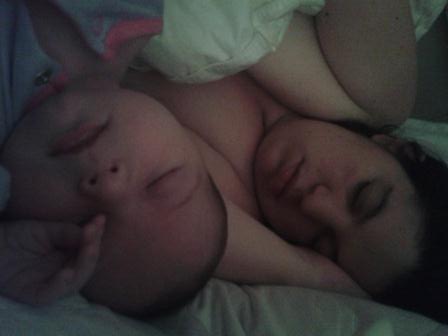
I mean, why would I want anything other than these two darlings?