The pleasures of toys (not that sort!)

Prior to the arrival of our little bundle of joy, I’d see those parents with a wicker basket of handcrafted wooden toys for their children – ‘we don’t believe in consumerism’ – and I’d think: ‘what a bunch of bloody hippies. Go back to smoking roll-ups and drinking herbal tea, the grown-ups are talking.’

In hindsight I think they’re geniuses and I really wish we’d had a rule about toys long before Izzie was born.

The problem is that without a clear idea of what you want, toys have a tendency to multiply. My lounge has turned into a multicoloured mayhem of shapes, materials and textures. It’s like living inside a Disney cartoon, complete with jaunty music, flashing lights, and twee sing-songs.

You see, Lizzie is obsessed with trawling around charity shops and baby jumble sales and returning with endless bargains in pink plastic and green felt. Bargains that ring and chime and jangle, and aren’t really bargains at all when you can’t walk from one side of the lounge to the other without stepping on something that squeaks, or dances, or blinks at you.

Most of the noisy toys are from a company called Vtech, and I have nothing against them. Individually. My problem comes from the fact that when the table is singing, and the walker joins in, the toy TV controller sings its song, and the toy phone starts to warble, it creates a cacophony so unholy it can summon Satan.

Worse, they seem to have used the same woman to voice all of them. ‘Watch some TV with some friends,’ she says, along with ‘can you find the duck,’ ‘ring home,’ ‘who’s calling,’ ‘now I know my abc,’ all at the same time. The voices never stop. These things are meant to teach kids, not make them schizophrenic.

And that’s just the start of it.

I’m not sure the lessons are as productive as they might think. Apparently, rabbits go ‘boing’. Never heard that myself. And one toy from Fisher Price sings, ‘five little cookies make a yummy snack.’ Really? I’d have thought five little cookies make a baby fat!

And thanks to it being in the public domain, every single one of them plays Twinkle, Twinkle, Little Star. That song’s always bewildered me, even as a kid. ‘Twinkle, twinkle, little star, how I wonder what you are.’ It’s a freaking’ STAR! The answer’s in the question. Okay, when Jane Taylor wrote it way back in 1800-and-whatever, she probably thought they were ‘God lights’ or ‘angel smiles’, or something, but damn, can’t we change it to reflect current understanding?

Twinkle, twinkle, little star, you’re a ball of hot gases undergoing nuclear fusion, that’s what you are.

Better?

The ABC song, which I’ve noticed has the exact same tune as Twinkle, Twinkle, Little Star and Baa, Baa, Black Sheep, and which all the toys also play, is driving me utterly insane. In American English it work fine: ‘T U Vee, W X, Y and Zee.’ But the toys have all been recorded in British English, so she sings: ‘T U Vee, W X, Y and Zed.’ It doesn’t seem to bother Lizzie, but every time the song starts up I cringe, waiting for that awful, jarring non-rhyme. The only way I can cope is to sing along with it, substituting  Zee for Zed. And doing that fifty times a day isn’t relaxing.

I think there’s a reason the musical drum Lizzie brought home a few weeks back was so cheap, because if you ever want to torture someone, this thing was designed by the Marquis de Sade. Every time you tap it, it plays a note. The notes it plays seem to unite to create ‘The Wheels On the Bus.’ But it doesn’t play ‘The Wheels On the Bus.’ There are extra notes crammed in there at random, and others arbitrarily removed. If you were to sing along to it in your head, as you do automatically, it would go like this: ‘The wheels on round and round, round and round round, round and round, the wheels on the round and round, all all day day long.’

‘Just turn them off!’ I hear you scream.

I fully agree. But you clearly don’t appreciate the depth of my problem. Turning them off isn’t as easy as you might think. You find a switch and flip it, move onto the next one, only to discover you haven’t turned it off at all – you’ve simply switched it from ‘annoying tune’ to ‘annoying song’, or increased the volume, or switched on the lights so you can enjoy your own disco/epilepsy. One of them even rolls around the room, forcing you to chase it, and once you’ve caught it, it spins a chicken over the top of the off-switch, as if laughing at you: ‘ha, the only way you can reach this switch is with lightning reactions, or else you break it!’

Funnily enough, despite all the bells and whistles she can choose from, Izzie’s fallen in love with a little cuddly green dog that has become something of a security blanket. Well, not the dog, actually – the bone attached to the dog by a little blue cord. She’s only happy when she’s clutching this blue cord, the bone on top, the dog dangling down under her feet. She drags the dog around behind her, trips over it, gets it stuck on things. Instead of using two hands to pull herself to her feet, she only has one free nowadays.

It’s made dressing her, or changing her nappy, or strapping her into the car seat or high chair, an absolute nightmare. Because she has to let go of it so you can put her arm through the sleeve or the strap, or avoid getting poo on it, and letting go of it is not something she’s going to do without a fight, followed by excessive amounts of screaming.

She even sleeps with it now, and I have to admit, I’m happy to let her if it keeps her quiet.
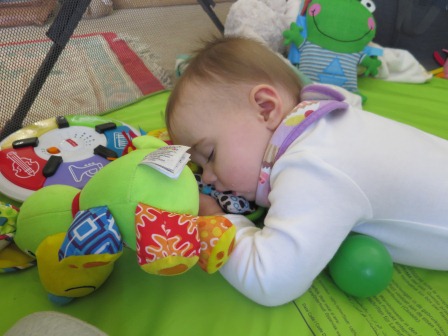
IMG_0847
She’s asleep, we have fifteen minutes to turn off all the toys!

So here’s to the hippy parents with the handcrafted wooden toys, roll-up cigarettes and herbal tea – I take mine with milk and a sweetener, thanks. See you at the commune!
Interest in People

In the past week, Izzie has decided that faces are awesome (I said faces! I was quite clear about that). Whether pulling faces or, indeed, pulling faces, those things that go together to make up the human face have become inescapably fascinating (and not just human faces either; I have to give a shout out to Ozzie the cocker spaniel, who sits patiently while the baby pulls on his eyelids).

As fascinating as faces are to her, it’s equally fascinating for me to watch how she’s learning what faces mean, and that the things attached to them – people – are just as cool.

Amazingly, she seems to recognise the difference between adults and children, boys and girls – and she’s definitely more interested in those who can one day grow facial hair. At the pub on Mother’s Day she spent the whole meal turning in her seat so she could watch the boy at the table behind us. When he left with his parents, she smiled at him and waved – she’s eight-months old, for crying out loud!

Children elicit a different response to adults. When she sees a grown-up, Izzie watches them, before slowly smiling and then waving – when I took her on a journey around the pub the other night, she made sure to wave at every adult in there until I was sure her arm would fall off. But at least they tend to smile and wave back.

When she sees children, she shouts at them. A loud cry like she can’t contain her excitement at recognising a kindred spirit. She even does it when she sees a baby on TV – she sits in silence, ignoring the noisy idiot box in the corner, until an advert for Pampers or Aptamil or Cow & Gate comes on, and suddenly you jump out of your skin as the baby on your lap roars at the screen. Crazy smart!

Along with waving, she’s learned to point, but only with her right hand. If you point your finger back at her she slowly extends her arm until she touches your fingertip, just like God and Adam on the ceiling of the Sistine Chapel. And this’ll sound really syrupy, but it’s the most adorable thing ever.

Except, perhaps, when you see her practicing her Jedi skills. She reaches for things that are way out of reach – like fifteen feet out of reach – and keeps on reaching, staring at it intently as though she can use the Force to draw it to her. She also sweeps her palm from one side to the other in front of your face from time to time as if doing the Jedi Mind Trick – ‘You will bring me milk and cookies. None of that broccoli shit.’

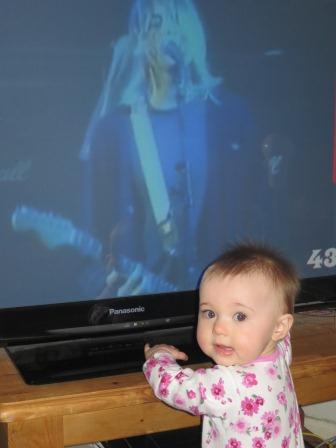
She’s been so drawn to the TV of late we’ve had to fence it off. She wants to touch it all the time. At first, we thought she was looking at herself in the reflection, but then this happened:

IMG_0832
What’s an Aneurysm, daddy?

[As an aside, I showed this picture to an acquaintance and she thought the person on the screen was Lady Gaga. When I told her it was one Kurt Donald Cobain, she replied, ‘Oh yeah, he was in Thin Lizzy!’ For those of you unsure why that’s so, so wrong, look up Smells Like Teen Spirit, and you’re welcome.]

Because she loves her reflection. If she’s screaming her head off, you just need to hold her up in front of a mirror and she stops instantly, to laugh, and giggle, and reach for the baby in the glass. If you give her a small mirror, she can’t help kissing her reflection like a tiny Narcissus.

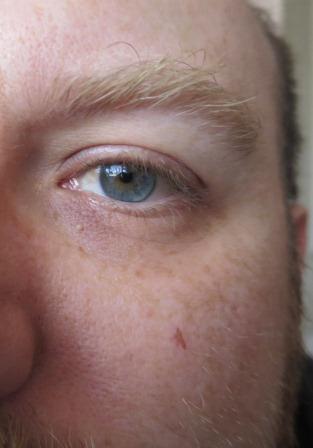
And that’s the problem: her fascination with faces isn’t satisfied just by looking. She’s constantly trying to pull your mouth open, twist your lips, ram her chubby little fist down your throat. As she’s so strong, you can easily get hurt along the way. I had no idea a baby could gouge a chunk of flesh out of your cheek:

IMG_0845
That’s going to leave a scar…

This need to pull at faces is teaching her about life and death, or rather, the difference between animate and inanimate. At baby group the other day she picked up a doll for the first time (she normally prefers to play with things she’s not allowed, like TV remotes, phones, i-pads, drinks cans, nunchuks). The first thing she did was try to open its mouth by prising apart its solid plastic lips, and struggled to work out exactly why this was a non-starter. Since it seemed to be ignoring her, and was confusing, she went to the old fall back of giving its hair a good solid yank.

And – ohmygod – it didn’t react. She looked around, confused, perplexed – when she pulls daddy’s hair, especially the hair on his belly, you can bet your bottom dollar it provokes a reaction. You could see her trying to fathom out why this thing that looked like a person wasn’t behaving like a person. It’s like watching a leap up the evolutionary ladder, the moment a monkey first realised it could use a stick to beat the crap out of other monkeys. I’m not entirely sure the penny dropped – there was no ‘ah, I get it – it’s a doll’ moment – but then she has plenty of time to work out that dolls are not real (for one thing, they don’t wake you up at three in the morning, and for another, you don’t have to worry about them one day coming home and telling you they’re pregnant but that it’s okay, he’s a rock musician and one day his band is going to be really big – ‘Well, you did let me listen to Nirvana when I was a baby, dad, so what did you expect?’).

Other than this confused, befuddled, all-is-not-well-with-the-world expression, she’s picked up a couple more. There’s the shocked, split-second oh-my-god-I’ve-lost-my-balance-and-I’m-going-to-fall expression, which she’s become rather adept at as it happens every few minutes. But far scarier is what I call the I’m-a-grown-up-girl-and-I-know-what-I-want-and-how-to-get-it expression. In this second expression, I can see the face she’s going to grow into: self-assurance in the set of her mouth and wisdom in her eyes far beyond her years (months?).

It’s the face of someone who’s going to be strong, and smart, and determined. And quite probably a precocious know-it-all who can cry on cue as she fights tooth and nail to get her own way with everything.

In all honesty, that’s not a face I’m ready to see yet. I provide it here for posterity. Look upon the future and tremble!

IMG_0840
*Gasp!* Magnum!


AS, Anxiety and Baby Safety

It is rare to meet someone with AS who doesn’t have some kind of anxiety problem, and yet anxiety is not part of Asperger’s Syndrome. Rather, it seems the symptoms of Asperger’s – the social confusion, difficulties with understanding, need for routine and inability to cope with change – often lead us into situations we can’t cope with and encourage others to tease us, humiliate us and bully us, and it is a lifetime of such occurrences, repeatedly falling on our arses, that causes the anxiety.

Even then, some of us can be bigger worriers than others.

It turns out that I have a reputation amongst the NCT crowd of being something of a worrier and rather overprotective (shocking, I know!). As I’ve said before, in order to cope with our anxieties, people with Asperger’s plan their lives to avoid risk and the unpredictable. Having a baby means that you don’t just have to plan to keep yourself safe – you have to think of the baby too. And your anxieties about yourself pale into insignificance alongside your need to protect your baby.

Now eight-and-a-half months old, Izzie has reached that stage where she wants to be involved with everything. And by everything, I mean EVERYTHING. She wants to know what you’re doing, what your partner’s doing, what the dog’s doing, what the cat’s doing, what the people out the window are doing, what’s behind that sofa, what’s in that cupboard, can I open this drawer, why can’t I wear that hat, your glasses would look better if I bent them, what happens if I empty out your bag, and everything in between. And keeping her safe has become a nightmare.

The house is starting to resemble a fortress. There are barred gates across every doorway, a wooden fence blocking access to the TV, a hexagonal playpen that looks like a cage-fighting arena taking up half the lounge, and foam corner protectors uglying up most of the furniture. We’ve put down a soft mat as the floor was (probably) too hard, and I’ve even relented about bumpers and put protectors around each slat of the cot because she keeps falling and cracking her head against the bars. Every single night.

But it’s all to no avail. She’s determined to stand and walk before she’s ready, which means she falls often and falls hard. Worse, she doesn’t seem to care – if she’s standing up against the sofa and wants to get to the other, she throws herself down like an unemployed stuntman so she can crawl; if she has a toy, she thrashes it about until she’s knocked herself almost senseless; and within a few seconds of putting her in her cot you’ll hear an awful, heavy thud as she drives her head into the wood, deliberately and repeatedly, as if that’s how the cool kids get to sleep these days.

I’ve had to come to the conclusion that it’s impossible to safeguard her entirely. I can chase her around the room as she waddles about, and catch her if she falls backwards – I can’t stop those face-planting forward falls that squish her nose and knock her teeth back into her gums. Nor can I stop her crawling over her wooden blocks, getting her fingers caught when she bashes two toys together, headbutting my knees or suddenly slamming her face into my forehead – no matter what precautions you take, she’s got you.

I was sitting on the sofa the other day when the lamp started sliding across the sideboard all by itself. Did we have a ghost? I jumped up to find Izzie had pulled herself to her feet, squeezed into the gap down the side of the dresser, reached up to the top and, even though it was out of sight, found the lead with her fingertips and was slowly preparing to pull the whole, heavy ceramic base of the lamp down on her head. This is just one example out of a hundred. Unless we have no phones, lights, chairs, sideboards, tables, floors, people in the room – anything, in fact – we will never eliminate risk.

All of this means the bruise above her eye the size and shape of a thumbprint has been joined by two on her temple the size of peanuts and one right in the middle of her forehead as big as an egg. And she’s into scratching herself too. We take her out in public, all black and blue and red, I’m terrified we’re going to get arrested for using her as a football. ‘It happened when she fell,’ I tell family and friends, and even I think I sound guilty.

The same is true of weaning. I freaking hate feeding her these days. Before, it was milk – pure, wholesome, liquidy milk. Now, it’s all kinds of food, food with bits, with lumps, with chunks. It’s bread, it’s meat, it’s pasta, it’s fruit. So at least once a meal she’ll laugh, or try to talk, or simply swallow something too big, and she’ll start to choke. Totally normal, apparently, totally natural, since she’s learning new textures and tastes, but as her face turns purple and her eyes bulge and tears spurt out of them, I have to fight down the panic because I don’t want to alarm her any more than she already is. So I’m a nervous wreck before we even begin, waiting for that unexpected moment she’ll suddenly start choking, and – something particularly hard for me – there is nothing I can do to prevent it. We can’t keep her on yoghurt and soup all her life, but good gosh I wish we could!

It’s a hard reality to accept but one that I guess all parents eventually have to – we cannot protect our children from the world or from themselves. We can try our best to ensure they’re kept safe, in a protected environment that minimises the risk factors, and be there to pick them back up, but ultimately they’re going to get bumps and bruises, fall out of trees, start dating that boy you don’t like just to piss you off – the trick is not to make a big deal out of it and hope that the damage is never too great. Otherwise you’ll make them neurotic and yourself a basket case, or worse – you’ll turn them into you.

Funny ha-ha and funny weird

Thanks to that funny thing called life (along with a chemical imbalance called ‘my brain’), I’ve been rather down of late, so I thought I’d cheer myself up (and others?) by recording those funny and weird things my daughter’s been doing. Because really, when you’re circling the abyss and getting ready to fall, there’s no better lifeline than a child’s laughter to pull you back from the edge (disclaimer: a child’s laughter is no substitute for a lifeline. Always use a rope from an accredited climbing centre when circling abysses.)

I discovered this last night while dancing about to John Denver as I was cooking dinner. It was, apparently, the funniest thing Izzie had ever seen. I’ve never heard her laugh so much. And nice laughter too. I guess in a few years, the laughter will come for a different reason, but for now she thinks I move like Justin freakin’ Timberlake, so that’s a boost to the self-esteem.

Of course, a slight blow comes from the fact I just realised yesterday that instead of singing about his lover, a hillbilly strumpet named Country Rose, John Denver was actually singing about ‘country roads’. So I’ve been singing it wrong for twenty years. Yikes! A bit like Jimi Hendrix’s ‘Scuse me while I kiss this guy…’

Which brings me neatly to sounds. Izzie has learnt two new sounds. The first isn’t so bad. It’s a loud, drawn out roar that combines hello, how are you, I’m Izzie, do you want to be friends and let’s play. A little weird when you’re pushing her round the village and she roars at everyone you walk past, but survivable.

The second sound is drawn from the depths of hell.

She’s discovered she can make a noise on the in-breath as well as the out-breath, but this  in-breath noise is enough to make you shudder. It’s a gasping, choking hiss, like she’s being strangled or some strange demon creature has possessed her and wants to summon serpent warriors from a netherworld. It’s worst when you’re settling down to sleep and this freaky, banshee shriek comes through the monitor, sending a chill down your spine. You leap out of bed because it sounds like she’s having an asthma attack, but no, she smiles up at you, innocent eyes all aglow. And then roars at you in greeting. Creepy.

Actually, night time has become altogether weird. Three a.m. I’ll hear a noise and get up to check on the baby. I stand outside the door to listen, but there’s silence. I gently, oh so gently, push open the door, and then I see…it. This figure, dressed in white, bathed in the white glow of the baby monitor, standing up, motionless, just staring at the wall two inches from her nose. Just standing there. Not moving, not making noise. Staring at the wall. It’s like something out of Poltergeist.

Then she slowly turns her head to look at you. Ye gads, at three in the morning that’s enough to give anyone the heebie-jeebies!

They're Hee-eeere!
They’re Hee-eeere!

Even weirder are the sounds from the monitor. A few weeks back it started playing piano music for a few seconds. There was nothing in her room that plays a tune. I looked at Lizzie, she looked at me. ‘Did you just hear -?’ ‘Yes, that was weird.’ Checked on Izzie and she was fast asleep.

A couple of nights back I jerked awake as I was sure I heard a man’s voice shouting profanities right in my ear, right through the monitor. But the baby was sound asleep.

And speaking of sound asleep, because she’s so active during the day, Izzie has started sleeping like a log. Or perhaps a better way of saying it would be that she sleeps the sleep of the dead. Half a dozen times in the past fortnight I’ve gone to check on her and she’s so still, so quiet, I’ve momentarily thought she’s dead. I watch for the rise and fall of her chest – nothing. I put my hand by her mouth to feel her breath – nothing. It then takes a huge effort of will to reach for her wrist and check her pulse, because I dread feeling cold skin beneath my fingertips. But she’s never been dead so far, so that’s good!

She’s developed a fascination with Grandpa’s cans of cider too. There’s this thing called object permanence – basically, once something’s out of their sight, babies don’t realise it still exists so won’t look for it, whereas later they realise things exist even if they can’t see them. Well, Izzie’s cracked that one – no matter where he puts it, where he hides it, she continues to look for it, crawling all over him like an alcoholic spidermonkey. Gives new meaning to the expression ‘monkey on my back’.

Her level of activity is astonishing. If I need the toilet during the day, I pop her down in her cot and go sit on the loo with the door open as it faces the nursery. Within seconds, a little hand will appear on the top of the headboard, then another, before the top of the head, eyes and nose come straining to get a look. She’s like that graffiti motif Kilroy Was Here. Watching me take a crap. Thanks honey.

It extends to nappy changes. You put her on her back on the changing mat and she immediately rolls onto her front and crawls away because she knows what’s coming. You manage to grab her by the ankles, drag her kicking and screaming back, take off her tights – she crawls away again. You hold her by the ankles, lift them up in the air, but she twists so her upper half is facing the opposite direction to the lower. In that odd, contorted position, you take off her nappy, clean her up. You let go for a split second, look away, look back to see a little naked bottom disappearing behind the sofa. At which point you think, ‘Sod it!’ and let her keep on half-dressed. Although it’s a bit like Russian Roulette – peace right now weighed up against the risk of having to clean poo out of the carpet. Sometimes peace right now is worth any amount of future scrubbing.


And since she’s just vomited yellow stuff all down my trousers, I’m going to sign off here. Like I’ve said before, you need a sense of humour to be a parent – otherwise, it’s just tragic!

AS, Parenting and Mental Exhaustion

Now that Izzie is crawling, standing, climbing and talking (albeit gibberish), people keep telling me how this is the best, most exciting, and most rewarding time of raising a baby. Those first months where she slept and cuddled and needed, needed, needed were boring, challenging, the hardest slog, but now that she’s interactive and starting to give something back, you can enjoy it. Now it gets interesting.

I have to admit, I feel the opposite.

It’s my belief that Asperger’s Syndrome is at root a problem with information processing. We have no problem taking in vast quantities of information, but our brains are so structured that we compartmentalize this data. It’s in trying to interpret it – to work out how it relates to everything else and what it all means – that we struggle.

I can explain it much better using an orange.

Imagine that each piece of information that goes into making a concept, activity or understanding about the world is a single segment of an orange. A neurotypical person only needs to see one segment, or at the very most two or three, in order to realise they’re parts of an orange, and since they know what an orange looks like, they can construct the orange – the concept, the understanding – without needing to find the rest of the segments or even really thinking about it.

Not so if you have Asperger’s.

You get a piece of information – a segment – and you store it in one part of your mind. Then you find another piece, and even though it relates to the first and is part of the same orange, you don’t have the faculties to realise this, so you store it in a totally different part of your mind. And you keep going like that, and even when you have all the pieces, and you’ve seen an orange before, you can’t work out what it’s meant to look like, so you cram these segments together, trying to work out how they fit, and throwing some things out, and adding bits that aren’t supposed to be there, and ultimately making something you’re happy with but that, to anybody else, looks nothing like an orange.

Thus, in order to compensate for our deficits and function on a daily basis, people with Asperger’s Syndrome have to expend huge amounts of mental energy. What comes naturally to so many neurotypical people, we have to consciously process, and like a computer, we only have a limited amount of processing power.

This is why socialising is so exhausting. Interpreting what people are saying, how they’re saying it, what they mean, in what way they mean it, what you should say, what you shouldn’t say, when you should say it, is your voice too loud, too quiet, do they understand you, are you standing too close, are you making too much eye-contact or not enough, what’s the relationship between this person and that person, how are you coming across, and what does it all mean, while trying not to get distracted by music, other conversations, traffic noise, light bulbs, their deodorant, the way the sun is reflecting off someone’s forehead, and the fact their DVD collection isn’t alphabetized, is excruciating. It’s no wonder we so often become overwhelmed and suffer burnout. And why we need extended down time to recover.

So how does this relate to being a dad?

I liken it to the old people’s home I used to work in. Those upstairs were frail and grumpy, but were compos mentis and had simple needs – toileting, bathing, dressing, eating and sleeping. After working seventeen straight hours without a break, I’d be physically exhausted but mentally quite alert. Other than latent old-fashioned racism (‘That dark girl has stolen my pearls.’ ‘You’re wearing them, Gladys.’), it was a breeze.

Downstairs, behind code-locked doors, were the Alzheimer’s and dementia residents. Most of them were able-bodied, and so working with them wasn’t nearly as physically tiring as working upstairs. Mentally, however, it was like being hit with a crowbar.

You’d have a suddenly-naked ninety-year-old man charge at you with his willy in his hand, turn around to find a woman trying to remove non-existent make-up with cutlery. You’d try to console a former naval officer sobbing over a cat that had been dead for fifty years, before bathing a woman who screamed at the top of her lungs all day long. You ever tried shaving a man who’s spitting at you? Fighting off the advances of a woman who thinks you’re her long lost lover back from the dead?

I’d go home after a shift downstairs and my back wouldn’t ache, my feet wouldn’t hurt, and I’d be capable of running a marathon, but good golly, my brain would be mush. Trying to process the assault of noise, colour, emotion, attempts at communication – it left me useless for the whole night and into the next day.

And that’s how it is with Izzie.

When she was little, it was physically demanding but mentally easy – she spent half the time asleep and the rest of it feeding or pooping. Her needs were simple, her sounds were few and explicable, it was easy to know what she wanted and to cater to that. It was like she was an extension of myself and I loved it, because I was good at it and it worked.

Now, however, she has morphed into a person, entire of herself and completely separate from me. Since my problems revolve around interactivity, having a suddenly very interactive child is something I’m struggling with. She’s become incredibly complicated. It’s like I’m behind those code-locked doors again, downstairs in the dark.

These days, Izzie is in near-constant motion from six in the morning till gone seven at night. Instead of cuddles and sleep, she’s climbing on the furniture, chasing after the dog, throwing tantrums if you take the TV remote off her, fighting you when you change her nappy. Mealtimes are complicated affairs where you try to get enough nutrients and fluid into her while getting it spat and flung back into your face. You can’t take your eyes off her for thirty seconds or she’s unplugging the telephone or ripping the pages out of your favourite book. And no matter what you do, it seems to be wrong.

She’s learning at an astronomical rate, discovering new textures, tastes, sounds, skills, vocalizations, facial expressions. She laughs, she shouts, she reaches for you, she pulls your hair, and you spend all day right there with her, trying to keep up. And every new texture, taste, sound, skill, vocalization and facial expression, I’m trying to interpret it, trying to process it, trying not to get left behind. Am I doing it right, how do I keep her safe, what does she want, what does she need, why’s she doing that, is this right, what should I do, has she eaten enough, I’ve got to catch her if she falls, what rules should I make for this, and that, and the other, and what does it all mean?

And that’s before we factor in visits from family and friends, health visitors, nursery nurses, social workers, care coordinators and support workers, and the everyday trivia of shopping, cooking, cleaning, writing, working, which create a whole bunch of processing issues of their own.

Mentally, I’m mush.

This interactive stage, before babies can express themselves but after they have a need to do so, is by far the hardest part of parenting I’ve experienced. Lizzie is loving it, but I can’t help counting down the hours until Izzie goes to bed, and that’s making me feel like a crap dad, especially as I keep being told that this is meant to be such an amazing period. By the time I’ve got Izzie down, I’m not fit for anything in the evening but staring numbly into space, my brain trying to make oranges out of everything I’ve seen and done. Throw in a touch of SAD and I can feel the Black Dog circling ever closer to me again.

I have an adorable daughter and I seem to be doing a good job of raising her. Physically, it’s easier than ever. But oh my gosh I’m finding it mentally exhausting at the moment.

Perhaps this is just something I’ll have to get used to.

The Dreaded Moment

It’s the moment every parent dreads. You put your baby in her cot, flat on her back and half-asleep. You wander to the bathroom to cut the tag off her new gro-bag. And when you return you see your not-quite-eight-months baby doing this:

IMG_5128
I am your worst nightmare!

Yup, she can stand. By herself. With no help from daddy anymore. Who needs you? Not me!

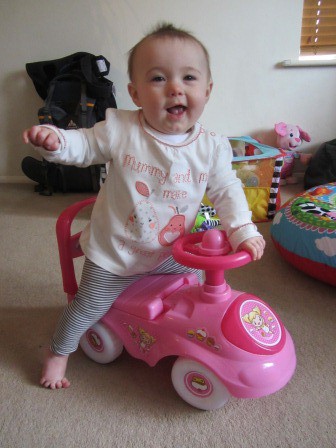
So in the morning you put her on her little pink scooter-car thing, and she not only shuffles around the floor like an infant Lewis Hamilton, she’s cocky about it:

IMG_5345
Ha! One hand! Eat my dust, turkeys!

It’s made mealtimes rather interesting, because along with this latest development comes a desire for independence stronger than some separatist movements. She doesn’t want me to hold her beaker anymore – she wants to do it herself. And if I try to help her, I get screamed at. Damn it, dad, I don’t care how much water I pour over myself, just let me do it my way!

Every achievement on the way to full mobility is written large upon her face. She grins from ear to ear, laughs uproariously, and babbles excitedly at how freaking cool she is.

But her ego has outgrown her ability.

She’s increasingly annoyed at how slow crawling is. You can see (and hear) her frustration that she can’t move as quick and easy as she wants. She keeps getting up on one knee and lifting both hands skywards as though asking to be picked up – but woe betide if you try, because she’s actually raising her arms in victory that she’s one step closer to walking and doesn’t appreciate you stepping on her freedom, thank you very much.

Her ‘victory hands’ are actually a little counter-productive to the whole standing project – she gets to her hands and feet like a cat arching its back, makes a triumphant one-armed salute, and face plants right into the carpet. But that doesn’t faze her at all, because she starts right up again.

And all of this while teething and fighting off an ear-infection. Determined is not the word: she’s a little trooper!

And yet, along with the pride, comes a tightening of the chest and a catching of the breath, because my baby is on the verge of becoming a toddler. I thought we’d have more time with our baby, that it’d be at least a year before she gave up her total dependence on us. I want to tell her to slow down, to stop being in such a rush, that it’ll come regardless, but she’s inherited my willfulness – I was the same as a baby, racing towards developmental milestones as though they came with prizes. I already feel like I’m being pushed aside, and I can’t say I altogether like it.

But then, when I think how far we’ve come since those first days of life in June, when I worried she wouldn’t be coming out of hospital, to how she is now, I have nothing to complain about. She’s a bona fide miracle.

20150619_085153
Week One
IMG_0794
Week 34

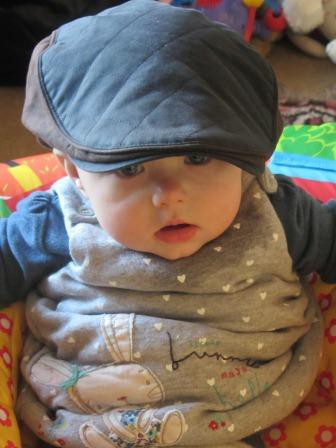
If her journey to independence continues at this rate, before I know it she’ll be trying on funky hats and telling me in a Mockney accent that she wants to be a chimneysweep’s scamp. I dread that day.

IMG_5123
Too late!

Medicine vs. Magic

When you’re a parent, people never tire of telling you what to do and how to do it, not in the form of advice, but in the form of judgement. And when it comes to health, they’re bloody insistent. With everything else you have to contend with, it’s damnably unfair to hear veiled criticisms of your parenting, especially when you’re in the emotionally vulnerable position of wanting to do the right thing with a screaming and thoroughly unhappy baby.

The best response is to bite back your annoyance and say, ‘Thank you for your advice, but as the mother/father of [insert baby’s name], I will make the decision as to what is best for my child.’ It’s short, polite, to the point, and reminds them where the power truly lies.

But it doesn’t stop you wanting to throttle them with their condescending attitudes and ridiculous ideas.

It’s like a friend of mine who is on a personal mission to stop me giving Calpol to my baby, because paracetamol is bad, it’s bad for babies, it damages their liver, it’s unnatural, and all that jazz. Whenever she discovers I still use it, she turns into an evangelical preacher and acts like I’m slowly and deliberately poisoning my child.

With Calpol.

I’m not saying that paracetamol is safe – overdoses do damage livers – and nor do I advocate dosing kids up on paracetamol as and when you feel like it, but when it’s necessary, and when it is administered carefully, at the right doses, then there is nothing wrong with it. Izzie has an ear infection and a high temperature, as I discovered yesterday afternoon when I rushed her to the doctor’s after she projectile vomited all over Lizzie. The doctor prescribed Calpol to bring down the fever. Simple.

But, according to my opinionated friend, I’m practically killing the baby by giving her paracetamol, and I should avoid using it until I’ve tried some alternatives.

‘What alternatives?’ I asked. ‘Child Ibuprofen? Because I have that too.’

Nope, lectured my forthright friend. Homeopathic remedies.

Ah. Magic water and wishful thinking, then. Glad we had this conversation.

Until a few years ago, I thought ‘homeopathy’ was simply another way of saying ‘alternative medicine’. I figured it was herbal remedies like St John’s Wort, cinchona bark, and suchlike. But that’s not homeopathy at all.

Homeopathy is a medical system invented in the late 1700s that posits that ‘like cures like’ (hence the ‘homeo’ part of the word). Its essential belief is that if you put something that causes an illness into some water – say, something that causes a headache – then dilute that water down almost exponentially until there’s unlikely to be a single molecule of the original substance left, that water is somehow energised and imprinted with the ‘memory’ of that substance and will therefore be able to cure headaches.

There’s another word for water that contains no molecules of any other substance:

Water.

Homeopathic remedies contain precisely zero active ingredients and are therefore precisely useless. And ‘like cures like’ has no basis in science whatsoever. That’s not just my opinion – the National Institute of Health and Care Excellence (NICE) does not recommend homeopathy is used to treat any ailment, the NHS say there’s no good evidence that homeopathy is an effective treatment for any health condition, while a 2010 House of Commons Science and Technology Committee report concluded homeopathy is no more effective than placebos (http://www.nhs.uk/conditions/Homeopathy/pages/introduction.aspx).

No matter how much you talk about Nature with a capital N, or the Law of Similars, or how substances leave a quantum imprint behind, I do not believe in homeopathy. I will take science and evidence over magic and fairy dust every time.

Then there’s the close relative who has this crazy notion that the best way to cure a cold is to consume vast quantities of vitamin C, and so tries to get us to overdose every time we have the slightest sniffle. The fact the human body can only absorb a finite amount of vitimin C before excreting it out, and excessive amounts give you diarrhoea, means it’s not the best advice, ta.

And don’t get me started on amber necklaces helping with teething. This whole ‘Baltic Amber contains up to 8% succinite, an anti-inflammatory and analgesic that will be absorbed into the baby’s skin to ease pain, cut drooling, and stimulate the thyroid’ is pseudoscientific claptrap. You show me a substance that is strong enough to exist for millions of years at excessive temperature and pressure, yet is weak enough to leak out when brought to a baby’s body temperature. I’d respect them more if they went right ahead and said, ‘It works by magic,’ or even, ‘We don’t know why it works, but it does,’ than duping people into thinking there’s a scientific basis for this. And since the same people who advocate amber necklaces also disparage modern medicine as ‘dangerous’, aren’t they worried that they have no control over the dose of succinite their baby receives?

I’ll end by paraphrasing GK Chesterton: it’s good to have an open mind, but don’t open it so much that your brain falls out!

Asperger’s, Parenting and Unexpected Change

As is well-covered in the literature of autism, people with Asperger’s have a love of routines and struggle to cope with change. What I’ve been realising lately is that this bald statement covers up the nuances of what this means in practice, particularly when you’re the parent of a seven-month old.

And it can affect two people with AS in opposite ways.

I cannot handle change in terms of things being added. I need time to process and accept things that are coming up. Ever since I was a kid, I needed plenty of notice – at least a week – to get my head around a visit from relatives, a trip out somewhere, or anything out of the ordinary. If not, I tend to moan, kick up a fuss, say some nasty things I don’t really mean, and then go along with it anyway. But I don’t have much of a problem with things being cancelled anymore – indeed, the principal emotion is relief I don’t have to go through the effort of painting on my ‘public’ face and holding onto a fake smile for however many hours. I would be a hermit if I could get away with it.

Lizzie suffers the opposite extreme: she can’t handle change when it’s things being removed. She is mostly fine with things being added to the routine, especially if she’s the one doing the adding, but if something is cancelled her first response is to throw a tantrum. I liken it to a person walking along a road and finding a brick wall blocking their path. While other people would try to find a way around it, or else turn back, Lizzie bashes her head against it until one of them gives – sometimes the wall, but most often the head. Actually, scratch that – most often the heads of those around her.

Babies, as some of you are well aware and others can easily imagine, are unpredictable. Not only that, the world becomes unpredictable when you have them. Visitors arrive with little or no notice, longheld plans need to be dropped without warning, and you have to rush off to the doctor out of the blue. It’s impossible to say which of us struggles the most with the changes having a baby has brought to our lives, but I can guarantee that I suffer the most.

Now, when I say ‘suffer’, I’m not being melodramatic. I’m not talking about the discomfort I feel at friends, relatives and healthcare professionals clamouring for our time or pitching up on our doorstep unannounced. Nor am I talking about the disruption that sudden trips to the shops for some vital knick-knack cause to my quiet, ordered life. Fact is, the baby’s needs come first. I have accepted that. My needs, as an autistic individual, are immaterial next to hers. I have made that choice.

Unfortunately, Lizzie is either unwilling or, by dint of her condition, unable to make that choice. And so I genuinely suffer.

Like before Christmas when Izzie had a cold and I hadn’t slept for two days. Sunday morning I was so tired I couldn’t see straight, my back ached, I was covered in snot and dribble, and my throat felt like I’d been swallowing razor blades. I hadn’t had the chance to drink, eat, go to the bathroom, since the night before. When Lizzie arose, well-rested, and made herself some breakfast, I asked her to please look after the baby for an hour to give me a rest. But she had planned to go shopping, and, unable to alter her plans, she toddled off for more than three hours of non-essential retail therapy. I suffered.

Or like a couple of weeks ago when I got a migraine about teatime. Lizzie had planned to go out, so out she went. I couldn’t open my eyes more than slits as the light burned, I kept seeing spots of light dancing in front of my face, and my head throbbed with every beat of my heart like somebody was burying an axe in my skull. Every time I bent forward, it felt like my brain was being forced out of my eye-sockets. But I duly bathed the baby, gritting my teeth and shouting in pain whenever it became too much; hissed as I dried the baby; roared as I dressed her in nappy and sleepsuit; cried out as I placed her as gently as I could into the cot; snarled as I sang her to sleep. And then I collapsed, nauseous, into bed. I suffered.

Or the other week in the storms – our village turns into an island during heavy rain, and three years back I wrote off my car by driving into floodwaters (the single-most butt-puckering moment of my life!). So although we’d planned to take the baby to town, I refused point blank to expose her to the risk of getting stuck down some country lane surrounded by cows pretending to be ducks. The sensible thing. Unless you have autism and can’t change plans, in which case you kick off like a wild animal, say some truly awful things, and then go out anyway sans partner and baby. It was only later she admitted I was right, it had been too wet and downright risky to go out in that weather, with or without the baby.

Now, as this is mostly a positive, light-hearted blog, I’d like to say that whenever this happens I smile wryly, roll my eyes, say, ‘That’s Lizzie!’ to hoots of canned laughter, accept that it’s just her autism, and forgive and forget.

But nor is this a fairy tale.

There is a lingering resentment bubbling away under the surface as my needs, and Izzie’s needs, repeatedly come second to Lizzie’s inability to alter her plans for the greater good. Whether she can help it or not doesn’t matter – the resentment is there.

I have heard it said before that partnering a person with Asperger’s Syndrome is a form of abuse – not for the Aspie but the poor neurotypical saddled with their unreasonable behaviour. As someone with AS, I disagree with that, but let me be clear – people with Asperger’s can be cold, insensitive, selfish pricks at times. That’s the reality hiding behind the innocuous words, ‘people with Asperger’s have a love of routines and struggle to cope with change’.

Never Too Young For Mischief

Before embarking on this parenting lark, I figured babies were like little balls of dribble and poop. Some were easy on the eyes, others less so. They were slaves to their needs for milk and bowel movements, demanding instant gratification or else letting out an ear-splitting howl. And they were all exactly the same. To talk of ‘personality’ in a baby was laughable.

How wrong I was.

Izzie has buckets of personality, and a talent for mischief that I wouldn’t believe in a seven-month old if I hadn’t seen it myself. Far from being a passive servant to her physiological urges, she’s an active participant in learning, laughing and game-playing – mostly at the expense of daddy.

Take what she did to my phone the other day. Since her favourite game is grabbing those things her parents deem important enough to deny her access to – mobile phones, TV controllers, cameras, tablet devices – Lizzie was using my phone as bait to encourage her to crawl. And of course, it would be unfair to take it off her once she got it.

At least, this was Lizzie’s philosophy. I was blissfully ignorant of it until I walked into the lounge and saw Izzie with one end of my phone in her mouth, her fingers tapping the touch screen like she was playing a flute.

Ah, how cute, I thought – she’s making a phone call.

I was less amused when I took it off her (unleashing a wall of tortured screaming) to see she was in some application on the internet and there were two buttons on the screen, one reading ‘confirm’ and the other ‘cancel’.

Panicked, I quickly cancelled out of whatever it was she’d been about to install, or buy, or delete, thinking I’d dodged a bullet. But that was just the start of it.

She’d turned on the wi-fi, turned on Bluetooth, turned on the GPS tracker, turned on mobile data, put it into flight mode, and changed the network from Vodafone to T-Mobile! God knows what else she might have done that I haven’t found yet – there’s an icon on the top left of the screen that wasn’t there before, and all attempts to remove it have failed. And it seems to think I have headphones plugged in all the time now.

It’s the same story with my Kindle (forgive the pun). I’ll be writing something, little ‘un on my lap seemingly engrossed in her own thing, and suddenly this little hand will swipe across the screen and exit whatever application I’m using, or delete my file, or undo changes. And she smiles and giggles, like she knows exactly what she’s done.

She has an uncanny knack for making mischief. The other day I spent a couple of hours baby-proofing the lounge, putting plastic squares on sharp corners and sticking rubber padding on the edges of furniture with double-sided tape. Then I brought Izzie into her new ‘safe’ playground.

The very first thing she did – the very first! – was to roll her way over to the sideboard, grab the bottom of the rubber padding and – riiiiippp – pull off the whole three-foot strip. Then she eyed-up the padding on the TV table, so I put her to bed.

Not that bed is safe from her shenanigans. She loves throwing her dummy down the back of the cot, perhaps because she knows it’ll force me to pull out the drawer and strain to squeeze underneath to retrieve it. The other night, she was lying peacefully in her cot, ready to sleep, so I stepped out of the room and closed the door. Within twenty seconds, I heard the dummy clatter down behind the cot and she started to make crying sounds, only to laugh the moment I stepped back in.

Having a bit of sense – only a bit – I put the second dummy in her mouth, stepped out, closed the door, and in less than ten seconds – I counted – it followed the first down the back of the cot.

After enduring five minutes of her tearful sniffling I went back in there and – lo and behold – she started laughing!

I’ve developed a new tactic in the Battle of Bedtime – I put Dummy 1 in her mouth, and as soon as she takes it out I pop in Dummy 2, so she ends up with one in each hand and a perplexed expression on her face. It’s not foolproof – she can just throw them both down the back of the cot – but she hasn’t quite figured that out yet. And long may she remain in ignorance, or else Dummy 3 will have to make an appearance on the scene.

Nothing but passive servants to their physiological urges? They’re devious, calculating monsters!

Now I’m dreading the arrival of my phone bill…


Endless changing

When you’re having a baby, you expect its arrival to be the Great Unknown: you’re going to jump off the edge of a cliff in the night, with no idea what awaits you. But once you get into it, you’ll get into a rhythm, and the changes from then on will be incremental and manageable.

Not so. Not so at all.

Sure, the birth and first month is like leaping – falling – into the abyss, but gradually you learn how to fly. You learn to interpret the sounds the baby makes and what they mean, become adept at nappy changing, feeding, prepping bottles, soothing her. You work out ways of carrying her that are safe and don’t break your back or your arms, get into a routine, discover you can cope with the lack of sleep and the irritations of cold or skipped dinners, vomit-stained clothing and the ever present weight of responsibility. Things are getting easier. The future looks rosy.

And then, around three months, it all changes again.

She suddenly makes different sounds, different facial expressions. Whereas before, you knew exactly what she wanted and could meet her needs right away, now you can’t anticipate them at all, and you only realise she wants something after she’s started screaming. But on the plus side, she starts to sleep through the night and you have time on your hands and no idea what to do with it. You’re now an expert at nappies and bottles. You’re finally getting a handle on this parenting thing.

And then around five months, it all changes again. She wants to roll over all the time, so nappy changes turn into a nightmarish battle of wills. She starts waking again in the middle of the night for two hours at a time, and you’re so out of practice at missing sleep, it hits you worse than it did the first time around. She wants solid food – well, mush – because the milk just doesn’t cut it anymore. And everything within arms reach is a potential hazard that if she gets her hands on goes straight into her mouth and causes her to choke.

But you invent new methods to cope. I kept losing count of how many spoonfuls of formula I put in her milk as I had to keep one eye on her, so I’ve scrapped the numbers 1-7 and replaced them with the words ‘Thumb, pointer, middle, ring, pinkie, thumb, pointer,’ along with visualising the relevant fingers. Such an effective method, I can have a conversation while doing it and still keep count.

And changing her is so much easier if you give her a plastic baby coat hangar to play with, as it keeps her on her back and keeps her hands busy (and thus out of her own poop). [But a word of warning on this technique – never use something big, like a teddy bear. I made this mistake yesterday. The first thing she did was rub it between her legs and smear poop all up her belly, so I tossed it aside and gave her a sock instead. Finished, I turned to recover the poop-covered teddy bear to find the dog licking it clean. Gross does not describe it!]

We are approaching another change. In the past three weeks, from six-and-a-half months to now (seven months and five days), she has learned to crawl, sit unsupported, remove her nappy, manoeuvre herself anywhere she chooses to go, throw her dummies across the room, and speak, albeit in Spanish (‘habla, habla, habla, habla’, which prompts me to reply ‘Espanol? No habla Espanol. Habla Ingles, por favor.’).

And suddenly she’s decided she wants to be a drummer. Everything’s a drum to her – the tray table of her high chair, her toys, the floor, the sofa, her inflatable donut chair, daddy’s belly, mummy’s boobs. It used to be ‘can I pick it up, can I put it in my mouth?’ It’s now ‘can I pick it up, can I slap it and make a noise, can I put it in my mouth?’ Anything comes on TV with a heavy beat, like the intro to Modern Family, she stops what she’s doing and stares transfixed at the screen. Weirdly, she didn’t bat an eyelid when a compilation of old Sugababes videos was on, but put on Bring Me The Horizon’s ‘Sleepwalking’ or ‘Shadow Moses’ and she’s fascinated (look them up if you want to know why that’s so unexpected! And yes, my musical tastes are eclectic).

And she’s started hooking things over her feet – any hoop or ring toy she gets she tries to turn into an ankle bracelet. The developments are coming so thick and fast – in sitting, crawling, walking, talking, facial expressions, reaching, holding, manipulating, weaning – that it’s hard to keep up. And she’s reached the point where she suddenly gets clingy and shy. A couple of weeks ago, she’d have gone with anyone; now, she glances at strangers then buries her face in my chest before glancing out again, or looks to me as if to say, ‘Is this okay, daddy? Are we safe? Or should I show this person the door?’

According to the Health Visitor, she’s way ahead of the curve, and she can’t believe how these developmental milestones have been reached so close together. Normally, she says, they’re more spread out so you have the chance to process them.

The end result of this is that Lizzie and I both feel we’re walking along the edge of an abyss. We can feel a giant change coming, a truly Great Unknown just ahead, invisible and unavoidable. We don’t know what it is – walking, words, a rudimentary nuclear reactor. We keep expecting to walk into the nursery in the morning to find her sitting dressed on the floor with a cup of tea, asking us whether we’d like one lump or two.

It’s not a very comfortable feeling. It feels like it did the week of the due date – like something huge and life-changing is rapidly approaching and we don’t know how we’ll cope and if we’re sufficiently prepared. Yet again we’ll have to find a way to adapt. And honestly, we’re both a little terrified of this unseen future.

So if you think having a baby will change your life, you’re wrong. It will change your life, then change it again, and again, and again, and again, and again…