
Such a Dad!

Lately I have been metamorphosising into a strange, inhuman creature known as a ‘dad’.

Now, of course, I’ve been a dad for eleven months, but it’s only now that it’s sinking inside and reorganising my DNA. Becoming a father doesn’t change you very much, but living as a father clearly does something to your body chemistry.

I went to a wedding on Friday. Normally I don’t dance, but as the music started I was suddenly driven by this urge to take Lizzie’s hands and lead her to the dance floor, where I jiggled about arrhythmically, rocked from foot to foot, did a few spins, and then caught sight of someone else doing exactly the same thing and realised: oh my gosh, I’m dad-dancing!

I was never a good dancer, but at the very least I could bop to the beat and unleash a bit of inner funk – now it’s just plain embarrassing!

I guess like most dads, I have to prove that I’m still young and try to impress my child by throwing myself into apparently ‘fun’ activities. When Lizzie was jumping up and down on a trampoline, of course I had to do it too to show I’m still with-it…and threw out my back, and hurt my neck, and hobbled around for the following week like an octogenarian. Before the baby came along, I’d never have got on a trampoline, so why do my dad genes make me do that?

And speaking of dad jeans, I went shopping the other day and spent the whole time going, ‘Why can’t I find any normal jeans? Why are they all skinny-fit, or slimline, or tapered? I don’t want trendy, I want comfort, with a high waistline and a zip fly for easy access and…whoops, when did I turn into a fifty year old?’

In fact, I’ve developed some rather strong opinions about youth fashion of late. Girls’ skirts are too short and their T-shirts don’t cover enough of their midriff. If I ever catch Izzie showing off that much skin, I’ll…damn, talking like a dad again.

Along the way I’ve grown fond of a hideously repetitive style of unfunny dad-ish one-liners. Every time Izzie poops herself, I say, ‘Shall we change you? We could change you for a nice Italian baby. That’d be good.’

I say that at least three times a day. It wasn’t particularly witty the first time I said it, and it doesn’t get any funnier as time goes by, but for some reason, that doesn’t stop me from saying it.

The same with opening the blinds in the morning: the moment they’re open and the light streams in onto my tired frame, I cry out, ‘Ah, I’m melting, oh, what a world, what a world,’ as I pretend to liquify down into the floor. Izzie has never once even smiled, but I still do it. Every day. Not funny, dad. Stop it.

Bathtimes have developed their own cheesy humour: we have a little blue shark bath toy, and no matter how many times I’ve done it, I whoosh it around the tub with just the dorsal fin poking above the water humming the Jaws theme and saying things like, ‘You’re gonna need a bigger bath,’ and, ‘Smile you son of a duck,’ and I listen to myself doing it and think, ‘Just shut up you sad old man!’

But at least I’ve not turned into a mum that talks through her child, the way Lizzie does.

‘Is daddy going to get mummy a drink?’ she says to the baby, or, ‘Mummy’s going to look after you while daddy mows the lawn,’ or even, ‘Daddy’s made a great big mess of the house and if he doesn’t tidy it up mummy will kick him out and cancel the wedding’ (see: passive-aggression for a full explanation of this behaviour!). T’would be nice if she’d ask me to my face instead of through a proxy!

Perhaps it’s inevitable that having a child turns you into a dad. In fact, most people would argue that having a child is pretty much the key factor in becoming a dad. But there’s a big difference between being a dad and being a ‘dad’. And while I’ve been the former for a while, the latter has crept up on me and cold-cocked me on the jaw.

What a strange state of affairs!
Millimetres from disaster

Every parent has been there, probably multiple times. You’re doing something, anything, and you come a hair’s breadth from disaster.

Sometimes it’s small – you’re carrying the little one up to bed in your arms and her head skims the door frame. You breathe a sigh of relief, knowing  you were a cat’s whisker away from cracking her skull into a solid piece of wood.

Sometimes, it’s bigger – you’re holding her in your arms, normally in public and over concrete, when she braces her feet against you and suddenly launches herself backwards into space. Somewhere between instinct, determination and sheer dumb luck, you arrest her fall with hands, arms and thighs. No trips to the hospital today, you think, shrinking from the disapproving stares. Crisis averted.

And sometimes, it’s on a whole other level.

I changed Izzie’s nappy the other morning, got her dressed, and left her to roam free upstairs as I finished getting myself ready. Long gone are the days where if you did that, she’d close the door to the nursery then sit behind it, sending you into a mild panic as you struggled to get back in without squishing her. Nowadays, she’s far more interested in exploring, and as long as you look round to check on her every thirty seconds, there’s not normally that much trouble she can get herself into.

And you can hear her – she’s fast, but boy is she noisy. Even when her hands and knees aren’t drumming over the floorboards, she babbles to herself constantly. If you want to know where she is, just listen for a couple of seconds and she’ll announce herself.

Anyway, the other morning Izzie was in the nursery pulling sleepsuits out of the drawer and throwing them over her shoulder, and I figured it’d be the ideal time to pop to the toilet. It would take her at least half a minute to completely empty the drawer, then another few minutes of flinging them to every corner of the nursery for her job to be truly finished. Plenty of time, and I’d hear her if she left the room.

So, I’m standing there, peeing, minding my own business, looking down, as you do when you’re a polite man who was taught how to aim, when to my absolute horror a little hand appears between my knees and grips the rim of the bowl. Then another little hand appears beside it, followed by the head of my little daughter, mesmerized by the majestic stream cascading down mere millimetres away from her face.

Oh. My. God. I cannot describe to anyone who has not experienced it the awkward awfulness of such a moment – hands full, mid-flow, the peace of a second before now hanging in shreds, replaced by the terrible fear you’re about to piss on your baby’s head!

I sprang into action. But just as I was pinching it off to avoid something that would haunt my nightmares for years to come – no mean feat in itself, any man can tell you – she switched her focus to the water (and other) in the bowl and reached down into the toilet, ready to scoop –

My free hand caught her wrist and stopped her a gnat’s bum fluff away from breaking the surface.

Manoeuvring her safely off the toilet and out of the bathroom – one hand on my junk, one clutching her wrist, and her so unsteady on her feet – wasn’t the easiest of things, but was nothing compared to what had come a moment before.

Now, I will never have to flashback to the day I gave my daughter the world’s worst hair wash. Never before have the words ‘millimetres from disaster’ held so much truth!

The Terrible Ten-Months

New parents hear so much about ‘the terrible twos’ that it’s very easy to be lulled into a false sense of security. You sit there with your incredibly well-behaved baby and think with smug complacency that you have two years of parenting practice before having to face the horrors of unstoppable tantrums and a wilful refusal to behave.

And then you discover that’s a load of total crap.

For the past couple of months Izzie’s known what ‘No’ means, but played a little game called ‘how far can I push it?’ That’s normal and natural and the sign of a confident baby with an active mind and growing sense of independence, and I welcomed it.

The door to the hallway, for example –  it doesn’t close properly, and Izzie’s aware that if she rolls the doorstop out of the way, slips her fingers into the crack and pulls, she can wrench it open and escape into the magical and dangerous world that is the rest of the house. So whenever she tries this, I give her a stern ‘No,’ with a pointed finger and a glare.

In the past, she looked back, her hands dropping into her lap. Then, slowly, without breaking eye contact, she’d lift her hand and start to stroke the door jamb – ‘not touching it, daddy, see? Quarter of an inch away, but my fingers aren’t in the crack. Not doing anything wrong.’

Same with the plug sockets. ‘I’m just stroking the wall, daddy, millimetres from the plug you told me not to touch. You could barely get a sheet of paper between my fingers and the socket, but I’m not touching it, so you can’t punish me.’

And if she ever did get the door open and I told her ‘No’ a moment too late, she’d hover on the threshold, hold my stare, tentatively ease a toe into the hallway, listen to me tell her ‘No’ again, and then slowly and deliberately shift her whole foot across the line – just to see what she can get away with, just to see how far she can go.

Provocative, sure, but entertainingly so. She was intelligently exploring the limits of my authority and the consequences of her actions; I was showing her where the boundaries are while she pushed against them to see how flexible they might be. Normal and natural. How I miss it.

In the past fortnight, Izzie has learned to clap, developed her first mole (on her forehead), and yesterday cut her first tooth (lower left incisor). And since she’s now so clearly an adult, she thinks she doesn’t have to listen to a word I say anymore.

It doesn’t matter how many times I tell her ‘No’, if she wants to open the hall door she’s damned well going to open it. And if she wants to touch the plug socket, hell, she’ll touch it just to show me that she can. And if she wants to crawl into the magical and dangerous world that is the rest of the house, nobody is going to stop her.

She forgets that I’m bigger and stronger than her and actually can stop her simply by picking her up and moving her somewhere else. But alongside the wilful disobedience comes the other symptom of the terrible twos – the tantrum.

Boy, does Izzie know how to tantrum. You wouldn’t think a ten-month-old could do it, but she’s got it down pat. She can’t even walk yet, but she knows how to stamp her feet. She’s as uncoordinated as the next baby, but she can ball her hands into fists and thrash them about in a temper.

A couple of nights back I was bathing her and she was playing with her plastic stacking pots, one in each hand. She took great delight in filling them with water and throwing it over me, before hitting me in the forehead with them and repeating it. After six or seven goes, I decided that enough was enough and tried to take them off her.

It was as if I had just declared World War III.

Getting the pots off her was no mean feet as she has the grip strength of an Amazon, but once I was done, the angry, screaming, thrashing, leg-kicking, arm-flailing, fist-waving tear monster sending tsunamis of water out of the tub and over the bathroom floor bore no resemblance to my cute little well-behaved daughter. It was like being caged with a wild animal with a toothache.

This stroppy self-righteousness has spread to all areas of her daily life. Don’t get me wrong, she’s a very good baby, hardly ever cries, and is a delight to be around most of the time. But she’s decided she can do what she wants, when she wants, and woe betide anybody who tries to stop her.

Terrible twos? If only they’d wait that long!

Parenting mistakes (to avoid)

All parents make mistakes. Sure, we think we’re great and we’re doing it right, because it feels right and because we’ve read the right books, but in actuality we’re making mistakes we know nothing about until it’s too late.

Too much love, too little, too much leeway, not enough – the consequences of these will not be known for decades, or at least until the teenage horror that was once your child picks up a psychology book and says, ‘Wah, the reason I can’t get a boyfriend is because you didn’t hug me enough/give me enough freedom/discipline me enough as a child!’ and all that crap. I guarantee that in twenty years time, everything we’re doing now will, apparently, have been wrong. But that’s the joy of parenting, guys!

Making mistakes we’ll be blamed for in the distant future is one thing; making mistakes with consequences in the here and now is quite another. For the edification of new or would-be parents everywhere, here are ten avoidable mistakes that I have made in my extensive ten months of parenting:

1. The muslin game.

Description: you throw a muslin over your baby’s head, and she pulls it off. You repeat with delight, and over time replace the muslin with sleepsuits, blankets, tea towels, nappies (clean), and whatever else is within reach: newspapers, books, telephones. What fun and what harm?

The unintended consequence: can we get Izzie to wear a sunhat? Put it on her head all you want, hold her hands, tie it under her chin, she thinks it’s highly amusing taking it off and flinging it away. After all, that’s what you’ve taught her with your fun and games!

How to avoid: don’t play with your child.

2. The bath plug

Description: at the end of a bath, you think it would be kind of cute if you let your baby pull out the plug. What a productive member of society she’ll be then.

The unintended consequence: the first thing Izzie does when she gets in the bath is pull out the plug. Because though you taught her how to pull out the plug, you didn’t teach her how not to pull out the plug.

How to avoid: don’t bath your child.

3. Dropsy

Description: when she’s in her high chair, your baby drops her beaker. You bend down, pick it up and hand it back to her. Well done! You’ve invented the game of dropsy.

The unintended consequence: twenty times a mealtime, every mealtime, Izzie drops her beaker on the floor. If you don’t pick it up, she screams; if you do, she immediately drops it again. What great fun!

How to avoid: don’t give your baby fluids.

4. Swimming

Description: you throw a toy out in front of your baby, she flaps her arms and you carry her through the water as though she’s swimming until she grabs hold of it. How can teaching her to swim possibly cause a problem?

The unintended consequence: when Izzie’s sitting in the bathtub and wants a toy that’s floating out of reach, she thinks she just needs to flap her arms to get it. This creates plenty of splashing, but strangely the toy doesn’t get any closer. You’ve taught her to get water all over the bathroom for no appreciable gain.

How to avoid: don’t teach your child to swim.

5. Raspberries and wibble-wibbles

Description: you know what’s just adorable? Teaching your baby to raspberry. First with just the lips, and later with the tongue. And teaching her to use her finger on her lips while humming to make that wibble-wobble sound: people just die when she does it. How cute is your baby?

The unintended consequence: you know what isn’t just adorable? When Izzie raspberries or wibble-wibbles with a mouthful of food, and either sprays it all over daddy or rubs it up her face. These are not memories to treasure.

How to avoid: don’t teach your baby to make sounds.

6. Yuuuuuuummmmmm and nom-nom-nom

Description: when your baby refuses to open her mouth and take the magic aeroplane spoon, what could be more natural then holding it to your own mouth and pretending to eat with a ‘yum’ and a ‘nom-nom-nom’? Your baby’s like, ‘Damn, that looks like it tastes good, I want me some of that!’

The unintended consequence: every time Izzie eats anything, she goes,’yuuuuuuuuummmm nom-nom-nom’ until she swallows. Then she takes another mouthful, and it’s ‘yuuuuuuummmmm nom-nom-nom’, and no matter how many times I tell her the other kids will think her weird if she moans over every mouthful, she steadfastly refuses to listen.

How to avoid: don’t feed your baby.

7. Feeding off your plate

Description: when your baby sits on your lap as you eat your dinner, you find yourself tempted to answer the question: ‘Would my baby like broccoli? A chip? Jalapenos?’ (NB for any social workers reading this, that last one’s a joke). So you pick up a morsel of food from your plate and find that, lo and behold, a love of barbecue pork ribs is another thing you have in common.

The unintended consequence: from now on, everything you have on your plate, no matter what it is, where you are, or what time of day, it’s fair game. That little chubby hand will reach for cutlery, crockery, burning hot potatoes, boiling stew, spicy curry, burgers, ice cream, pizza (you can see I have a great diet). And if you tell her it’s your food, and she’s already eaten, it’s like talking to someone who doesn’t speak English. Who’d have thought it?

How to avoid: don’t feed your baby (see point 6 for further details).

8. Wafer bribes

Description: your baby screams whenever you put her in her play pen. So you decide, quite naturally, to give her a wafer to munch on when you put her in there. That way, she’ll associate the play pen with happy thoughts, and won’t scream.

The unintended consequence: now, whenever Izzie goes into the play pen, she looks around with a ‘where the hell’s my gosh-darned wafer?’ kind of expression on her face. Then screams. You’ve merely delayed the inevitable.

How to avoid: leave her free to roam around the house.

9. What’s in a name?

Description: every parent wants their baby’s first word to be them. So you walk around saying ‘dad-dad-dad-dad-dad-dad-dad’ while your partner warbles ‘mum-mum-mum-mum-mum-mum-mum’ and you wait to see who’ll win.

The unintended consequence: Izzie walks around saying ‘dad-dad-dad-dad-mum-mum-mum-mum-dad-dad-mum-mum’, with no idea what either means. Now that she says mum and dad a hundred times a day, how the hell are we going to know when she says it and really means it?

How to avoid: don’t teach your baby your names.

10. Afternoon naps

Description: it’s half four in the afternoon, you’re feeding your baby and she falls asleep between mouthfuls. You think to yourself, ‘It’s okay. She’s so peaceful I’ll let her have twenty minutes kip. Poor thing’s so tuckered out.’

The unintended consequence: congratulations! Your baby will now be up till midnight.

How to avoid: never let your child sleep. Ever.

And there, in a nutshell, are my tips: don’t ever feed your baby, give her fluids, play with her, bath her, let her sleep, teach her your names, or sounds, or how to swim, and be sure to leave her to run free with no restraint whatsoever. Then you’ll be a perfect parent and avoid making any mistakes at all.

But nor will you be a parent for long…

Autistic Building Blocks

There’s an episode of Scrubs in which Dr Cox’s infant son has a playdate with a rival’s child. After seeing the other boy’s precision with building blocks, Dr Cox states that kids of that age shouldn’t be able to do that, leading him to suspect the boy has autism. And of course, since Dr Cox is like House, only with a larger ego, he’s absolutely right.

Far be it from me to take facts about autism from a TV show, particularly one that perpetuates the myth you can restart a stopped heart with a defibrillator (shocking revelation: you can’t!), but it’s lingered in the back of my mind for years. So when Izzie started playing with building blocks a few weeks ago, I watched her very carefully.

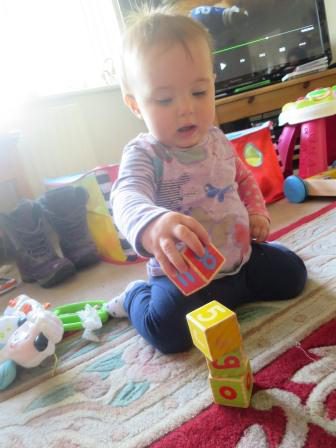
Actually, that’s not what happened. I was meant to watch her. Instead, as an autistic guy myself, every time she started to play with them I couldn’t resist the opportunity to shoulder her aside, organise the blocks by colour and shape and build towers all around the lounge. To my annoyance, Izzie kept knocking them over and mucking up my neat piles and throwing the bricks into her ball pit. I started to design stronger towers, pyramids, all kinds of defensive structures to protect my colour-coded edifices. Then, after about a fortnight of this, I realised I was getting obsessive over a baby’s building blocks and really ought to let Izzie play with them. Then I watched her.

Mostly she was destructive with them, smashing them together, bashing them against the furniture, throwing them at the wall, and stuffing them into her mouth. Just like a baby. Phew.

But then she started to play with them differently. Starting a couple of weeks back, she would empty them out of her trolley one at a time onto the carpet and then very carefully put them all back in again. After a few days of this, she decided that was too easy. From then on she’d wheel the trolley over to the coffee table, and one by one she’d put the blocks on top. Once she was done, she’d take them down and put them back in the trolley, walk over to her toy box and repeat the process. Stacking, unstacking, loading, unloading like a particularly conscientious warehouseman.

I consoled myself that she wasn’t able to make towers out of them yet. That would be the time to worry.

Two days ago she managed to stack two on top of each other. By yesterday, her towers were up to three blocks. Today, she managed five. And that’s when alarm bells started to ring.

I mean, they weren’t very good towers – they were wonky and multicoloured and would fall over if you walked too heavily across the carpet – but they were towers nonetheless. Were these the skills Dr Cox was talking about, those abilities with bricks a non-autistic child shouldn’t possess?

It says on the Baby Centre website that at 15 months she should be able to start putting one block on top of another, and by 18 months might be up to towers of three blocks.

Izzie is ten months old.

IMG_1252
That’s the wrong colour, dumb ass!

So without any further evidence, I started panicking that ohmygod she’s autistic.

After a few minutes of reassuring myself that it’s okay, she’s happy and if she has autism, that’s just the way things are, I’m autistic, Lizzie’s autistic, and we’re fine, everyone has problems, neurotypical, Aspie or otherwise, I decided it might be an idea to research early signs of autism.

And Izzie has NONE of them.

Now of course, not every child with autism is going to have all the signs, and even if a child has many of them, it doesn’t mean they’re autistic, but for anybody who’s curious, these early signs of autism are:

  • Lack of eye contact (I never made eye contact as a child; I sometimes have to look away, the amount that Izzie stares at me!);
  • Failing to imitate social cues, like smiling back at you (Izzie smiles so much, I’m sure her face must hurt);
  • Not babbling to themselves or making noises to get your attention (Izzie is by far the noisiest person in my life);
  • Failure to respond to their name (Izzie comes when called, and if I say, ‘Where’s mummy?’ she looks right at Lizzie);
  • Not using gestures to point things out or respond to your gestures (Izzie’s favourite activity is pointing);
  • Disinterest in physical contact like cuddling or being picked up (if you don’t pick Izzie up, she climbs up your legs!);
  • Doesn’t want to play with others (Izzie is currently loving rolling balls to me and getting me to roll them back);
  • Repetitive interests, movements or behaviours (Izzie does seem a little preoccupied with food…);
  • Delayed motor development i.e. rolling, sitting, crawling, standing (Izzie rolls, sits, crawls, stands, swims, climbs and throws).

Conclusion: Izzie doesn’t have any of the classic signs of autism.

So why is she so advanced when it comes to building blocks if not autism? Who knows? Maybe she’s just really really freaking intelligent.

Through a Baby’s Eyes

When people talk about parenting, they tend to focus on sleepless nights, nappies, screaming, tiredness and poop. What people don’t mention nearly so often is how much that we, as parents, can learn from our babies – about living in the moment, the dangers of preconceived notions, the creative possibilities of human ingenuity, and what our bodies are really capable of.

Everything Izzie touches, picks up, looks at and experiences, she comes at for the first time. Being around her as she stares with giggling delight at bubbles floating in the air, or screams with joy if I pick up my guitar, or laughs uproariously whenever she sees the cat, you start to realise that the world is full of wonders that we, as adults, simply take for granted.

As I was pushing her around town this afternoon, focusing on things to do, stuff to buy, she was pointing upwards and cooing. Stretched between the buildings were red, white and blue bunting for the Queen’s ninetieth, a sea of triangles fluttering in the breeze. I took a moment to stand in the sunshine and watch them, and it was beautiful, a beauty we don’t see because as adults we don’t live in the now.

It’s the same with her approach to the world. We live by rules, and fixed ideas, and received wisdom, but for babies the rules are not set. Earlier today I was trying to get Izzie to pound on her drum, but she kept turning it upside down and spinning the feet. ‘You’re doing it wrong,’ I kept thinking, and turning it right side up, and encouraging her to bang on the top, because it’s a drum.

But then I realised that there’s nothing wrong with what she was doing. To me, with my learned, conditioned way of seeing things, there is only one way of positioning a drum – upright – and one use for it – music. Her creative approach, with no concept of the ‘right’ way to use a drum, was to treat it as a toy. And why not? Why can’t we play with drum feet? Why, as adults, do we fix our viewpoints in place and categorise things as this or that without considering that they could be other? Babies teach us about the possibilities in life if we only dropped our rigid notions of how and why and simply allowed ourselves to experiment.

That said, I wasn’t overly pleased when she picked up Lizzie’s car keys and decided to bash them repeatedly into my guitar, revelling in the noise she made in the time between scratching the body and me snatching them off her. So I guess there have to be some rules in place.

What I’m really impressed by lately are a couple of navigational tricks Izzie’s come up with that reveal the incredible capacity humans have for problem solving. She’s discovered that if she puts a smooth object under her left hand when she crawls, she merely has to slide that hand and not pick it up, reducing the amount of labour involved and increasing her speed across the floor. And if she can’t reach something on the coffee table, she wheels her trolley of wooden blocks up to it and climbs inside to give herself an extra few inches of height. She’s ten months, for crying out loud – it makes you feel proud to be human.

And then there’s what she teaches us about our bodies. I see my body as a stiff, battered thing that isn’t capable of all kinds of movements – mostly exercise, to be fair. But Izzie – from sitting on the floor, she simply stands straight up without using her hands or getting to her knees first, all through the power of her legs. If she can do it, why can’t I? As we get older, we stop using certain muscles, spend too much time sitting, and our tendons tighten up and things turn into knots. But babies can do it, people who do yoga can do it, which means we can do it – we’ve just become lazy, is all.

And she’s taught me something about my body that is mind blowing – Izzie has started rolling her tongue. Since neither Lizzie nor I can roll our tongues, and I was taught at school (erroneously, as it turns out) that tongue rolling is heritable, I rushed to the mirror to make sure that there hadn’t been a mix-up at the hospital. And, after a few minutes of experimentation, straining muscles I’ve never used before, I managed to roll my tongue for the first time – after 36 years of being incapable of doing so.

Babies, then, remind us of everything we lose as we grow up, and everything we can get back if we only pay attention, and open our minds, and stop taking everything for granted. They show us how we can be creative and unfettered in our everyday lives, appreciate the world around us, and free ourselves from the prisons of our minds. And that isn’t mentioned nearly enough.


A Baby-Free Holiday

In June, Lizzie and I are walking down the aisle – rather, she’s walking down the aisle while I stand sheepishly at the front awaiting her arrival. As magical as this event might be (of course it’s not, it’s a wedding! The most common phrase in our household right now is: ‘Don’t let the wedding ruin the marriage!’), it has thrown up the worst imaginable dilemma: the issue of the honeymoon.

My parents have offered to pay for us to go to the Channel Islands. Lizzie’s mum has offered to look after Izzie. All well and good, you might think. But we’re having an issue with the duration of said vacation.

Lizzie says seven nights. A proper honeymoon. A way for us to reconnect after a year’s parenting, because you don’t stop being a couple the moment you become a parent. And the best gift you can give a child is a pair of de-stressed parents who are committed to one another.

I say four nights. I became a dad to create a family. Families go on holiday together. And I don’t think I could leave her for seven nights without feeling I’m abandoning her and being a horrible, selfish, unfit father. Even four nights will be a stretch.

There seem to be pluses and minuses on both sides. You trawl around the internet and 95% of people seem to say: do it! The kid won’t even notice. You need time as a couple. You don’t want to be a helicopter parent, constantly hovering over your child, unable to let them go. If you bring the baby with you, you won’t be able to relax.

And she loves it at her Granny’s.

On the other hand, there are the 5%, who, to be fair, come across as a little holier-than-thou and judgemental, who think it is a terrible thing to go away without the baby. You gave away your rights to grown-up time the second the little one plopped out. Her routine will be ruined and she’ll suffer separation anxiety, and then you’ll be sorry.

I want to do the right thing. The trouble with this is that there is no right thing.

Lizzie maintains I have a problem letting go, and she’s probably not wrong. Be that as it may, just because I struggle to let go doesn’t mean it’s okay to leave Izzie for seven nights.

It’s my choice, at the end of the day, but I’m utterly torn between my future wife, who wants a nice honeymoon, and my baby, who I don’t want to leave. And I guess that’s what it comes down to: not whether it’s right or wrong to leave her, but whether I’ll be able to live with myself if I leave her for seven nights.

I’m not sure that I can.


Afraid of Number 2, Part 3

Irrespective of whether you are religious, spiritual, agnostic or atheist, having your first child is an act of faith.

No matter how much you learn or how well you prepare, no first time parent knows what they’re getting themselves into. You don’t know if you’ll make a good parent, or how you’ll cope with the lack of sleep, or the crying, or the screaming, or if your relationship will survive the stress. You don’t know what it’s going to be like changing nappies, or feeding, or bathing, or dressing, or being entirely responsible for another life in its physical, emotional and developmental needs. It’s the equivalent of being led blindfold to the edge of a cliff and then jumping off and trusting you’ll survive the fall. It’s not rational at all.

So why do we do it? Unless we play fast and loose with contraception, we do it because we’re driven to do it, without rhyme or reason. We do it because a couple of billion years of evolution have programmed it into our DNA to ensure our genetic legacy. And we do it because our hearts are crying out for completion, for something more to love.

Having a second child is nothing like that. It’s not such a leap into the unknown as you pretty much already know what it is to have and raise a baby. You know how your lives have changed, how your relationship has altered, and therefore how a second baby is likely to affect this fledgling family dynamic. As a result, discussions about a second baby are less to do with the heart than they are with the head.

‘I want Izzie to grow up with a sibling so she has someone to play with, learns to share, and won’t be lonely. I think an age gap of two to three years is best – with Izzie at pre-school there’ll be less disruption, and they’re close enough in age to get along. And I’m better with toddlers, you’re better with babies, so you can look after the new baby while I look after Izzie. It’s the perfect division of labour.’

So says my partner Lizzie. It all sounds very logical, and rational, and clinical, but logic had nothing to do with why I had Izzie. I had Izzie because my entire being was crying out to become a dad. There was a gap in my heart that I knew only a baby could fill.

Izzie filled it. It might change in the future, but right now I feel complete. My heart is whole. I don’t feel the pressing need to have a baby that I did before. So surely, then, it wouldn’t be right to have another baby purely because I can justify it intellectually?

And there are other considerations. As I wrote yesterday, Izzie was our miracle baby, a gift from the gods. How ungrateful would we be to take that miracle and demand another? And the journey to her birth was so long, and moving, and life-changing that how could a second baby possibly compete?

‘This is our daughter Izzie. After years of fertility treatment and events conspiring as though Nature itself determined that we should become parents, we were gifted with her presence. And this is our son Gregory.’

[pregnant pause]

‘We thought Izzie might like a playmate.’

Now I know that our children aren’t meant to compete, and I know that every child is a miracle (No, says the biologist, it’s a natural process resulting from the coming together of two gametes), but Izzie has set the bar pretty darned high. Even the reason for having a second baby – for Izzie’s personal development – means even before it’s born it’s in her shadow, not desired or considered in its own right the way Izzie was. And that’s just wrong.

It’s wrong to Izzie too. I love her so much and we’re so close, I feel like having another baby would be something of a betrayal. It’s like saying to her, ‘You’re great, and all, but we need more. And you can’t provide it. So there. Sucks to be you.’

And, in all honesty, I am afraid of having a second baby. My heart is full. People say that you always worry you won’t love the second child as much as the first, and then it arrives and your heart grows to fit all the love you feel and you don’t know what you were worrying about. You discover your capacity for love is boundless, and blah, blah, bollocks.

But what if you don’t? What if you discover that, heaven forfend, you have a limited capacity for love, and wouldn’t you know it, you’ve just hit your limit? Do not pass Go. Do not collect £200. Go to the back of the class.

I have specific reasons for my doubts. Because of my Asperger’s, I’ve always struggled to manage feelings and relationships. If I had a friend, I couldn’t be friends with anyone else because not only would it be a betrayal (I know it’s not, but I can’t help feeling it is), I couldn’t find the mental space to consider the needs of more than one person at a time. And when I have a partner, like I do now, the very thought of wanting to spend time with anyone else just makes me feel dirty. This is a lifetime pattern of behaviour. I’m a U2 kind of guy (one-love, one-life).

I loved the fish until we got the chickens; I loved the chickens until we got the cat; I loved the cat until we got the dog; and I loved the dog until we got Izzie. What if, by having another baby, I transfer my love to it and can no longer care about Izzie or manage to consider her needs in such a way that I go from being a good dad to merely an adequate one? I don’t want to turn my attention and my heart away from her towards anything else and let her down. The very thought of it is heartbreaking.

This is all a very long-winded way of saying I’m afraid of having a second child. I’m afraid I don’t have enough love to encompass two children. I’m afraid that my relationship with my daughter will irrevocably change. And I’m afraid if I’m spread so thin I’ll lose my ability to be a good, caring, attentive dad.

So in a way, I guess having a second child is a leap of faith. You’re not sure you’re going to love it – you don’t feel that you can – but you have it anyway, trusting that it’ll come good in the end. I said before that you can’t live your life imprisoned by fear, or else you deny yourself the chance of something good, and perhaps this is one of those things.

But not right now. Right now, I don’t feel the desire for a second baby, not on its own terms. My heart isn’t crying out for something to love. And until it does, I can’t even think about bringing another child into this world.

It’s explaining this to Lizzie that’s the hard part.

Afraid of Number 2, Part 2

My route to fatherhood wasn’t the usual one. The thing with watching your girlfriend undergoing IUI with donor sperm to get pregnant with a baby you don’t particularly want is that over time you come to accept that, for better or worse and with no input from you, there’s going to be a baby in your future. And that does weird things to both your head and your heart.

Because Lizzie so wanted a baby – because her very being ached for it – I wanted it to work. For her. I read books on babies, pregnancy, parenting and babies conceived by donor sperm so I could support her through every stage of her becoming a parent. I injected her every afternoon with hormones, drove her thirty miles to watch her have probes inserted into unmentionable areas to scan her ovaries, then thirty miles back listening to her excitement that we’d seen a follicle or heartache that we hadn’t.

Then, after a couple of years adjusting to this weird set of circumstances, I sat in the room and held her hand as she underwent insemination with the seed of a man she’d never met and was never likely to (which means a virgin can get pregnant – take that, God!). After which, I treated her like a queen – albeit a queen that needed her court jester to help her with two suppositories a day. Definitely think I got the shitty end of this arrangement…

Two weeks later came the agonising – ‘Is that blood? No, that’s not blood, it’s just – oh God, please don’t be blood. Oh Christ, it’s blood. But maybe – no. It’s gone. That little follicle we watched grow and grow on the ultrasound screen, that we nurtured and spoke to and treated as though it was an actual baby, has gone. And those two weeks we’ve spent thinking and hoping you might be pregnant – they’re over.’

The strangest thing – I was just as heartbroken as Lizzie. I don’t think anybody who hasn’t undergone fertility treatment can understand what it’s like when it doesn’t work. It feels like a miscarriage because you’ve seen the egg, you’ve seen the sperm, you’ve seen them meet. It’s not just a period – it’s the loss of a baby, a dream.

People who knew what was happening said, ‘So? It took me/my partner a year to get pregnant.’ But that is not the same thing. When you’re trying for a baby naturally, a period means you simply try again – an upcoming month of sex, cuddling and romance, yay! When you’re having IUI, it means another month without sex. Another month of injections, three-hour round trips to the clinic every couple of days, scans, pressure, insemination, suppositories. It’s cold, clinical and the most unromantic thing you can imagine.

Also, you’re acutely aware of the fact that you only have enough money for three attempts. As Lizzie couldn’t grow follicles without injections, and wouldn’t ovulate without a different injection, and was using donor sperm, each failure dramatically reduced the possibility of her ever having a baby. So it’s completely different from trying for a baby naturally.

On the second attempt, on the way to the insemination, I drove my car into flood waters and screwed the engine. Looking back, I wonder if, subconsciously, I did it deliberately as a result of the stress of the whole shebang. But we were towed out of the flood, made it to the hospital, and Lizzie was promptly inseminated again.

This, similarly, didn’t work, but we were more prepared for failure this time and we knew we still had one shot.

It really was third time lucky. The follicle grew beautifully; the hormone-induced mood swings were almost non-existent; and the insemination went so well, we were almost guaranteed a healthy, happy baby. So when the blood came again, we pretended it wasn’t a period for the longest time, until we had to face the devastating truth – there would be no baby in our future.

After having spent three years getting my head around having to raise a baby, the fact that suddenly there wasn’t going to be one knocked me for six. Over the years, I had grown not just to accept my impending parenthood, but desire it, not in my head but in my heart. I was as desperate to be a dad as Lizzie was to be a mum.

But we’d run out of money. That third miscarriage/period was the most painful experience of my life.

On the other hand, I’d run out of reasons why I didn’t want to be a father. After a lot of soul-searching, I realised they were all based on fear – that I wouldn’t be good enough, I’d mess the kid up, I wouldn’t be able to cope, it wouldn’t like me, it’d be autistic. But then I thought: what if I was able to cope? What if I was good enough? By wrapping myself in cotton wool and avoiding the possibility of bad things happening to me, I was denying myself the possibility of good things – great things – happening too.

If you deny yourself the possibilities in life, then you’re not living and you might as well be dead. And what had all my self-protection got me? Life still found a way to intrude, time and time again.

It was like a spiritual awakening. I realised I needed to give up control and learn to embrace a little chaos and random chance – not an easy admission for someone with Asperger’s Syndrome. Suddenly, I had faith in myself and life. So I decided to leave the issue of my parenting in the lap of the gods – we would stop using contraception, and if I was meant to be a father, Lizzie would become pregnant.

Not that I expected much. We’d learnt during the fertility treatment that Lizzie ovulated without drugs about twice a year. She also didn’t form a thick enough wall of the uterus to enable the egg to implant without suppositories. And on three occasions, viably-proven sperm had been implanted right on top of the egg and failed to fertilise it.

The odds of Lizzie growing a follicle, the follicle getting big enough to mature an egg, the egg being released, us having sex at exactly the right time, the sperm penetrating the egg and the egg implanting, were so astronomically small that we figured we’d be in for a long, hard slog. So, in the meantime, we’d get a puppy and live our lives as normal. If a baby came along then great, but if not, we had to get on with our lives.

Lizzie was pregnant within two months.

I knew from the second of that first positive pregnancy test that everything would be fine, Lizzie would carry it to term, and it would all work out okay – I’d trusted in the Universe to tell me if I should be a dad and the Universe had answered with a massive, emphatic yes! There was no chance whatsoever we’d be given such a gift only for it to be taken away.

I’m not a religious person, but everything that happened seems as though it was meant to be, as though somebody wanted me to be a dad and took our little family on a journey of pain and spiritual growth in order to make that happen. And as soon as we were both ready and willing and trusted to fate, we were handed our longed-for baby.

Izzie is a miracle. I truly believe that. She is a gift from heaven we had no right to expect.

But now Lizzie wants another…

Continued tomorrow…


Afraid of Number 2, Part 1

No, this isn’t a post about poop – I’ve done enough of those. And I’m not afraid of poop anymore – I’ve changed so many nappies now that I’m the poop master. Well, maybe not the master – after changing Izzie and washing my hands, I quite often look down half an hour later and think, ‘Why on earth is there poop on my knuckle?’ – so maybe I’m more like the poop first mate. Or at least the poop deck hand. But that’s by the by.

Instead, this post is about baby number two.

With the little sprocket now being nine months old, the same amount of time she was in the womb, the subject of repopulating said womb has been raised. Actually, it was first raised when Izzie was five weeks old and her mother informed me she was desperate to be pregnant again. So in truth, the subject is not now being raised so much as I’m being beaten repeatedly over the head with it.

Trouble is, it’s an entirely cerebral conversation – how much of an age gap do you want between the kids, do we wait until the first child is at preschool or go for it as quickly as possible, how many kids do you want in total? This has prompted Lizzie to suggest we start trying for a second baby in October. Rather, she has tried to suggest it – I have recently developed a serious medical condition where I go deaf whenever the subject is broached. Shame.

People seem to think that second babies will be easier than the first, and I guess that’s true in the same way that the fire that sweeps through the ruins of your house after it’s been knocked down by a tornado isn’t that bad because you’ve already lost everything anyway. But don’t forget that alongside the new baby you have a toddler. As hard as it is with one, it’s going to be exponentially harder with two. It’s like a man hanging off a cliff with a brick in his hand suddenly deciding he wants to hold a second brick in his other hand and hang on by his teeth – it’s doable, I suppose, but good golly gosh you’re making things difficult for yourself.

And I’m not sure I’m capable of planning my reproductive future with anything even approaching logic. ‘How many children do you want?’ asks Lizzie. How could I possibly know the answer to that? I have no idea what our lives would be like with two kids, let alone three, four, five. It’s a totally abstract concept. It’s like asking how many hairs I’d like in my eyebrows – um, a hundred? A thousand? I don’t have a freaking clue.

This could be because I’ve never given the possibility of a second child a moment’s thought. Bizarrely for someone who has taken hold of this parenting thing like a drowning man a lifeline, I spent all of my life up to fifteen months prior to Izzie’s birth not wanting kids – gritty, snotty, smelly little things that would take up my time, my energy and my money. But something happened to change all that.

Around four years ago, Lizzie’s mum asked when we were going to make her a grandmother. Cheers for that. I told her that I didn’t want kids because I always thought I’m too selfish for kids, I never wanted to pass on my depressive mindset to another generation or inflict my bullshit onto anyone else, and I wouldn’t be a good role model, not to mention that it’s a shitty, overpopulated world filled with misery, despair and an aching sense of ennui, and what possible right, or rhyme, or reason did I have playing God and bringing a little person into it? Frankly, the thought of a little version of me running around, blaming me for forcing it into life, was the worst hell I could imagine.

Her response was: ‘Well, that doesn’t stop Lizzie having children.’ And before I knew it, donor sperm had been imported from Denmark and some random fellow named Jan was going to impregnate my significant other.

It was, without a doubt, a game-changer. But since Lizzie acquires pets like a successful zoo then leaves me to look after them, I figured it would be something like that – I would help her raise the unholy affront to nature, but without any responsibility for deciding upon its future or blame for giving it faulty genes. In short, I would be uncle dad, mummy’s partner, and nothing more. Hardly ideal, but it was that or leave. And truth be told, I was looking forward to the Facebook update – ‘My girlfriend’s pregnant.’ ‘Wow, congratulations, you’re going to be a dad.’ ‘I never said I was going to be a dad. I said my girlfriend’s pregnant.’ Ouch…

So we embarked upon a journey of IUI treatment (intra-uterine-insemination) involving blood tests, internal and external ultrasounds, dye injected into fallopian tubes, hormone therapy that turned Lizzie into a snarling, vicious animal, daily injections, suppositories and counselling. We watched follicles grow day by day on her ovaries but never get large enough to pop. She became a medical object that had to be scanned and poked and prodded and studied, month after month after month. Not good times, for sure.

But then, amazingly, one of the follicles grew. And it kept growing. And it reached the right size. So we gave her an injection to release the egg, and a day later Jan came out of the freezer and his seed was separated from his juice (the womb is designed for sperm; semen irritates it), and he was placed into a long transparent tube and off he went.

Then something strange happened. I discovered in that sterile, unromantic hospital room that somewhere between watching the follicle grow on the ultrasound screen and repeatedly injecting hormones into Lizzie’s belly, her journey had become my journey. And good gosh I hoped that Dane’s alien sperm knocked up my girlfriend…

Continued tomorrow…