NEVER tell me I have ‘man flu’

What is the most sexist, unsympathetic, demeaning thing you can say to a guy when he’s ill?

Call it ‘man flu’.

I just slammed the door in my neighbour’s face for exactly this reason, and do I feel bad for such unwelcoming behaviour? In all honesty, no. No I do not.

Let me explain why this sort of thing pisses me off. I generally do a 17-18 hour day looking after a one-year-old and a three-year-old, regardless of how I’m feeling. Oftentimes, it’s a great deal more than that. The last four nights my little one stayed up till 3am, 2.15am, midnight, and 2am. On two of those nights, the other one got me up at 4. Why? Because they’ve both got coughs and colds and are feeling too unwell to sleep. I kid you not, my clothes are held together by snot stains and phlegm.

It doesn’t matter if I only snatch a couple of hours sleep – I get up at 7am to change nappies and wipe arses, get others dressed and breakfasted before myself. I play mind-numbing games, take the kids swimming, give them baths, cuddle them, read them stories, cook them lunch and dinner, drive around trying to get them to sleep. I can’t even take a shit by myself anymore.

Which is funny considering I’ve caught my youngest’s upset stomach and had to sit on the toilet eight times yesterday. The human body just can’t take that kind of pressure indefinitely. Something’s got to give, and it has.

Today I’ve woken up exhausted, with a headache, sore throat, pink eyes, runny nose and blocked ears, and I feel like a piece of crap mushed into a taxi’s floor mat. But I still got up, got the kids dressed and fed, took them swimming, brought them home, got them lunch…and then there was a knock at the door.

My neighbour looked at me and the first thing she said was, ‘Are you unwell?’ because I clearly look like shit.

‘I feel awful,’ I said.

‘Oh, poor you,’ she replied sarcastically. ‘What is it, man flu?’

I’ll tell you, she got off lightly with a door slammed in her face.

How did society reach a point where it’s deemed okay to mock somebody who is feeling unwell purely because of their sex? I’m talking to women, because it’s only women who do this, such as my wife, my neighbour, work colleagues, casual acquaintances, TV shows, adverts – exactly how can you justify mocking people for being ill? If you wouldn’t mock a woman in the same way, why not? And what kind of person does that make you?

I know there’s going to be a section of people out there reading this who’ll say, ‘Well, women had it bad for ages, so suck it up, dude,’ but if such people can’t see the irony in combating sexism by being sexist, then you’re too stupid to be reading my site. I have never mocked anybody, male or female, for being unwell. Why would I? It’s just plain rude.

It’s part of a wider trend of belittling, ugly, anti-male rhetoric that you see out there. Explain something to a woman? You’re mansplaining. Interrupt a woman? You’re manterrupting. Because of course, only men talk down to people or interrupt them.

What the hell has sex got to do with anything? If someone talks down to you or interrupts you, it’s not a male thing – it’s an asshole thing. If a woman talks down to me or interrupts me, I don’t immediately infer it’s because of her sex and use some bullshit, made-up word like womansplaining or womanterruption. You know why? Because neither sex has a monopoly on assholes.

And besides, we already have perfectly good words for these behaviours that don’t try and divide us as people – ‘condescending’ and ‘interrupting’. And there’s a great, inoffensive word you can use when I man is feeling ill that doesn’t belittle him – ‘ill’.

Seriously, I believe in equality. We all have the right to be treated equally and have the same opportunities, regardless of our sex, ethnicity, religion or sexuality. There are, undoubtedly, areas in which women are unjustly discriminated against, just as there are those in which men are unjustly discriminated against (but you’re pretty unlikely to read about that anywhere), but if you believe that ‘raising women up’ to be equal to men is synonymous with ‘pulling men down’, then you’re part of the reason we live in such a fractured, divided society.

Now I’m going to get on with my afternoon, ill or not, knowing I’ve probably got another thirteen hours before I can crawl into bed.

Rant over.

The Problem With the World Today

I don’t normally get political or socially conscious on this blog, but damn it, I can’t hold back anymore. Not after the conversation I had with my three-year-old this evening when an Indian gentleman appeared on the TV.

‘Look, daddy!’ my daughter cried. ‘What’s he got on his skin?’

I frowned, unable to see what she was talking about. ‘He hasn’t got anything on his skin.’

‘It’s all black!’ she said.

Ah. The penny dropped. Since an early age she’s been exposed to people of many different ethnicities, but this is the first time she’s mentioned it.

Knowing my response might impact her view of the world, I phrased my words very carefully. ‘It’s not black, it’s brown,’ I replied. ‘That’s just the colour of his skin. It’s perfectly normal.’

‘But, but, he’s a boy!’ she said. ‘He’s supposed to be white!’

As you can imagine, this threw me through a loop. ‘What do you mean he’s supposed to be white?’ I demanded. ‘Who told you that? And who do you know who has white skin?’

‘We do,’ she said.

‘No we don’t,’ I replied. ‘Our skin is a kind of pinky peach colour. Why do you think our skin is white?’

She ummed and ahhed about this, and then started pointing out other people on TV, and saying, ‘He’s white,’ and ‘She’s black,’ depending on their ethnicity.

‘People aren’t black or white,’ I told her. ‘People have different skin tones, from very pale like ours through olive and bronze and all shades of brown to very dark. Like people have different coloured hair and different coloured eyes, people have different coloured skin too, but inside we’re all the same.’

I could have dismissed it as simple childish curiosity, but what really disturbed me was that she somehow knew the manmade categories of white and black – skin tones that rarely, if ever, exist in nature. I have deliberately never spoken to her about race as I want her to treat people as individuals, not as belonging to one group or another. Once you start lumping people together into groups you begin to assign values and assumptions to those groups, and that’s why I’m so determined that she takes people as she finds them – especially living in a county that at the last census was 98% white. The fact that even kids as young as three are arbitrarily dividing people into ‘us’ and ‘ them’ is indicative of the world as a whole, and, I have to admit, makes me fear for the future.

I recently commented on a blog called Pointless Overthinking that asked readers to suggest the biggest problem facing humanity right now. I didn’t have to consider my answer because it’s something I’ve been thinking about for months.

In my opinion, the biggest problem afflicting society right now – in the West, at least – is polarisation: the division of people into discrete, competing and mutually exclusive categories. While this has always been a problem, the last five years seem to have launched us into a face-off with one another that has reached truly frightening proportions, from the level of the individual right up to that of government and state. It isn’t good for any of us and it really needs to stop.

We live in the age of Black Lives Matter, of Fourth Wave Feminism, of #MeToo and MGTOW (Men Going Their Own Way); Donald Trump and Women’s Marches; Brexit and Trans-Acivists. Every day we hear about patriarchy, white privilege, rape culture, mansplaining. We’re increasingly being divided by our sex, our skin colour, our sexuality – even whether our genitals match our gender identity. We’re being put into boxes, stripped of our individual identities and judged on the basis of arbitrary characteristics that don’t really mean anything at all.

These days, you’re either left or right; a bleeding-heart Democrat or an evil Republican; a racist Brexiteer or an unpatriotic Remoaner. You’re an oppressed person of colour or a privileged white person; a female victim or a male rapist; a trans or a cis. And instead of reaching across the divide and trying to understand the other side as people, all we’re doing is throwing insults, and spreading hatred, and treating whole categories of people as though they all share the same opinions, the same values, the same attitudes and beliefs.

People blame Trump for this polarisation, but it started before him. He wasn’t the cause of it, but a symptom of the growing divisions that are pushing everything to the opposite extremes and leaving the middle ground empty. People are mostly reasonable, rational if complex beings, and should be treated as such, but instead of finding what we have in common, we’re using terms like racist and sexist and transphobic to reduce people on the other side to simplistic bogeymen. Calling somebody a Communist while they call you a Nazi isn’t going to build bridges – quite the opposite, in fact.

What I don’t understand is how we got here. How did social categories – those things I was brought up to believe were unimportant – become so damned important again? I thought we were beyond the male/female thing, the white/black thing, the straight/gay thing. I thought we’d reached a point where we judged people by who they are rather than what they are. But apparently not.

That’s why we have books like Why I’m No Longer Talking (To White People) About Race: white people are unable to understand racism because of the colour of their skin. And why men are frequently told they are not allowed an opinion on abortion because of their sex. And why the voices of cisgendered individuals are often marginalised, even within the LGBTQ+ community, because of their gender identity. In a society that everywhere tells us not to judge a book by its cover, we are everywhere judging and being judged by our covers. The rich individualities we hold inside are being ignored.

The circus of the Senate Judiciary Committee Hearing over the alleged sexual assault of Christine Blasey Ford by Brett Kavanaugh shows just how divided we’ve all become. Instead of the solemnity and seriousness with which such an allegation should have been treated, it became the focal point for all the  various polarised tensions that exist today, an explosion of anger and judgment and partisanship, of emotion and categorisation. The truth of what happened to those people all those years ago seemed less important than what they represented and how they could be used to score points against the other side.

And there is the truth of today’s world. Political discourse these days is about demonizing the other side and reducing the wondrously individual entity that is the human being to a mere cipher for everything you hate. ‘Us and them’ is alive and well in a day and age intelligent and aware enough to know that such a division is not only dangerous, it is untrue.

So how about we stop treating people as men and women, straights and gays, blacks and whites, trans- and cisgenders, evil this and evil that, and start treating one another as people again? All sides, left and right, male, female, woke and still asleep – you’re all equally to blame. Try explaining your point of view to one another, instead of simply shouting, and try listening to what the other person has to say, instead of hearing only what you expect to hear.

It was 1963 that Martin Luther King Jr had a dream that his children would not be judged by the colour of their skin but by the content of their characters. Those words are as resonant today as they were all those years ago. I will continue to teach my kids to take people as they find them. I just hope that others will show them the same courtesy in return.

Que Sera Sera

When I was just a little girl,
I asked my daddy, what will I be?
Will I be pretty?
Will I be rich?
Here's what he said to me:

Oh my God, will you give it a rest, you are the neediest kid, stop it with all the gosh-darned questions, can you just give me five minutes to myself, you’re driving me insane, I feel like I’m taking crazy pills, and leave your sister alone, no I can see you doing it, get off her, GET OFF HER, she’s not a toy, just be quiet and sit still, no sit still, do you want me to take you into the woods and leave you there, go in your playroom I can’t take it anymore, no there are no dinosaurs in your playroom, no there are no dinosaurs anymore, no there aren’t, okay fine there are dinosaurs but there are no dinosaurs around here, no it’s too cold this far north, they’ve all gone south for the winter, so go away and leave me alone, and stop saying what, stop saying WHAT, right that’s it, say what again, SAY WHAT AGAIN, I dare you, I double dare you, say what again, no, no I was quoting a movie, no I don’t want you to say what again, I don’t want you to say what, oh my gosh my brain is melting, how about I put on Topsy and Tim, okay you can watch Topsy and Tim but only if you promise to stop saying what and give me a break, you promise, okay great, which episode, we’ve got fifty episodes why do you always want that one, you’ve seen it a hundred times, okay whatever watch it then, are you watching it, why aren’t you watching it, well this is the one you wanted, oh for crying out loud, leave your sister alone, no you can’t have an ice-lolly, no you can’t, stop crying, it’s five minutes to teatime, stop crying, no I’m not mean, just because I said you couldn’t have an ice-lolly, come on cheer up, be happy, leave your sister alone, no don’t you dare start singing that song, if you start singing that song I’ll, baby shark doo doo do do do do, baby shark doo doo do do do do, no it’s stuck in my head now, how many hours till your bedtime, three, THREE, oh my God how am I going to manage it, mummy, mummy can you come and look after your little princess, uh huh yeah I’m sure it’s really important but I’m trying to serve up dinner, yeah she keeps saying what again, what, yeah three hours till bedtime, no I don’t know how we’re going to make it either, que sera sera.

Millennial mothers: Grow the hell up!

When people talk about millennials, they can’t fail to bring up two things: their addiction to social media and their overinflated sense of entitlement. In the three years since becoming a father, I’ve discovered that when you add motherhood into the mix, an addiction to social media and an overinflated sense of entitlement combine to create a perfect storm that threatens the very future of society. Hyperbole? Perhaps. But this post is a request, nay, a demand that certain people grow the hell up before they suck all the joy out of one of life’s genuine grown-up pleasures: adult friendship.

Now I’m not saying that all millennial mothers need to get in touch with their ‘inner adult’, and I’m not even sure it is restricted to the ‘gentler’ sex – since I have no friends of the masculine variety in the millennial generation, I’m lacking data to make a comparative analysis – but it happens often enough for it to be an issue. It might even have nothing to do with motherhood – perhaps there are significant numbers of women who act like they belong in a school playground even without having procreated – but golly gosh it needs to stop.

What am I talking about? Well, it’s probably best to begin by explaining how I, an autistic male born in the 1970s, understands friendship. To me, friendship is a one-to-one relationship with an individual that rests upon shared enjoyment of certain activities, backed up by compassion and understanding. If Person A invites me to the cinema with Person B, and then another time Persons A and B go to the cinema together without me, who cares? My friendship with Person A has no bearing on their friendship with Person B, or C, or D for that matter.

What if I’m also friends with Person B and want to invite them out for a coffee? That’s no problem either. I don’t have to check with Person A if that’s okay because I haven’t needed to ask anyone’s permission since I first grew facial hair – I can be friends with whoever I want. Sometimes all three of us will meet up, sometimes just two. You meet up if and when you want to and if you don’t, you don’t. You demand nothing and expect nothing. An invitation to a social encounter is a privilege, not a right. That’s what I understand of friendship.

Among the millennial mothers who have befriended my millennial wife, however, friendship seems to work in a completely different way. It’s like they’re all married, or something. Whether they’re friends from NCT, friends from mother-toddler groups, old school friends, it goes like this:

My wife and Mother A bump into one another while out with the kids and spontaneously decide to have a coffee. Afterwards, Mother A posts this on social media. Mutual friend Mother B, seeing this, then sends both Mother A and my wife a snotty text-message demanding to know why she wasn’t invited, and saying how hurt she is to have been excluded. This leaves my wife and Mother A feeling awkward and guilty about doing something completely normal. So they apologise and arrange to meet up with Mother B and her kids.

They do this and share it on social media, whereupon Mother C, who is friends with my wife and Mother B, then sends them both a snotty text-message demanding to know why she wasn’t invited, and saying how hurt she is to have been excluded, especially when she’s known you so much longer than Mother A. So my wife and Mother B then feel awkward and guilty and arrange to do something with Mother C and the kids without Mother A.

So they do it, and what do you know? They share it on social media, and now Mother A is wondering why she wasn’t invited and then texts both my wife and Mother B a snotty text-message demanding to know why she wasn’t invited, and saying how hurt she is to have been excluded, and so on and so forth.

You think I’m exaggerating? I’ve had three years of it. The politics of millennial mother friendship is more complicated than the frickin’ Cold War. The number of times I’ve had to listen to this prattle, advise my wife on what to write in a text message, tell her to stop obsessing over what someone’s put on Facebook, I’ve wasted weeks!

Had a good time without me, did you? I’m really upset. I was free that afternoon. I could have done with some time-out. I feel like I’m the one always making the effort. I thought we were friends? You’ve made me feel like shit. 

Can you imagine the massive sense of entitlement a person must feel to think that not only are their friends obligated to invite them to any and all social encounters, but they should challenge them if they don’t? I can understand you might be a bit upset if it seems your friends prefer each other to you, but how can any rational, grounded person possibly send a message that pretty much reads, ‘How dare you not invite me?!’ I mean, how big must your ego be to make a statement like that?

I’m hoping this is all the result of hormones and the pressures and strains of parenting – I know first-hand how staying at home with little people can drive you completely insane – because if it’s not, then there’s a hell of a lot of people out there who think friendship comes with chains, with guilt-trips and emotional blackmail to boot. It’s like primary school – ‘You can’t be friends with her!’

So here’s what I’d like to say to all the millennial mothers out there who don’t understand that friendship is voluntary and not an obligation: Grow the hell up! Or at the very least, stop sharing all your comings and goings on social media, because I seriously can’t cope with another three years of this shit.

Explaining ‘fat’ to an innocent

Just had my own Anchorman: The Legend of Ron Burgundy moment with my three-year-old. Luckily, I caught the whole thing on video, so what follows is a transcript of a real conversation with a toddler.

Izzie: I want something to eat.

Me: No.

Izzie: I want something to eaaaaaaattttt!

Me: No. There’s no way you can still be hungry. Why do you want to eat?

Izzie: Because… [no answer]

Me: You’ve just spent all afternoon eating.

Izzie: Um, I want to eat…I want to get fat like you.

Me: [silence]

Izzie: I want to get fat like you, daddy.

Me: That’s really hurtful. Is daddy fat?

Izzie: Yes.

Me: Is daddy bald too?

Izzie: Yes.

Me: Is daddy a great big loser at life?

Izzie: Yes.

Me: Thanks so much.

Izzie: I have something to eat?

Me: No. Look, come here, sit down. I want to have a talk with you. Do you really think I’m fat?

Izzie: Yeah.

Me: Is mummy fat?

Izzie: Yeah.

Me: Who else is fat?

Izzie: Rosie [her baby sister]

Me: What about you?

Izzie: I am fat.

Me: Gramps?

Izzie: Yeah.

Me: Granny?

Izzie: Yeah.

Me: But they’re thin and you’re definitely not fat.

Izzie: Yeah.

Me: So what do you think ‘fat’ means?

Izzie: Brick.

Me: Brick!?

Izzie: Yeah.

Me: Fat means brick?

Izzie: Yeah.

Me: What does ‘brick’ mean?

Izzie: Brick means beads.

Me: Brick means beads? What does ‘beads’ mean?

Izzie: Chair.

Me: [pause] Are you just saying things you can see?

Izzie: Table.

Me: What does ‘fat’ mean?

Izzie: Err… [no answer]

Me: Do you know what ‘fat’ means?

My wife: What do you think it means, Izzie?

Izzie: Wall.

Me: Do you really think that’s what it means or are you still just saying things you can see?

Izzie: Wall.

Me: I love lamp.

Izzie: Wharf.

Me: Wharf?

Izzie: Yeah.

Me: You said daddy was fat.

Izzie: Yeah.

Me: But you don’t know what it means, do you?

Izzie: I do!

Me: So what does it mean?

Izzie: Fort.

Me: Fort?

Izzie: Yeah.

Me: So what does ‘fort’ mean?

Izzie: Fort means eeurgh! Yuk!

Me: [chuckling] You are such a freakazoid.

Izzie: I have a bath now?

Me: Sure, go and have a bath. But sweetheart, don’t call people fat, okay? It’s not nice. Okay?

Izzie: Okay.

Me: Okay.

Later, I tried to explain to her what ‘fat’ meant, and you know what? It’s an awful lot harder than you realise. I told her that when you eat too much you can become very big, but she thought that was a great idea.

‘No,’ I said, ‘You don’t want to be big.’

‘But I a big girl!’

‘Yes, you’re a big girl, but tall and grown-up big, not fat-big. Fat-big is when you’re big sideways. Look, see daddy’s big belly. When it’s big like this, it’s fat, okay? And when your arms are big, and they hang down, that’s…well, that could be because you’re old, and…you know what? Yeah. Sod it. Fat means brick. Fat means wall. If you’re built like a house, that’s what fat means.’

She was right all along…

[And in case you haven’t seen the movie, here’s the Brick Tamland scene where he loves lamp.]

When parenting gets weird (the owls are coming!)

Parenting a three-year-old and a ten-month-old is, by itself, far outside the norm – I mean, how often do non-parents have to explain over the breakfast table that a noo-noo doesn’t spontaneously turn into a willy on your fourth birthday? – but some days are weirder than others. Last Monday, for example: what started as Parenthood quickly descended into Twin Peaks territory…and not the recent disappointing reboot.

After a long day at Peppa Pig World – and if you’ve ever been to Peppa Pig World, you’ll know just how long a day that can be – I cooked some dinner and then tried to get my youngest, Rosie, down to bed. Three-and-a-half hours later, my wife, who has no religious leanings whatsoever, stormed into the nursery, informed me that our daughter is demon-possessed, and demanded I remove her from the house/exorcise her (depending on my mood) since the incessant screaming was driving her mad. This I duly did, strapping her into the car seat and heading off into the vast emptiness of the New Forest.

That’s when things got strange.

It was down a dark, narrow road in the middle of nowhere, the trees meeting overhead and obscuring the stars, that out of the corner of my eye I suddenly caught a glimpse of a round face, big black eyes, brown feathers flecked with black, and – CRACK! – an owl flew smack into my windscreen, with a report like a gunshot going off.

My heart thumping against my ribs, I drove on a quarter of a mile, found somewhere to turn around and drove back to where my headlights illuminated a large brown form lying sprawled across the road like an old burlap sack. Clearly a tawny owl, clearly not moving. The speed at which I’d hit it – 35mph or so – didn’t bode well. Crap, I thought – what are the superstitions about owls? What happens if you kill one? Have I opened a door into the underworld, or something?

I considered my options. I had neither my phone nor my wallet with me, and no torch either. At the very least, if it was dead I could move it off the road; if somehow still alive, I could take it to the local owl sanctuary, though I doubted there’d be anyone there at this time of night. In any event, I had to do something.

I climbed out onto the pitch-dark roadside, and in that moment a deer leapt out of the bushes and landed on the road beside me. I don’t know which of us was more startled, but the deer looked at me, freaked, and threw itself back into the bushes, crashing away through the undergrowth into the night. By this point, I was thoroughly unnerved, but I had to check on the fallen owl.

When I turned back to it, the dead owl was now standing in the middle of the road, staring right at me, its big black eyes shining like obsidian in my headlights. It was only a few feet away and the forest had gone unnaturally quiet. It was horribly eerie, like I’d awakened whatever demonic soul inhabited its avian body.

Nonetheless, I held out my hands and spoke to it in a soft voice. ‘It’s okay, I’m a friend, I just need to check that you’re okay.’

I took a step towards it and it took a step away. I took another step; so did it. And then it skipped, spread its wings and flew into the air. I felt a rush of relief as I watched it go, relief that turned to horror as it shot over the top of my car and then – SMACK! – it flew right into a tree.

As it crashed down through the leaves, making one hell of a ruckus, it managed to grab hold of a branch and ended up hanging upside-down, its wings held out to the sides like something you’d see crouching on a cathedral. Worse, it was now directly above a stream that ran under the road, and if it fell it would surely drown.

But still it stared at me.

It was further from the car, directly to the side so outside the arc of my headlights, but I could just about make it out in the dark. I felt incredible responsibility for this creature, this fellow traveller that I had collided with on life’s highway – literally. There was a steep bank down into the water, overgrown with nettles and thorns, and I thought if it fell I would have to leap into the stream to rescue it.

But then I thought of the baby still refusing to sleep in the back of the car. I thought of the darkness all around, and of the stream that slid silent and black through the Stygian gloom. I had no idea how deep it was, or if getting in I’d even be able to get out. If the owl, in its panic or its malice, would claw me with its talons and tear at me with its beak. If my car would be found in the morning at the roadside, empty, no trace of any of us – just the dusty outline of an owl upon the windscreen.

Such are the thoughts that come to you deep in a forest late at night.

I tried to shoo it away, clapped my hands at it, just to get it to a safer place – it simply stared at me. It let go with one foot, stretched out its leg, flexed its toes, then swapped over, but refused to move. And just. Kept. Staring.

Eventually, I decided there was nothing more I could do. I bid the owl farewell, got back in the car and drove on. But a couple of minutes down the road, I felt an irresistible urge to turn back – I had to see this through to the end.

When I got to the tree, the branch was empty and my heart dropped. I checked the stream but couldn’t see anything. The unknown swirled around me. In the less than five minutes I’d been gone, something had happened. Whether it had burst forth to new life, or fallen into death, I couldn’t know.

I was about to leave when there was a sudden rustle above my head, and looking up I found myself staring into those same black eyes. It was higher in the same tree, on top of a branch now, its wings tucked neatly away as its eyes bored into mine.

We watched each other several moments, the aggressor and the aggrieved, with something like mutual respect – for a short time, though being of different species, our fates had become entangled and we had shared a connection that transcended the limitations of our bodies. I saluted the owl, and I could swear that he nodded at me in return. Our time together was at an end.

And what was more, the baby had finally fallen asleep. I turned for home.

I spent the next ten minutes carefully making my way past ponies and cows and foxes in the forest, my nerves on edge as the darkness pressed in around me. I only had to get home. It was barely a few miles away. I was safe.

But safety is an illusion. Out of the corner of my eye I saw movement, and slamming on my brakes I caught a glimpse of a round face, big black eyes, brown feathers with black trim and – WHOOSH! – a great big tawny owl flew right across my windscreen. I must have missed it by a foot.

It couldn’t have been the same owl. Couldn’t have been. But my nerves now shot to pieces, I crawled home, hoping beyond hope I didn’t hit anything else.

Maybe it cursed me. Maybe some supernatural power in the depths of its being decided that I should suffer. For worse was yet to come.

I got home, put the baby to bed, and crept into the bedroom. There was my wife lying fast asleep in bed, a thin sheet draped over the curves of her naked form. I wanted nothing more than the peace of climbing into bed beside her and cuddling away the nightmare of the forest.

Slowly, carefully, I eased myself onto the memory foam mattress and – CRACK! – my knee snapped one of the wooden slats clean in half!

‘What the hell did you just do?’ my wife cried, jerking awake. ‘You’ve broken the bed, you’ve broken it! You’re too fat, you’ve broken the bloody bed!’

What I wouldn’t have given to be back out in the forest with that owl…

Holidays (with children)

A holiday to North Devon in a heatwave. What could be better? I imagined it as an opportunity to reconnect with my wife to the backdrop of glorious sunsets and a soundtrack of tinkling wine glasses. Something like this, in fact:

DSCF4410
Heaven.

Alas, that’s not us. That’s some random childless couple we found while driving around at 21.45 trying to get the kids to fall asleep (without much success, I hasten to add).

The reality of holidaying with children couldn’t be further from the above image. I know that sounds kind of obvious, but my God, I had no idea the true horror of spending seven days in a static caravan with a nine-month old, a three-year old, and a wife. Dante’s Inferno is nothing next to this.

It’s not just the whining and the crying, the constant distraction, having to watch this one nearly drowning in the pool while wiping the other one’s nose, remembering to apply the suncream, saying no to the third ice-cream of the day and enduring the tantrum, taking this one to the toilet after that one has just pissed all over your lap – it’s the fact that the sun doesn’t set until half-nine, the van is like a furnace inside, and they don’t go to bed until midnight even if you start trying at six. Far from reconnecting with my wife, there was no time to do ANYTHING without the kids. And I mean anything.

I haven’t had a pee or poop for a week without an attentive audience.

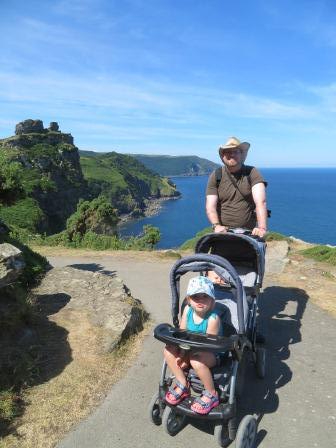
It’s not as though we didn’t cram the days with activities to wear them out. I’ll take one day as an example, the day of the above photo. It started at the Valley of the Rocks in the morning, where we did a 3-mile round trip along the cliff path, with me pushing the double buggy while carrying a heavy backpack loaded with water, milk, biscuits, nappies, wipes, suncream, hats, spare clothing, maps, plasters, painkillers, dolls, rattles, camera…

IMG_1768
My daddy, the hero.

…while my wife carried herself. We then went to Lynton and rode the railway down to Lynmouth, explored and ate ice-cream, and I took some beautiful pictures of the harbour.

DSCF4149
Pretty.

After riding back up again, we drove to Heddon Valley, where there’s a track to Heddon’s Mouth that’s ‘suitable for all-terrain pushchairs’.

IMG_1896
My arse.

After struggling a mile down a rough, rocky track with a double-buggy and heavy backpack, we made it to a pebble beach where my eldest threw stones into the sea while I fed the little one…

IMG_1904
All right, wait for it!

…and then I struggled the mile back UP the rough, rocky track with the double pushchair and the heavy backpack, now loaded with stones my wife thought looked pretty, while she continued to carry herself. And did I mention the temperature was 30-degrees-plus? I must have lost a gallon of sweat.

After a bite to eat, we headed back to the campsite and went for a swim, and then tried to put the children to bed.

Well, you already know how that one ended. At midnight. With me exhausted, dehydrated, and just about ready to undo the brakes and watch the caravan roll down the hill into the sea, kids, wife and all.

In fact, instead of improving my relationship with my wife, this holiday gave it a bloody battering. I don’t recall ever having bickered quite so much. Where’s this, where’s that, why did you do that, why can’t you ever…? Oh for goodness sake, for crying out loud, what the hell, oh come on, and on and on. As an illustration of how innocent I was, I packed a book to read and a DVD for my wife and I to watch one evening. Ha! Read a book? Watch a DVD? Are you freaking kidding me?

But at least it wasn’t just us. One night, I put the kids in the puschair and walked down the hill, and from inside every caravan I passed I heard a similar tale of woe – crying, screaming, bickering, shouting. I wonder if anybody enjoys going on holiday with young children.

I think it would have been easier if I’d realised, going in, that it would be full-on as a daddy and zero-on as a husband or even an individual. Perhaps when they’re a little older, things will be different, but at this age, holidays are all about the kids.

But don’t ever make the mistake of thinking this will make them happy, or grateful, or even pleasant to be around. It doesn’t matter if you’ve spent seven hours with them in the swimming pool, or taken them to the amusements to blow a fortune on 2p machines, or carried them strapped to your back or chest up and down mountains, or gone to an interesting castle only to spend the whole time in a playpark, or read to them a million stories – the next time they’re hungry, or hot, or tired, or just irritable, it will be your fault and they will make you pay.

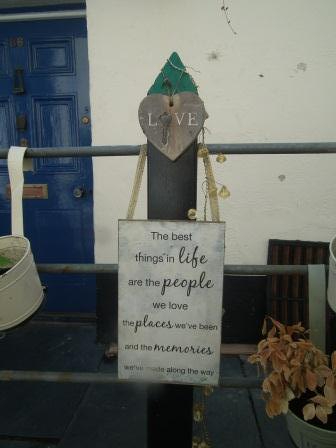
So why go on holiday? Why indeed. I mean, you’re still doing all the crap you do at home, only it’s far harder because the routine has gone out of the window and the kids are overstimulated so they’re harder to handle. But then, perhaps this sign I saw in Clovelly can explain it better than me:

DSCF4261
The best things in life are the people we love, the places we’ve been, and the memories we’ve made along the way.

And while changing a nappy is always changing a nappy, when you’re doing it in a place that looks like this…

DSCF4492

…it can’t be all bad, can it?

How to Discipline a Toddler, Part 2: The Fundamentals

Right from the get go, let me say that I’m not a professional, I’m not trained in child care, and despite living all day, every day with a toddler, I am by no means an expert. Nor am I a perfect dad – like every parent, there are days I find my little girl’s behaviour so exasperating I just want to throw her out the nearest window – without opening it (I don’t, just to be clear for all the social workers reading this!). I make mistakes, fail to follow my own advice, and can sometimes make a real mess of things – especially as most of my books are out of date.

That said, I do think I’m doing a pretty good job of raising a polite and conscientious – if spirited, wilful and independent – little girl, and it’s all down to discipline. For those who think that ‘discipline’ is synonymous with ‘punishment’ or ‘conformity’, it doesn’t mean suppressing her individuality or stifling her need to express herself – it simply means we have certain standards of behaviour we all need to follow in order to get along with one another, and teaching a child what these are from an early age makes life a lot easier. Nobody wants a child that bites, or hits other children, or thinks it’s fun to break all their toys. Discipline is how you prevent that.

So, in that spirit, let’s begin.

Boundaries

Whether you’re a strict parent or more laid back, every child needs boundaries, even simply as something to push against as they develop their personalities. It doesn’t matter if you have five house rules or fifty-five (although that does seems slightly excessive), as I mentioned in How to Discipline a Toddler, Part 1: Understanding your toddler, the basis of discipline is to be clear, calm and consistent. Your child needs to know where the boundaries are and what happens when they cross them, every time, no matter what day it is, where they are or who they’re with. And that takes thought and communication.

You need to decide what’s important and what the rules are, and you need to make sure your partner, parents and other care givers are on the same page. I’m not saying the grandparents have to follow the rules exactly – they’re meant to spoil the grandkids – but make sure everyone knows what’s expected. Otherwise, your child won’t know whether they’re coming or going, or worse they’ll play you off against each other because they know you’re inconsistent in your approach, and if you want problems in a relationship, that’s a great way of starting them.

For the most part, effective discipline is simply saying what you mean and meaning what you say. Don’t lie to a child to make things easier right now, because you’ll have to deal with the repercussions of that dishonesty later. Don’t negotiate or bargain, don’t beg or plead, and don’t get into arguments, because they’re a toddler and their stubbornness knows no bounds. And if you threaten something or promise something, you have to follow through with it. The moment you fail to be consistent, you’re sending mixed messages and starting down the slippery slope towards chaos.

If your child asks for something they know they’re not allowed to have, look them in the eye and calmly but firmly say no. And then disengage. You’ve already answered their request, so they need to know that all the subsequent shouting, whining and playing up isn’t going to get them what they want. And no matter how hard it is, stick to it.

Nobody wants to spend all day shouting at their kids and saying no, no, no all the time, but that’s something you see practically everywhere in public – supermarkets, beaches, fairgrounds, the swimming pool. Shouting parents, screaming children, locked in a battle of wills. It shouldn’t be a battle – you’re the adult and what you say goes. Sticking to consistent boundaries is how you achieve that.

Avoiding discipline

The best way of avoiding conflict is discipline, and the best discipline is avoiding having to discipline at all.

What the hell does that mean? Simple. The use of specific disciplinary techniques should be part of a wider strategy that encourages good behaviour, anticipates problems, and relies on punishment only when necessary.

I heard recently that the average toddler receives around 300 negative statements a day – don’t do that, stop, be quiet, put that down, you’re driving me insane – and only ten positive comments. I can well believe it.

Instead of constantly correcting your child and turning your lives into a misery, use the other tools in your repertoire. Toddlers are easily bored, but this also means they’re easily distracted. If your toddler is fiddling with something you don’t want her to fiddle with, pick her up and move her away from it. If she’s heading towards something you know she shouldn’t, distract her with something else. Involve her in what you’re doing. Ask her if she can help you find X, Y or Z. Tell her to shout out if she sees a red car. Make a game of everything. Channel that energy into something positive and tell her well done and very good, because that way you’re giving her attention and reinforcing good behaviour instead of focusing all your attention on the bad.

This last skill is very important. If you’re spending all your time engaging with your toddler when she’s naughty, then she has a reason to be naughty – even if she’s not getting what she wants, she’s getting you. This is especially true if you have a younger sibling in the house – the acting out is to bring your attention from the baby and onto them. So one technique is to ignore the bad behaviour if you can – don’t give it the oxygen it needs to breathe. This is really clear if your child picks up a swear word. Reacting to it only makes them say it more – ignore it and they stop using it. Knowing when to punish and when to ignore is a judgement call, but one that becomes easier with experience.

With experience you can also anticipate problems and head them off at the pass. I know my daughter is going to kick off when getting out of the bath, at bedtime and when leaving a friend’s house, so instead of dumping these things on her, I give her a five-minute warning to get her head round it, then a two-minute warning, and a one-minute warning. You’re an expert on your child so you know the flashpoints, and you have to adapt your behaviour accordingly.

Much of this is about planning. For example, most kids are at their worst when they’re hungry and when they’re tired, so make sure they’re properly fed and well rested. Don’t cram too much stimulation into one day or you’re setting yourself up for a fractious child. Also, be careful what you feed them – a sugary snack is a nice treat from time to time, so long as you’re prepared to scrape them off the ceiling afterwards as their blood sugar goes sky high, and then deal with the corresponding sugar crash when it drops again. With a little effort and a lot of creativity, you’ll find you’re winning in the behaviour wars.


Types of discipline

Of course, avoiding discipline only goes so far, and sometimes, whether it’s once a day or twenty, you have to go further.

According to Hoffman and Saltzstein (1967), disciplinary techniques can be divided into the following three types:

  1. Power assertion – physical punishment, removal of material possessions such as toys.
  2. Love withdrawal – paying no attention, showing no affection.
  3. Induction – letting the child know the effect their behaviour has on others.

As Feldman (1977) showed, a key difference between these types is that the first encourages good behaviour through fear of an external threat, whereas the second two encourage good behaviour through an internal sense of guilt. In the long term, children disciplined through love withdrawal and induction are far more likely to develop self control than those disciplined through power assertion, who come to depend upon the threat of external punishment to control their behaviour. Indeed, the more aggression a parent shows, the greater a child’s dependence on this external threat, whereas those disciplined in the other two ways learn to behave irrespective of any exterior influence.

In basic English, this means that shouting at your kids from time to time isn’t going to do them any harm, but if it’s your main means of controlling them, eventually the only way you’ll be able to make them behave is by shouting at them – which is going to cause everyone a great deal of aggro, especially if you’re in a restaurant. Furthermore, if you’re not looking or they think they can get away with it, they are less likely to behave because the behavioural controls haven’t been internalized – they’re only behaving because they’re afraid of being caught and punished.

On the other hand, a technique such as the naughty step (see Part 3: the Techniques), which combines both love withdrawal and induction, is a far more effective way of creating a child who will behave whether you’re watching or not. Instead of behaving because they’re afraid of punishment, the child behaves because they want to be loved and don’t want to hurt other people’s feelings – which, for my money, makes it a no-brainer which type of discipline to use.

However, studies have also suggested it is not necessarily the type or strictness of the disciplinary technique but its consistency that is the key to developing good behaviour. Furthermore, utilising a single technique tends to reduce its effectiveness over time, so the choice of what to use is up to you.

The process of punishment

When resorting to punishment, it is helpful to know how punishment works and thus what might work best for you and your family.

The process of punishment tends to go like this: the child commits an infraction, which destabilises the equilibrium; the child is punished, creating a rupture in their relationship with the parent; the child performs a restorative act that repairs the relationship; and the equilibrium is restored. An example would be that the child hits her sister; you put her on the naughty step; she says sorry; then you kiss and make up and the punishment is over.

The shorter the gap between the transgression, the punishment and the restorative act, the more strongly they are associated in the child’s mind and thus the more effective the technique. Therefore, the punishment should be performed right away – no ‘wait till your dad gets home.’

This is another reason that the naughty step technique is so effective – it requires the restorative act to complete, whereupon everyone’s happy and gets on with their day. With power assertion techniques, the punishment ends with the smack or the toy being confiscated, and it can be a long time before a restorative act is performed. This means that, rather than being a short, sharp punishment, something like smacking is a punishment that lasts far longer than the simple physical act.

I well remember being sent to my room as a child and waiting for my father to come up and administer my punishment. After being smacked, the relationship would remain tense and an uncomfortable atmosphere would linger in the house, making it a prolonged and deeply unpleasant experience all round. Effective use of the naughty step is a far more appropriate means of controlling bad behaviour without creating an unhappy household.

A special note on smacking

This leads me to my last section in this post: whether or not it is right to smack your children. While there are arguments for and against the moral issue of corporal punishment, most experts agree that it just isn’t very effective – certainly not as effective as the other techniques that are available.

Legally, smacking is very much a grey area. In England, for example, smacking is classed as common assault, but if done in the home, the parent is able to use the defence of ‘reasonable punishment’, provided it doesn’t cross the line into ABH, GBH or child cruelty. However, where common assault becomes ABH  – the injury must be more than ‘transient and trifling’ – is unclear, and there is no definition of what constitutes ‘reasonable’ punishment. Citizens Advice suggests that if the smack leaves any kind of mark – a bruise, for example – the parent is liable for prosecution and can have their kids taken away and placed into care. Whether you want to risk that is up to you.

As somebody who was smacked as a child, I can honestly say, ‘It never did me any harm.’ Yes, I remember being smacked so hard on the bottom when I was four, I literally couldn’t sit down for the rest of the day – but I had just bitten my brother, and I never bit him again. Smacking, in this instance at least, did its job.

On the other hand, I’ve never smacked my kids and I don’t intend to, for several reasons. Firstly, if you smack your children when you’re angry, then you are lashing out and taking out your annoyance on a toddler, which seems wrong on so many levels. Furthermore, if good discipline is all about consistency, how consistently can you smack when you’re angry? Anybody who has slammed a door can attest to being unable to accurately gauge force when angry, so really, if you smack a child when you’re angry, you have no idea how hard you’re hitting them.

I also have problems with smacking children after you’ve calmed down. While it’s true that the force you use can be more measured, if you’ve waited until you’re less riled up, the punishment comes way after the transgression. Furthermore, deliberately deciding to inflict pain upon your loved ones for their own good when you’re not angry with them doesn’t seem like a psychologically healthy long-term strategy.

And lastly, if you’re hitting children in order to teach them not to hit, what kind of a cock-eyed lesson is that?

‘Don’t (smack) hit (smack) people (smack).’

Hypocrisy, thy name is you.

Look out for How to Discipline A Toddler, Part 3: The Techniques