
As the title suggests, part two of my interview is now online.
Click here to access it.
Gillan
Hey Aspie Daddy fans,
I recently did an interview for a site called Learn From Autistics about living with a late diagnosis of autism. It is the first of a two-part series.
Click here to see it and thanks for reading!
Gillan
Oh my gosh, my daughter is driving me insane. Now nearing three-and-a-half, she has reached the stage where imaginative play is pretty much the only thing she wants to do, and my life has consequently devolved into an endless game of mummies and babies, doctors and nurses, car journeys, shopping trips, picnics and tea parties, and I honestly don’t know how much more I can take.
I don’t mind playing with her. I like building towers out of wooden blocks and playing with her toy trains. I like sword-fighting with her and doing flash cards and making up songs. It’s the pretending games I can’t stand.
When I spend all day and much of the night looking after a real baby, I have little interest in looking after a plastic one. When the only thing I do that isn’t looking after a baby is driving to the shops to go food shopping, it’s a real struggle to get motivated about driving an imaginary car to an imaginary supermarket to buy imaginary items with imaginary money. And I have no idea how many cups of air I’ve drunk, or wooden finger cakes I’ve scoffed, but if they were real I’d bankrupt the NHS with my soaring blood sugar and endless bladder problems.
Ironically, the easiest one to bear is being a patient in hospital.
‘Daddy, please can you play doctors with me?’
‘Do I have to do anything other than lie on the sofa?’
‘No. You got a dinosaur in your tummy and I got to cut it out and make you better.’
‘Fine, knock yourself out. I’ll just close my eyes for a minute…’
At the other end of the scale, the hardest is when she decides the four square feet between the back of the armchair and the wall is her house, and I’m her neighbour, who lives in the main part of the lounge, because she always invites me over for dance parties where I’m expected to shake my booty.
‘How about you come over to my house, where there’s much more room?’
‘Coz it’s my party in my house.’
‘But why don’t we pretend this much bigger space is your house?’
‘Because this is my house and you need to be dancing!’
So I squeeze myself in and simply shift my weight from foot to foot, because that’s all I can do. You want to know where I get my ‘dad dancing’ from? It’s here. This. Especially when it’s to Justin freaking Fletcher. (Although to be fair, his version of ‘What does the Fox say?’ isn’t the worst song I’ve ever heard, even if my daughter sings it as, ‘Why does the fuck’s sake!’)
And she gets so into her games that anybody not buying into her reality gets short shrift.
‘The drawbridge is closed, you can’t come through here!’
‘But my coffee’s on the windowsill.’
‘You can’t come in.’
‘Well, I am because I’m going to get my coffee.’
‘No, you can’t come in, no, NO!’ Cue screaming, shouting, crying, trying to block me, holding onto my ankle as I drag her behind me across the lounge (‘You’re in the moat! You’re in the moat!’) to get my gosh-darned drink. It’s excruciating and it never seems to end.
Now, I imagine many parents have this problem, but for once I’m going to play the autism card and say, ‘I just can’t do it, and it’s because of my autism.’
I have NEVER got imaginative play, even when I was young enough to enjoy it. Actually, that’s not entirely accurate. I understood my own play – it was other people’s imaginative play I couldn’t get.
I’d treat my own toys as though they had thoughts and feelings. I once dragged my mother all the way back to playschool because I left my imaginary pet rabbit there. But give the same suspension of disbelief to other people’s toys and games? I didn’t have the ability.
That’s why at nursery, I’d wander straight through the middle of the farmyard the other kids had set up and not understand why they were now angry and upset – they were just pieces of plastic. That’s why I had no problem breaking my brother’s toys – they had no feelings, although he clearly did, and I’d invariably feel bad (and confused) a moment afterwards when I saw his tears. I was simply unable to appreciate that others could have the same emotional attachment to their toys and games as I did to mine – a fundamental inability to understand how other people think and feel.
And that’s why I’m struggling so much right now. I just don’t get that my daughter is investing her emotions into an imaginative reality.
However, while I might not get it, I can understand it at an intellectual level and adjust my behaviour accordingly. I know that imaginative play is important in child development, and I know that for the benefit of her emotional wellbeing, not to mention our relationship, I have to pretend that the things that are important to her are also important to me. So that’s what I do, as painful as it is.
The best way of surviving it? Biblical levels of sarcasm that she’s too young to understand.
‘What’s that? You want me to keep my voice down so I don’t wake your baby? Gosh, I wish she was just a cheap piece of hardened petrochemically-derived organic polymers, but since she’s clearly a real baby, then okay, honey, I’ll be quiet.’
‘What? Your baby has a poorly knee? Oh poor her, what an absolute tragedy. I’d better drop everything and see to it right away because it’s definitely so much more important than anything I was doing.’
‘I can’t come through here because it’s on fire? Well, let me check what’s on my utility belt, shall I? Wow, what do you know? I just so happen to have a fireproof suit I can put on. Holy asbestosis, Batman! Now get out of my way.’
Of course, if she learns to detect disingenuousness before she grows out of this imaginative phase, I don’t know what the hell I’m going to do!
My little (neurotypical) daughter is now three, and by January we have to select her schools. I had thought that this would be easy – have a look at them, decide which is best, and apply – but what I hadn’t counted on was how much my own experiences of school would colour my thinking, or how this process would stir up all the unpleasant emotional and psychological shit that has lain buried inside me for twenty years.
There are two schools in particular that we’re looking at, one small and with more of a personal focus, the other big and more academic. Both of them fill me with dread.
At the big, academic school there’ll be plenty of kids for my daughter to make friends with, but the environment is less supportive. In the small school, she’ll be better looked after, but if the other kids turn on her and she’s the one who’s the outsider then there’ll be nowhere to hide.
In all honesty, I don’t care about the academic standing of either – I care about my daughter’s happiness and emotional wellbeing, and the damage that can be caused by making the wrong decision.
As you’ve probably inferred by now, I hated school. I found the other children silly and immature. I couldn’t relate to them or their games. I preferred hanging around with the teachers and the dinner ladies. Sometimes I took teddy bears to school and played with them instead because they were easier to understand. That’s when I wasn’t collecting insects or classifying all the trees, or crying all the time at the slightest provocation.
When I was seven we moved house and I changed schools. I decided that I didn’t want to be known as a crybaby, so every time I got upset I forced the feelings inwards. I hated sitting with the other kids in lessons, preferring a seat by myself while all the rest were chatting and playing. At breaktimes I’d join in with the games, but mostly I’d keep up a stream of narration, pretending I was a commentator observing the people around me. Always separate, even when I was part of the whole.
I always preferred my own company. If it was a wet break I could stay in and draw a picture or read a book – infinitely better than mixing with others. People made fun of me for my interests and good behaviour and excellence at schoolwork, laughed at my complete lack of sporting prowess. I had spiky hair, goofy tooth, and massive plastic glasses. Whenever somebody called me names or wouldn’t let me play with them or tried to force me into being naughty, I inwardly wept.
Being told off by the teachers – normally for things that other people had done and blamed on me – was an indignity I dwelt on for days. That was when I wasn’t correcting their spelling, pointing out mistakes in the maths textbooks, or telling them every intimate detail of my life.
Every morning I’d tell my mum I had a funny feeling in my tummy, and every morning she’d say, ‘Just go and see how you feel. If it gets worse they can always ring me to come and pick you up.’ But of course, they never did.
I always knew that I was different. I was constantly moody, constantly confused and just wanted to be left alone. But none of that really bothered me until I was ten, when I started to want friends but realised I was unable to have them.
My brother always seemed to have it easier. He just drifted through school without any struggles. He could make friends with anybody, and normally did. He was always out on his bike, off to the cinema, heading to parties. Sometimes my parents made him take me along, something he hated only slightly more than I did – I had my pride.
I often asked when I would have friends like my brother did. ‘When you get to secondary school,’ my mum used to say. ‘You’ll make plenty of friends there.’
My father was less optimistic. He constantly stressed how I needed to learn how to get on with people or else I wouldn’t cope with life. I think they were terrified that I was different and desperate for me to be normal. They started sending me to Christian boys’ camps in the summer, hoping I would build my character and somehow learn to socialise. They were abject lessons in just how incapable I was of functioning in a group of my peers. I came home from them bruised and scarred and even more aware of my utter ineptitude.
It was when I started secondary school at age 12, an institution of 1500 kids that taught you your only value was in your grades, that everything went to hell. Lessons were bad but survivable – people would steal my pencil case, snap my rulers, stab me with compass needles and squirt ink on my shirt, but there was never a shortage of people wanting to sit by me so they could copy. It was the breaktimes that broke me down.
I hung around with people I’d been to middle school with – people who hadn’t actually liked me for the past few years and now, to impress their new friends, showed off their disdain at every opportunity. I was the guy to push, the guy to throw things at, the guy to trip up in the mud; I was the guy to call names, to run away and hide from, to spread rumours about and laugh at. I wasn’t handsome or cool or popular – I was what they called a ‘gorm’, short for ‘gormless’ – a nerdy, geeky swot, teacher’s pet, loser. Sometimes they’d take turns spitting on me – thick, snotty loogies on my bag, on my back, even in my face.
If ever I stood up for myself, which was rare, I’d make threats I had no possibility of following through with. They’d simply threaten to beat the crap out of me, so I did nothing, and let my pride, my dignity and my self-esteem sink into the earth beneath my feet, where I wished I could curl up and die. Looking back, I’d have preferred them to beat me – those wounds heal. The wounds they gave me can last a lifetime.
Those twenty minutes a day killed me.
Luckily, we lived opposite the back gate of the school so I was able to go home for lunch. That was my lifeline. Without it, I don’t know how I’d have survived. I sat by myself, ate some lunch, recharged my batteries to face the afternoon. And, most importantly, I didn’t have to mix with anybody else.
I put up with this crap for a year. One whole year. Until, one week before the school year ended, I started hanging around with a boy that I will call Judas.
I don’t know how it came about that we hung out together. We sat next to one another in most of our classes, and I thought he was pretty darned awesome. He was intelligent, like me, but he was also sporty, which made him well-liked. For whatever reason, we hung out together at morning break, and then the next day. The following day, I even stayed at school for lunch, and the next, before we broke up for the summer holidays. For four days I had a friend.
My God, I was happy. If this was what it meant to have a friend, then I now knew everything I’d been missing out on, and everything that everyone else seemed to have. In the rain-drenched misery among the bullies at boys’ camp, I looked forward to the new term, not with horror and apprehension, but with a sense of anticipation, because now I had a friend!
The first day back at school, Monday morning, second period – art. I sat next to Judas like the cat that got the cream. I was so excited to catch up, so excited for the future. It felt so good to be normal.
When the bell went for morning break, I almost burst with excitement. He turned to me and said, ‘See you after break,’ and walked out of the room.
I thought it was a joke. I followed him at a distance, and when he stepped outside I jumped out at him.
‘Ha ha, surprised you!’
He glared at me. ‘I said I’d see you after break.’
‘Yeah, funny,’ I said, still thinking it was some kind of joke I just didn’t understand.
He stopped walking. ‘No, I’m serious, Gillan,’ he said. ‘Just piss off. I’ve got some new friends now.’
And he walked on.
I followed him again, unsure just what was happening. He walked up to a group of lads – football lads. He’d made new friends over the holidays and they didn’t include me.
I don’t think I have ever felt so alone.
Near where they stood were my old ‘friends’. I wouldn’t go back to them, no way. I was desperate, but not that desperate.
I saw a kid I’d known at middle school – Lucifer, we’ll call him – with a group of kids I didn’t know, and decided I’d try to hang with him, just for today, just so I wouldn’t have to be alone. In truth, he was a bully and had been the scourge of the middle school, but he’d always gone easy on me, possibly because there was no fun in beating on the developmentally disabled kid, albeit undiagnosed, and possibly because the one time he’d tried to put me in a headlock, I’d panicked and in a flurry of punches knocked him on his ass.
Anyway, Lucifer and his friends were all eating slices of pizza from the cafeteria. I was caught in the midst of despair, and not having a clue about how to approach people, I simply walked straight up to him and said, ‘Lucifer, can I have some of your pizza?’
He reacted as though I’d asked to sleep with his sister. I’ve never seen a face show such disdain. With an evil, mocking sneer, he hissed, ‘You fucking skank,’ and with a wall of expletives he ripped a chunk off his pizza and threw it in my face. His friends laughed, and some smiling, some sneering, ripped pieces off their pizzas and threw them at me too, shouting and swearing and laughing.
Everybody turned to look – my old friends, Judas and his new friends – everyone.
I did what I’d sworn not to – I cried. But I hid it well. Holding my head up high, I turned and strolled away from the mockery, bits of tomato sauce on my cheeks, pretending I wasn’t humiliated and utterly heartbroken. I headed for the nearest toilets and cried my eyes out. (Years after this, whenever this group saw me they’d throw things at me and call me a skank. Once when I was 17 they came upon me in the street, shoulder-barged me into the road and threw cigarette lighters at me).
After break, I went back to art and Judas sat down next to me as though nothing had happened. ‘Why can’t I hang around with you at break?’ I asked.
‘You wouldn’t fit in,’ he said. ‘They wouldn’t like you.’
And that was that.
The rest of the week, I hid in the toilets, hid in the bushes – I didn’t want people to see that I was entirely on my own. One day I even tried to join the group regardless of Judas’s warnings. They couldn’t physically push me out, could they? It turned out that they could. After being frogmarched across the playground, I decided not to repeat that indignity.
It was with a heavy heart, leaden legs, that the following week I walked up to my old ‘friends’ at breaktime. ‘Oh, you’re back,’ they said. And things resumed as though I’d never been away. Because being bullied was better than hiding in the toilets.
About ten months later, the school decided to build a new block and new playground. Because of all the builders on site, it was thought prudent, for health and safety reasons, to shrink lunchtime from one hour to just 25-minutes. As a result, they revoked all the lunch passes. My 20-minutes of hell each day was going to be 45.
Unable to cope with being bullied 3 hours and 45 minutes each week, I spied on the other friendship groups, found one I thought I might be able to join – a mixed group, some of whom were in my classes – and after a week trying to build up the courage, I approached one of the members and asked if I could hang out with him and his friends at breaktime.
‘Sure, whatever, I don’t care,’ he said, and I was in.
Things didn’t go exactly to plan. I was so desperate to fit in, so terrified of being rejected, that I lost the ability to speak. It was weeks before I managed to say a single word. I stood at a slight remove from them, waiting my chance. Every time I opened my mouth to speak, this little voice in my head screamed, ‘DON’T SAY THAT THEY’LL THINK YOU’RE WEIRD!’ and I clamped my lips together. Sometimes I managed to think up something decent, but by the time I worked up the courage to voice it, the conversation had moved on and it was already too late. So I stood, in silence, like the number one buzzkill, so afraid they wouldn’t like me that I guaranteed they wouldn’t – the dictionary definition of a self-fulfilling prophecy.
Within the first week I realised it wasn’t going to work. While not as bad as my old ‘friends’, my new ‘friends’ didn’t exactly make me feel welcome. One told me to my face, repeatedly, that she hated me because I was so weird and she wanted me to go away. One used to stuff her rubbish in my shirt pocket as though I was a dustbin. They loved telling me I wasn’t actually part of ‘their group’. I was the butt of every joke. I smiled, as though I was in on it, when in fact I knew they were mercilessly mocking me.
I knew from the start that it wasn’t going to work. I hung around with them for a year and a half. Breaktime and lunch. Forty-five minutes a day. Because I had no one else.
You don’t have to be a psychiatrist to know what that kind of thing does to a person. My self-esteem, self-identity, my confidence – my very value as a human being – they all went away. It got to the point where I was too afraid to put up my hand in class, even though I knew the answer, because people would look at me and I couldn’t bear their judgement. Looking back, I’m surprised I didn’t become a statistic, if you catch my meaning.
And throughout this time, Judas still sat next to me in every class we had together, and listened sympathetically as I told him of my loneliness, and made all the right sounds and facial expressions when I told him I was being bullied, and watched as I shrank into a shell of my former self, and he did nothing. Except, that is, on the days when I couldn’t face them and so wandered about alone – he’d always be sure to tell me he’d seen me wandering around on my own, and that if he’d noticed I was being a loner then other people would too, and perhaps I’d better go back and hang out with the bullies again. Because, evidently, it’s better to be bullied than have no ‘friends’.
I asked him repeatedly if I could hang out with him at breaktime. I begged – I told him I wouldn’t even have to say anything, I’d just stand there so I didn’t have to be alone. His answer was always the same. ‘You wouldn’t fit in.’ For a year and a half.
What hurt the most was that he was my best friend in the classroom. He was my lab partner, my vocab buddy. Every project we’d do together, every history assignment, every book report. Art, music, craft, IT. But other than those four days in our first year, outside of the classroom he wanted nothing to do with me.
I loved that guy for three-and-a-half years, right up to the moment I realised that I hated him far more than any of the bullies, and stopped sitting next to him in class. He never spoke to me again, even though we went to the same VI Form. I was amazed by how quickly and easily I was replaced, though it should have come as no surprise. I clearly meant nothing to him.
About the same time, I decided I couldn’t go on anymore as I had. I spent the last six months of my time at that school hanging out with the band geeks who congregated on the benches at breaktime with their inhalers and head braces and vocal jazz stylings. I didn’t particularly like them, but it was all about survival by this point, and they weren’t really in a position to bully anyone. Luckily, by this time, the block was built and I could go home for lunch again, because all of them had orchestra, and music lessons and choir practice at lunch.
And so I survived, in body if not in mind. I left school, and I buried these experiences and haven’t spoken to anybody about them for twenty years now. I wonder if all the tattoos and piercings I got in my late teens, and all the challenges I undertook in my early twenties – rock climbing, bungee jumping, parachute jumping, scuba diving, tall ship sailing, backpacking – were a way of trying to work through all that anguish and self-hatred. To punish myself and see if I really mattered.
I thought I’d got over. Thought it was left in the past. Until I’ve had to start looking at schools for my little girl. And I realise I’m not over it at all.
I can think of my best friend telling a thirteen-year-old me to piss off because he’s found new friends, and it still hurts. I can think of reaching out to another for help in my lowest moment, only to have him literally throw it back in my face, and I still cringe at the way he looked at me. And worse, I can think of repeatedly begging a friend to save me from my bullies only to have him refuse because I ‘wouldn’t fit in’, but instead of the despair I felt at the time, now I feel only anger.
I never dealt with any of these feelings. I live my life looking forward, not back. What’s in the past no longer has the power to hurt you – or so I thought.
So perhaps you’ll understand why I don’t care about the league tables my mother-in-law sends me, and why I don’t care about the Ofsted reports, and why I don’t care if every one of the school’s pupils fails their SATs. The only thing I care about is if my daughter will be happy at school. Because if she’s not, all the league tables and Ofsted reports in the world couldn’t make me send her there.
Welcome to Aspie Daddy, the website of Gillan Drew, author of An Adult With An Autism Diagnosis: A Guide for the Newly Diagnosed. Here I blog about autism, parenting, writing and surviving domestic abuse.
I was diagnosed with autism at 28 and have two adorable neurotypical children who I don’t get to see nearly as often as I’d like.
If you have any suggestions for posts or want to ask me my opinion on literally anything, leave a comment below and I’ll do my best to respond.
Thanks for dropping by.
Gillan
When I was just a little girl,
I asked my daddy, what will I be?
Will I be pretty?
Will I be rich?
Here's what he said to me:
Oh my God, will you give it a rest, you are the neediest kid, stop it with all the gosh-darned questions, can you just give me five minutes to myself, you’re driving me insane, I feel like I’m taking crazy pills, and leave your sister alone, no I can see you doing it, get off her, GET OFF HER, she’s not a toy, just be quiet and sit still, no sit still, do you want me to take you into the woods and leave you there, go in your playroom I can’t take it anymore, no there are no dinosaurs in your playroom, no there are no dinosaurs anymore, no there aren’t, okay fine there are dinosaurs but there are no dinosaurs around here, no it’s too cold this far north, they’ve all gone south for the winter, so go away and leave me alone, and stop saying what, stop saying WHAT, right that’s it, say what again, SAY WHAT AGAIN, I dare you, I double dare you, say what again, no, no I was quoting a movie, no I don’t want you to say what again, I don’t want you to say what, oh my gosh my brain is melting, how about I put on Topsy and Tim, okay you can watch Topsy and Tim but only if you promise to stop saying what and give me a break, you promise, okay great, which episode, we’ve got fifty episodes why do you always want that one, you’ve seen it a hundred times, okay whatever watch it then, are you watching it, why aren’t you watching it, well this is the one you wanted, oh for crying out loud, leave your sister alone, no you can’t have an ice-lolly, no you can’t, stop crying, it’s five minutes to teatime, stop crying, no I’m not mean, just because I said you couldn’t have an ice-lolly, come on cheer up, be happy, leave your sister alone, no don’t you dare start singing that song, if you start singing that song I’ll, baby shark doo doo do do do do, baby shark doo doo do do do do, no it’s stuck in my head now, how many hours till your bedtime, three, THREE, oh my God how am I going to manage it, mummy, mummy can you come and look after your little princess, uh huh yeah I’m sure it’s really important but I’m trying to serve up dinner, yeah she keeps saying what again, what, yeah three hours till bedtime, no I don’t know how we’re going to make it either, que sera sera.
When people talk about millennials, they can’t fail to bring up two things: their addiction to social media and their overinflated sense of entitlement. In the three years since becoming a father, I’ve discovered that when you add motherhood into the mix, an addiction to social media and an overinflated sense of entitlement combine to create a perfect storm that threatens the very future of society. Hyperbole? Perhaps. But this post is a request, nay, a demand that certain people grow the hell up before they suck all the joy out of one of life’s genuine grown-up pleasures: adult friendship.
Now I’m not saying that all millennial mothers need to get in touch with their ‘inner adult’, and I’m not even sure it is restricted to the ‘gentler’ sex – since I have no friends of the masculine variety in the millennial generation, I’m lacking data to make a comparative analysis – but it happens often enough for it to be an issue. It might even have nothing to do with motherhood – perhaps there are significant numbers of women who act like they belong in a school playground even without having procreated – but golly gosh it needs to stop.
What am I talking about? Well, it’s probably best to begin by explaining how I, an autistic male born in the 1970s, understands friendship. To me, friendship is a one-to-one relationship with an individual that rests upon shared enjoyment of certain activities, backed up by compassion and understanding. If Person A invites me to the cinema with Person B, and then another time Persons A and B go to the cinema together without me, who cares? My friendship with Person A has no bearing on their friendship with Person B, or C, or D for that matter.
What if I’m also friends with Person B and want to invite them out for a coffee? That’s no problem either. I don’t have to check with Person A if that’s okay because I haven’t needed to ask anyone’s permission since I first grew facial hair – I can be friends with whoever I want. Sometimes all three of us will meet up, sometimes just two. You meet up if and when you want to and if you don’t, you don’t. You demand nothing and expect nothing. An invitation to a social encounter is a privilege, not a right. That’s what I understand of friendship.
Among the millennial mothers who have befriended my millennial wife, however, friendship seems to work in a completely different way. It’s like they’re all married, or something. Whether they’re friends from NCT, friends from mother-toddler groups, old school friends, it goes like this:
My wife and Mother A bump into one another while out with the kids and spontaneously decide to have a coffee. Afterwards, Mother A posts this on social media. Mutual friend Mother B, seeing this, then sends both Mother A and my wife a snotty text-message demanding to know why she wasn’t invited, and saying how hurt she is to have been excluded. This leaves my wife and Mother A feeling awkward and guilty about doing something completely normal. So they apologise and arrange to meet up with Mother B and her kids.
They do this and share it on social media, whereupon Mother C, who is friends with my wife and Mother B, then sends them both a snotty text-message demanding to know why she wasn’t invited, and saying how hurt she is to have been excluded, especially when she’s known you so much longer than Mother A. So my wife and Mother B then feel awkward and guilty and arrange to do something with Mother C and the kids without Mother A.
So they do it, and what do you know? They share it on social media, and now Mother A is wondering why she wasn’t invited and then texts both my wife and Mother B a snotty text-message demanding to know why she wasn’t invited, and saying how hurt she is to have been excluded, and so on and so forth.
You think I’m exaggerating? I’ve had three years of it. The politics of millennial mother friendship is more complicated than the frickin’ Cold War. The number of times I’ve had to listen to this prattle, advise my wife on what to write in a text message, tell her to stop obsessing over what someone’s put on Facebook, I’ve wasted weeks!
Had a good time without me, did you? I’m really upset. I was free that afternoon. I could have done with some time-out. I feel like I’m the one always making the effort. I thought we were friends? You’ve made me feel like shit.
Can you imagine the massive sense of entitlement a person must feel to think that not only are their friends obligated to invite them to any and all social encounters, but they should challenge them if they don’t? I can understand you might be a bit upset if it seems your friends prefer each other to you, but how can any rational, grounded person possibly send a message that pretty much reads, ‘How dare you not invite me?!’ I mean, how big must your ego be to make a statement like that?
I’m hoping this is all the result of hormones and the pressures and strains of parenting – I know first-hand how staying at home with little people can drive you completely insane – because if it’s not, then there’s a hell of a lot of people out there who think friendship comes with chains, with guilt-trips and emotional blackmail to boot. It’s like primary school – ‘You can’t be friends with her!’
So here’s what I’d like to say to all the millennial mothers out there who don’t understand that friendship is voluntary and not an obligation: Grow the hell up! Or at the very least, stop sharing all your comings and goings on social media, because I seriously can’t cope with another three years of this shit.
Just had my own Anchorman: The Legend of Ron Burgundy moment with my three-year-old. Luckily, I caught the whole thing on video, so what follows is a transcript of a real conversation with a toddler.
Izzie: I want something to eat.
Me: No.
Izzie: I want something to eaaaaaaattttt!
Me: No. There’s no way you can still be hungry. Why do you want to eat?
Izzie: Because… [no answer]
Me: You’ve just spent all afternoon eating.
Izzie: Um, I want to eat…I want to get fat like you.
Me: [silence]
Izzie: I want to get fat like you, daddy.
Me: That’s really hurtful. Is daddy fat?
Izzie: Yes.
Me: Is daddy bald too?
Izzie: Yes.
Me: Is daddy a great big loser at life?
Izzie: Yes.
Me: Thanks so much.
Izzie: I have something to eat?
Me: No. Look, come here, sit down. I want to have a talk with you. Do you really think I’m fat?
Izzie: Yeah.
Me: Is mummy fat?
Izzie: Yeah.
Me: Who else is fat?
Izzie: Rosie [her baby sister]
Me: What about you?
Izzie: I am fat.
Me: Gramps?
Izzie: Yeah.
Me: Granny?
Izzie: Yeah.
Me: But they’re thin and you’re definitely not fat.
Izzie: Yeah.
Me: So what do you think ‘fat’ means?
Izzie: Brick.
Me: Brick!?
Izzie: Yeah.
Me: Fat means brick?
Izzie: Yeah.
Me: What does ‘brick’ mean?
Izzie: Brick means beads.
Me: Brick means beads? What does ‘beads’ mean?
Izzie: Chair.
Me: [pause] Are you just saying things you can see?
Izzie: Table.
Me: What does ‘fat’ mean?
Izzie: Err… [no answer]
Me: Do you know what ‘fat’ means?
My wife: What do you think it means, Izzie?
Izzie: Wall.
Me: Do you really think that’s what it means or are you still just saying things you can see?
Izzie: Wall.
Me: I love lamp.
Izzie: Wharf.
Me: Wharf?
Izzie: Yeah.
Me: You said daddy was fat.
Izzie: Yeah.
Me: But you don’t know what it means, do you?
Izzie: I do!
Me: So what does it mean?
Izzie: Fort.
Me: Fort?
Izzie: Yeah.
Me: So what does ‘fort’ mean?
Izzie: Fort means eeurgh! Yuk!
Me: [chuckling] You are such a freakazoid.
Izzie: I have a bath now?
Me: Sure, go and have a bath. But sweetheart, don’t call people fat, okay? It’s not nice. Okay?
Izzie: Okay.
Me: Okay.
Later, I tried to explain to her what ‘fat’ meant, and you know what? It’s an awful lot harder than you realise. I told her that when you eat too much you can become very big, but she thought that was a great idea.
‘No,’ I said, ‘You don’t want to be big.’
‘But I a big girl!’
‘Yes, you’re a big girl, but tall and grown-up big, not fat-big. Fat-big is when you’re big sideways. Look, see daddy’s big belly. When it’s big like this, it’s fat, okay? And when your arms are big, and they hang down, that’s…well, that could be because you’re old, and…you know what? Yeah. Sod it. Fat means brick. Fat means wall. If you’re built like a house, that’s what fat means.’
She was right all along…
[And in case you haven’t seen the movie, here’s the Brick Tamland scene where he loves lamp.]
Parenting a three-year-old and a ten-month-old is, by itself, far outside the norm – I mean, how often do non-parents have to explain over the breakfast table that a noo-noo doesn’t spontaneously turn into a willy on your fourth birthday? – but some days are weirder than others. Last Monday, for example: what started as Parenthood quickly descended into Twin Peaks territory…and not the recent disappointing reboot.
After a long day at Peppa Pig World – and if you’ve ever been to Peppa Pig World, you’ll know just how long a day that can be – I cooked some dinner and then tried to get my youngest, Rosie, down to bed. Three-and-a-half hours later, my wife, who has no religious leanings whatsoever, stormed into the nursery, informed me that our daughter is demon-possessed, and demanded I remove her from the house/exorcise her (depending on my mood) since the incessant screaming was driving her mad. This I duly did, strapping her into the car seat and heading off into the vast emptiness of the New Forest.
That’s when things got strange.
It was down a dark, narrow road in the middle of nowhere, the trees meeting overhead and obscuring the stars, that out of the corner of my eye I suddenly caught a glimpse of a round face, big black eyes, brown feathers flecked with black, and – CRACK! – an owl flew smack into my windscreen, with a report like a gunshot going off.
My heart thumping against my ribs, I drove on a quarter of a mile, found somewhere to turn around and drove back to where my headlights illuminated a large brown form lying sprawled across the road like an old burlap sack. Clearly a tawny owl, clearly not moving. The speed at which I’d hit it – 35mph or so – didn’t bode well. Crap, I thought – what are the superstitions about owls? What happens if you kill one? Have I opened a door into the underworld, or something?
I considered my options. I had neither my phone nor my wallet with me, and no torch either. At the very least, if it was dead I could move it off the road; if somehow still alive, I could take it to the local owl sanctuary, though I doubted there’d be anyone there at this time of night. In any event, I had to do something.
I climbed out onto the pitch-dark roadside, and in that moment a deer leapt out of the bushes and landed on the road beside me. I don’t know which of us was more startled, but the deer looked at me, freaked, and threw itself back into the bushes, crashing away through the undergrowth into the night. By this point, I was thoroughly unnerved, but I had to check on the fallen owl.
When I turned back to it, the dead owl was now standing in the middle of the road, staring right at me, its big black eyes shining like obsidian in my headlights. It was only a few feet away and the forest had gone unnaturally quiet. It was horribly eerie, like I’d awakened whatever demonic soul inhabited its avian body.
Nonetheless, I held out my hands and spoke to it in a soft voice. ‘It’s okay, I’m a friend, I just need to check that you’re okay.’
I took a step towards it and it took a step away. I took another step; so did it. And then it skipped, spread its wings and flew into the air. I felt a rush of relief as I watched it go, relief that turned to horror as it shot over the top of my car and then – SMACK! – it flew right into a tree.
As it crashed down through the leaves, making one hell of a ruckus, it managed to grab hold of a branch and ended up hanging upside-down, its wings held out to the sides like something you’d see crouching on a cathedral. Worse, it was now directly above a stream that ran under the road, and if it fell it would surely drown.
But still it stared at me.
It was further from the car, directly to the side so outside the arc of my headlights, but I could just about make it out in the dark. I felt incredible responsibility for this creature, this fellow traveller that I had collided with on life’s highway – literally. There was a steep bank down into the water, overgrown with nettles and thorns, and I thought if it fell I would have to leap into the stream to rescue it.
But then I thought of the baby still refusing to sleep in the back of the car. I thought of the darkness all around, and of the stream that slid silent and black through the Stygian gloom. I had no idea how deep it was, or if getting in I’d even be able to get out. If the owl, in its panic or its malice, would claw me with its talons and tear at me with its beak. If my car would be found in the morning at the roadside, empty, no trace of any of us – just the dusty outline of an owl upon the windscreen.
Such are the thoughts that come to you deep in a forest late at night.
I tried to shoo it away, clapped my hands at it, just to get it to a safer place – it simply stared at me. It let go with one foot, stretched out its leg, flexed its toes, then swapped over, but refused to move. And just. Kept. Staring.
Eventually, I decided there was nothing more I could do. I bid the owl farewell, got back in the car and drove on. But a couple of minutes down the road, I felt an irresistible urge to turn back – I had to see this through to the end.
When I got to the tree, the branch was empty and my heart dropped. I checked the stream but couldn’t see anything. The unknown swirled around me. In the less than five minutes I’d been gone, something had happened. Whether it had burst forth to new life, or fallen into death, I couldn’t know.
I was about to leave when there was a sudden rustle above my head, and looking up I found myself staring into those same black eyes. It was higher in the same tree, on top of a branch now, its wings tucked neatly away as its eyes bored into mine.
We watched each other several moments, the aggressor and the aggrieved, with something like mutual respect – for a short time, though being of different species, our fates had become entangled and we had shared a connection that transcended the limitations of our bodies. I saluted the owl, and I could swear that he nodded at me in return. Our time together was at an end.
And what was more, the baby had finally fallen asleep. I turned for home.
I spent the next ten minutes carefully making my way past ponies and cows and foxes in the forest, my nerves on edge as the darkness pressed in around me. I only had to get home. It was barely a few miles away. I was safe.
But safety is an illusion. Out of the corner of my eye I saw movement, and slamming on my brakes I caught a glimpse of a round face, big black eyes, brown feathers with black trim and – WHOOSH! – a great big tawny owl flew right across my windscreen. I must have missed it by a foot.
It couldn’t have been the same owl. Couldn’t have been. But my nerves now shot to pieces, I crawled home, hoping beyond hope I didn’t hit anything else.
Maybe it cursed me. Maybe some supernatural power in the depths of its being decided that I should suffer. For worse was yet to come.
I got home, put the baby to bed, and crept into the bedroom. There was my wife lying fast asleep in bed, a thin sheet draped over the curves of her naked form. I wanted nothing more than the peace of climbing into bed beside her and cuddling away the nightmare of the forest.
Slowly, carefully, I eased myself onto the memory foam mattress and – CRACK! – my knee snapped one of the wooden slats clean in half!
‘What the hell did you just do?’ my wife cried, jerking awake. ‘You’ve broken the bed, you’ve broken it! You’re too fat, you’ve broken the bloody bed!’
What I wouldn’t have given to be back out in the forest with that owl…
A holiday to North Devon in a heatwave. What could be better? I imagined it as an opportunity to reconnect with my wife to the backdrop of glorious sunsets and a soundtrack of tinkling wine glasses. Something like this, in fact:

Alas, that’s not us. That’s some random childless couple we found while driving around at 21.45 trying to get the kids to fall asleep (without much success, I hasten to add).
The reality of holidaying with children couldn’t be further from the above image. I know that sounds kind of obvious, but my God, I had no idea the true horror of spending seven days in a static caravan with a nine-month old, a three-year old, and a wife. Dante’s Inferno is nothing next to this.
It’s not just the whining and the crying, the constant distraction, having to watch this one nearly drowning in the pool while wiping the other one’s nose, remembering to apply the suncream, saying no to the third ice-cream of the day and enduring the tantrum, taking this one to the toilet after that one has just pissed all over your lap – it’s the fact that the sun doesn’t set until half-nine, the van is like a furnace inside, and they don’t go to bed until midnight even if you start trying at six. Far from reconnecting with my wife, there was no time to do ANYTHING without the kids. And I mean anything.
I haven’t had a pee or poop for a week without an attentive audience.
It’s not as though we didn’t cram the days with activities to wear them out. I’ll take one day as an example, the day of the above photo. It started at the Valley of the Rocks in the morning, where we did a 3-mile round trip along the cliff path, with me pushing the double buggy while carrying a heavy backpack loaded with water, milk, biscuits, nappies, wipes, suncream, hats, spare clothing, maps, plasters, painkillers, dolls, rattles, camera…
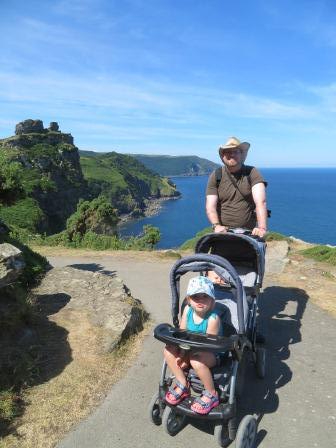
…while my wife carried herself. We then went to Lynton and rode the railway down to Lynmouth, explored and ate ice-cream, and I took some beautiful pictures of the harbour.

After riding back up again, we drove to Heddon Valley, where there’s a track to Heddon’s Mouth that’s ‘suitable for all-terrain pushchairs’.
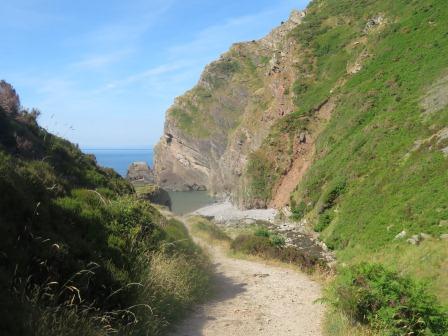
After struggling a mile down a rough, rocky track with a double-buggy and heavy backpack, we made it to a pebble beach where my eldest threw stones into the sea while I fed the little one…

…and then I struggled the mile back UP the rough, rocky track with the double pushchair and the heavy backpack, now loaded with stones my wife thought looked pretty, while she continued to carry herself. And did I mention the temperature was 30-degrees-plus? I must have lost a gallon of sweat.
After a bite to eat, we headed back to the campsite and went for a swim, and then tried to put the children to bed.
Well, you already know how that one ended. At midnight. With me exhausted, dehydrated, and just about ready to undo the brakes and watch the caravan roll down the hill into the sea, kids, wife and all.
In fact, instead of improving my relationship with my wife, this holiday gave it a bloody battering. I don’t recall ever having bickered quite so much. Where’s this, where’s that, why did you do that, why can’t you ever…? Oh for goodness sake, for crying out loud, what the hell, oh come on, and on and on. As an illustration of how innocent I was, I packed a book to read and a DVD for my wife and I to watch one evening. Ha! Read a book? Watch a DVD? Are you freaking kidding me?
But at least it wasn’t just us. One night, I put the kids in the puschair and walked down the hill, and from inside every caravan I passed I heard a similar tale of woe – crying, screaming, bickering, shouting. I wonder if anybody enjoys going on holiday with young children.
I think it would have been easier if I’d realised, going in, that it would be full-on as a daddy and zero-on as a husband or even an individual. Perhaps when they’re a little older, things will be different, but at this age, holidays are all about the kids.
But don’t ever make the mistake of thinking this will make them happy, or grateful, or even pleasant to be around. It doesn’t matter if you’ve spent seven hours with them in the swimming pool, or taken them to the amusements to blow a fortune on 2p machines, or carried them strapped to your back or chest up and down mountains, or gone to an interesting castle only to spend the whole time in a playpark, or read to them a million stories – the next time they’re hungry, or hot, or tired, or just irritable, it will be your fault and they will make you pay.
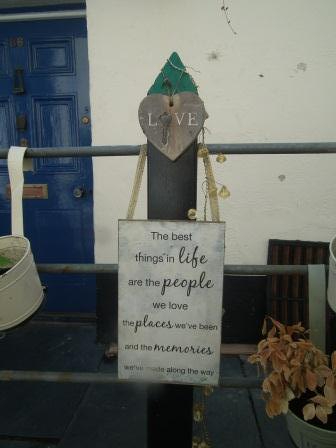
So why go on holiday? Why indeed. I mean, you’re still doing all the crap you do at home, only it’s far harder because the routine has gone out of the window and the kids are overstimulated so they’re harder to handle. But then, perhaps this sign I saw in Clovelly can explain it better than me:
And while changing a nappy is always changing a nappy, when you’re doing it in a place that looks like this…

…it can’t be all bad, can it?
 Aspie Daddy