
Asperger’s, Parenting and Unexpected Change

As is well-covered in the literature of autism, people with Asperger’s have a love of routines and struggle to cope with change. What I’ve been realising lately is that this bald statement covers up the nuances of what this means in practice, particularly when you’re the parent of a seven-month old.

And it can affect two people with AS in opposite ways.

I cannot handle change in terms of things being added. I need time to process and accept things that are coming up. Ever since I was a kid, I needed plenty of notice – at least a week – to get my head around a visit from relatives, a trip out somewhere, or anything out of the ordinary. If not, I tend to moan, kick up a fuss, say some nasty things I don’t really mean, and then go along with it anyway. But I don’t have much of a problem with things being cancelled anymore – indeed, the principal emotion is relief I don’t have to go through the effort of painting on my ‘public’ face and holding onto a fake smile for however many hours. I would be a hermit if I could get away with it.

Lizzie suffers the opposite extreme: she can’t handle change when it’s things being removed. She is mostly fine with things being added to the routine, especially if she’s the one doing the adding, but if something is cancelled her first response is to throw a tantrum. I liken it to a person walking along a road and finding a brick wall blocking their path. While other people would try to find a way around it, or else turn back, Lizzie bashes her head against it until one of them gives – sometimes the wall, but most often the head. Actually, scratch that – most often the heads of those around her.

Babies, as some of you are well aware and others can easily imagine, are unpredictable. Not only that, the world becomes unpredictable when you have them. Visitors arrive with little or no notice, longheld plans need to be dropped without warning, and you have to rush off to the doctor out of the blue. It’s impossible to say which of us struggles the most with the changes having a baby has brought to our lives, but I can guarantee that I suffer the most.

Now, when I say ‘suffer’, I’m not being melodramatic. I’m not talking about the discomfort I feel at friends, relatives and healthcare professionals clamouring for our time or pitching up on our doorstep unannounced. Nor am I talking about the disruption that sudden trips to the shops for some vital knick-knack cause to my quiet, ordered life. Fact is, the baby’s needs come first. I have accepted that. My needs, as an autistic individual, are immaterial next to hers. I have made that choice.

Unfortunately, Lizzie is either unwilling or, by dint of her condition, unable to make that choice. And so I genuinely suffer.

Like before Christmas when Izzie had a cold and I hadn’t slept for two days. Sunday morning I was so tired I couldn’t see straight, my back ached, I was covered in snot and dribble, and my throat felt like I’d been swallowing razor blades. I hadn’t had the chance to drink, eat, go to the bathroom, since the night before. When Lizzie arose, well-rested, and made herself some breakfast, I asked her to please look after the baby for an hour to give me a rest. But she had planned to go shopping, and, unable to alter her plans, she toddled off for more than three hours of non-essential retail therapy. I suffered.

Or like a couple of weeks ago when I got a migraine about teatime. Lizzie had planned to go out, so out she went. I couldn’t open my eyes more than slits as the light burned, I kept seeing spots of light dancing in front of my face, and my head throbbed with every beat of my heart like somebody was burying an axe in my skull. Every time I bent forward, it felt like my brain was being forced out of my eye-sockets. But I duly bathed the baby, gritting my teeth and shouting in pain whenever it became too much; hissed as I dried the baby; roared as I dressed her in nappy and sleepsuit; cried out as I placed her as gently as I could into the cot; snarled as I sang her to sleep. And then I collapsed, nauseous, into bed. I suffered.

Or the other week in the storms – our village turns into an island during heavy rain, and three years back I wrote off my car by driving into floodwaters (the single-most butt-puckering moment of my life!). So although we’d planned to take the baby to town, I refused point blank to expose her to the risk of getting stuck down some country lane surrounded by cows pretending to be ducks. The sensible thing. Unless you have autism and can’t change plans, in which case you kick off like a wild animal, say some truly awful things, and then go out anyway sans partner and baby. It was only later she admitted I was right, it had been too wet and downright risky to go out in that weather, with or without the baby.

Now, as this is mostly a positive, light-hearted blog, I’d like to say that whenever this happens I smile wryly, roll my eyes, say, ‘That’s Lizzie!’ to hoots of canned laughter, accept that it’s just her autism, and forgive and forget.

But nor is this a fairy tale.

There is a lingering resentment bubbling away under the surface as my needs, and Izzie’s needs, repeatedly come second to Lizzie’s inability to alter her plans for the greater good. Whether she can help it or not doesn’t matter – the resentment is there.

I have heard it said before that partnering a person with Asperger’s Syndrome is a form of abuse – not for the Aspie but the poor neurotypical saddled with their unreasonable behaviour. As someone with AS, I disagree with that, but let me be clear – people with Asperger’s can be cold, insensitive, selfish pricks at times. That’s the reality hiding behind the innocuous words, ‘people with Asperger’s have a love of routines and struggle to cope with change’.
Asperger’s, parenting and social care

The provision of social care for adults at the more functional end of the autism spectrum has always been somewhat spotty. If you’re at the lower end – with classic or Kanner’s autism – there’s plenty of help and support, but those of us with Asperger’s Syndrome face a lottery.

You see, as far as care services are concerned, AS falls between the Mental Health Team and the Learning Disabilities Team. It is not a mental health disorder, but then nor is it really a learning disability – it’s a developmental disorder. Nevertheless, autism tends to be within the Learning Disabilities Team’s remit – but they only get funding to deal with the lower end of the spectrum. In terms of care, then, if you have Asperger’s Syndrome there’s nothing the care services can provide.

You are, however, assigned a social worker – well, sometimes. But herein lies another problem. The team to which you are first assigned is the team you’re stuck with. I was first assigned to the Mental Health Team long before I was diagnosed with Asperger’s; as soon as I was diagnosed, I was discharged by the psychologists, psychiatrists and counsellors, but kept the social worker from the team. And as I said before, Asperger’s isn’t a mental health problem and most social workers I’ve met are gobsmacked when they meet me to find I’m not Rain Man. Different end of the spectrum, guys. Thanks for joining us.

The job of the social worker is to give the service user (i.e. me) access to services pertaining to their condition. Since, as I said, there are no services for adults with Asperger’s, this access takes the form of money that can be used to buy support from private care agencies. I was deemed to require six hours of support each week, so they decided to fund me for three, and I pay for the other three. Thus three times a week, for two hours at a time, I have support workers come in to make sure I’m carrying out my activities of daily living – changing my clothes, cooking, cleaning, etc., and to help me with paperwork, budgeting and the various minutiae of modern life I’m thoroughly incapable of coping with.

This is the way it has been for around seven years now. However, things have changed lately because of the arrival of my little bundle of giggles and poop, otherwise known as Izzie. As regular followers of my blog will know, my partner Lizzie (yes, I know it rhymes and in hindsight it’s quite confusing) has struggled with the demands of motherhood. Like me, she has six hours of support each week, and also has a social worker from Mental Health. Since things were so tough over the first six months, we asked for additional hours just to help us out until we managed to find our feet again. Here is the response we received, paraphrased and dramatized:

‘We’re adult mental health social workers. Neither of you has a mental illness. We’re not even sure why we’ve been assigned to you. Unfortunately, you fall down the cracks between Mental Health and Learning Disabilities.’

But it’s not our fault what we have doesn’t fit into your organisational structure. What we’re asking for is additional funding for more hours for assistance. Because at the rate we’re going, we’ll end up with mental health issues.

‘Well, here’s the problem. We don’t deal with children – we only deal with adults.’

But we are adults. Adults who are asking for help.

‘The thing is, before the baby arrived you were both stable on six hours a week. The disruption in your lives has been caused by the baby. Therefore, if you need extra help because of the baby, the baby will have to fund it.’

I’m not sure I understand.

‘Being a parent is not a mental health problem. If you want any assistance, Izzie will have to get a social worker, and be assigned funding from Child Services.’

I see. So will you refer us?

‘I can give you their number…’

To cut a long story short, we applied to get a social worker for Izzie, to get us extra help as her parents, but as she’s at no risk of abuse or neglect, we were turned down. So, no help there.

Another avenue explored was the Perinatal Mental Health Team. Lizzie was assessed by them, and they concluded her difficulties were caused by her autism, not by postpartum depression, and since autism isn’t a mental health problem, they can’t provide any assistance. So if her autism is causing the problem, who can we go to for help with that? Apparently, nobody.

You can now perhaps understand something of our quandary. We have autism, and despite the joys of the past six months, it’s been a real struggle. We are not the same as every other parent, even though I like to pretend we are, but we’re too high-functioning to get any help from public services, too attentive to Izzie’s needs to get access to child services, and not suffering enough mentally to get extra funding.

To add insult to injury, we have just been summarily dropped by the one piece of free support we were receiving. Since I work Tuesday afternoons in a charity shop, and Lizzie struggles to cope at home on her own with the baby, we had an outreach worker from the local children’s centre who would come out and sit with them for an hour. It was useful and we were grateful for it.

We didn’t hear from the outreach worker after the festive period until she texted on Monday 11th asking to come out either Wednesday afternoon, Thursday morning or Friday morning. Since Wednesday afternoon Lizzie was out with her mother, Thursday morning she takes Izzie to baby group (which is beneficial for mother and baby both), and Friday morning we have swimming classes (which cost £110 a term), we said we were busy. Besides, wasn’t the whole purpose of her visits to sit with Lizzie on Tuesday afternoons?

So she texted us again Tuesday just gone to tell us that they are closing our case because we have ‘disengaged from the process’ and failed to make ourselves available and haven’t kept in touch and if we ever want any help from the children’s centre again we will have to get Izzie a social worker and be referred.

This has left us both feeling perplexed and upset, principally because we have no idea which ‘process’ we are supposed to have disengaged from, but also because we don’t understand why we should have cancelled a Thursday morning Mother and Baby group or Friday morning swimming lesson when the whole reason she was coming was to sit with Lizzie for an hour on Tuesday afternoons? Furthermore, the wonderful invention called the telephone could have resolved whatever issues they had with us – what’s all this text message crap?

They clearly have no idea about autism. We like routines and we cannot abide change, so we make plans and stick to them – disruptions to our timetable make us agitated, anxious and insecure. When plans change you feel small and scared, but you can’t rationalise it away because there’s nothing you’re actually afraid of. It’s simply a general, all-pervading fear that all is not right with the world, a feeling of danger and fright when there’s nothing coming for us – just shadows in the dark. That’s why we don’t change plans at the drop of a hat. If people understood that, it might make things easier.

It reminds me of the time before my breakdown, before my diagnosis, when I was climbing the walls and my thoughts were tearing me apart. I was referred to a psychiatrist under the mental health team. But I wasn’t opening the post – I hadn’t for six months –  so when they sent out the appointment by letter, I didn’t open it and I therefore missed it. So they discharged me with the stipulation that if I was referred again I would go to the back of the queue. I only discovered this months after my breakdown when I finally had the energy to face up to opening the huge box of post my parents had kindly collected from my flat. How different things might have been if someone had actually picked up a phone. And how switched-off to the realities of mental health do you have to be to send someone an appointment by post when it said in the referral that he doesn’t open it?

I honestly think that, going forward, we’ll be better off as a family without the interventions of any of these social workers, care providers or so-called experts. The other day, when Lizzie was feeding Izzie during a support session, Izzie choked. We’ve just started her on food with a coarser texture, and choking is par for the course during weaning. The support worker even said that it was entirely innocent, normal, there wasn’t too much on the spoon or too much in her mouth, it was just one of those things. But she still felt the need to report it to her manager, and have it logged that on this day, at this time, during weaning our baby choked. Everybody is just looking for you to fail, and covering their arses in case you do, and that’s not an environment in which I want to raise my child.

Ending on a positive note, the past couple of weeks Lizzie has been so much better, it’s like she’s a different person. She’s far more attentive to Izzie’s needs, supports me more than she ever has, and is suddenly settling into the role of motherhood. And I have finally made peace with the fact that bedtimes and overnight is my domain, because Lizzie will never be capable of getting up in the night. We have different roles to play and given how Izzie is far ahead of the curve in almost every respect, we’re playing them damn well!

It’s just a shame it’s been such a struggle to get here.

Partnership vs. Parenting

It has struck me of late how the requirements of being a partner and those of being a parent are often diametrically opposed.

It’s the quintessential conflict at the heart of Jane Austen – do we pick a partner based on practical considerations, like Charlotte Lucas in Pride & Prejudice, or do we marry for love, like Elizabeth Bennet? Actually, since Elizabeth Bennet only really warms up to Mr Darcy after she sees the size of his package (i.e. Pemberley), perhaps Marianne Dashwood from Sense & Sensibility is a better example. Except she decides not to marry the man she loves because she concludes he wouldn’t make her happy, so marries a rich guy old enough to be her father and learns to love him. And while Fanny Price marries for love in Mansfield Park, Edmund is her first cousin. In fact, the only character in Austen free to marry for love is the titular Emma – she’s the only one with an independent fortune who doesn’t need supporting by a man.

But whatever the case, that this is such a preoccupation in Austen’s novels shows that in Georgian times, it was a very real conflict. And so it still is in some areas of the modern world – the upper crust, for example, who seem to marry the person who fits the job description of ‘wife and mother’ while refusing to give up the mistresses they really love (no names mentioned). But for the most part, these days we in the Western world marry for love.

As partners, me and Lizzie are great for each other. While I’m a sensible, reclusive stick-in-the-mud, Lizzie is a childlike, emotionally-liberated basket case. While I fret about rules, money, going out, she ignores all propriety, splashes out on frivolities, and is so restless it’s nigh impossible to pin her down. Throughout our relationship, therefore, she’s encouraged me to let my hair down while I’ve helped her face up to her responsibilities – at least in part. She reminds me that the world is a magical place where fun should be had – I remind her that there are boundaries and we need to stay safe. That’s why we love each other.

Trouble is, the very things that you love in a partner are not necessarily very attractive in the parent of your child. In fact, they’re often the opposite.

Before Izzie was born, we pulled each other towards the middle, but since the birth we seem to have returned to our outer limits – I am the responsible worrier again, Lizzie the frivolous spendthrift.

Unfortunately, these two mutually exclusive positions have been playing havoc in our household of late. The most commonly used phrase in the past six months, since I became primary carer extraordinaire and Lizzie has struggled with her role as mother, has been, ‘Look, you don’t need to make things easier for me, just don’t make them any harder than they already are.’

I hate being the responsible one, the one who has to rein the other in, the one who has to say no more often than he can say yes. But it is the role I’ve had to take. And being a parent spills over into being a partner: those very things I love about Lizzie – her clumsiness, her messiness, her devil-may-care attitude – have lately been driving me insane.

Perhaps it’s because it’s the festive season. Christmas is different as a parent – at least it was for me. Normally I look forward to it, get excited, wake with boundless joy Christmas morn, suffer agonising anti-climax once the presents are opened, recover enough by lunchtime to be contented, and wobble in a confused daze until New Year where I’m filled with hope over the coming months and regret over where I’d considered I’d be by this stage of my life. And Lizzie, well, she lived through every one of those experiences and emotions, and then some.

I didn’t. I lived from day to day, hour to hour. Bottles, milk, solids, steriliser, muslins, bibs, toys, car seat. Have we got enough nappies? The baby wipes? Where’s her extra vest in case she soils this one? Teething gel? Spare dummy? While Lizzie dressed the baby in Christmas jumpers and Santa hats and woke her up to sing Auld Lang Syne, I fed her and changed her and rocked her back to sleep. While Lizzie drank champagne and ripped open presents, I listened to the baby monitor and kept the noise down. I didn’t mind it – Izzie was my stable anchor in the chaos of the silly season – but it hammered home how different we are, as parents, as partners, and as people.

If we were living in Georgian times, choosing our partners based on practical considerations, then, hand on heart, I doubt that many of us would have chosen the people we’re with now. We’d have chosen people who were different, better, smarter, funnier, kinder. I can’t imagine I’m the only person with a young child who’s looked around at other people and thought – if only I’d picked them, how much easier would my life be now?

But such thoughts are nothing more than fantasies. It’s so easy when you’re stressed, tired, overwhelmed, overfed, and surrounded by twinkling lights, to forget the important truth: we’re not living in Georgian times, and we didn’t choose our partners, at least not consciously – our hearts did. Not based on their parenting abilities, but because we loved them and love them still. Because they appealed to some intangible need or desire deep down within ourselves that only they could fulfil.

Lizzie might annoy the hell out of me as the mother of my child, but there’s nobody else I’d rather share my life with. It’s separating out these two conflicting realities that’s the hard part.

Future Worries

I had an argument with my six-year-old niece today.

‘I know more than you,’ she said.

‘No you don’t.’

‘Yes I do. All you know is how to eat chocolate.’

‘Not true,’ I said. ‘I know how to dispose of a body where nobody will ever find it.’

Her jaw dropped open. When she’d recovered, she said, ‘Well, I know how to kill a dinosaur.’

‘That’s nothing,’ I said. ‘I’m the reason there are no dinosaurs.’

And it got worse from there.

I’ve always been a bit of an easy target for kids. No matter how old I get, they treat me like I’m one of them. In fact, they treat me like I’m beneath them. When I was an eighteen-year-old sixth former – tall, bearded, tattooed and pierced, with a leather jacket, a ponytail and chunky army boots – the eleven-year-old Year 7s used to trip me up, call me names, tease me, even spit on me. And it’s always been this way.

No matter how much I threaten, shout, growl, snarl, swear, they still think I’m just a big teddy bear. Maybe it’s my Asperger’s Syndrome, but I have no idea how to get a child to respect me as an adult. And since Izzie turned six months old yesterday, that’s starting to worry me.

I want Izzie to like me, of course. I want to be best friends with her. But I also want her to respect me. To trust me. Not to see me as a figure of fun to be poked and teased, but as a person with a wealth of knowledge and experience and, stemming from this, a certain amount of authority. If today with my niece and nephew is anything to go by, she’ll laugh at me, snap at me, make fun of me, throw things at me, hit me, talk down to me, roll her eyes when I talk, and generally treat me as just another plaything. As kids have always done.

It’s worse for Lizzie. Instead of people just seeing her as a big kid, she is a big kid. Thanks to her autism, learning disability and dyspraxia, she thinks the wind is caused by trees, spends her time doing paint-by-numbers and playing with gadgets, and can’t walk past a ‘keep off the grass’ sign without cartwheeling on the lawn. She gets on great with kids because she’s on their emotional level – space hoppers and trampolines, Kinder Eggs and Happy Meals – and she’s so clumsy, everything she does looks like it’s been made by a five-year-old. This is not to be mean – she would admit as much herself.

And so, as little Izzie grows, Lizzie is daily becoming more nervous about how she’ll cope with a young, precocious child. She’s terrified of Izzie growing up and making fun of her. She’s terrified of Izzie overtaking her very quickly and coming to look down on her. And she’s terrified of Izzie growing up to be embarrassed of her immature, incapable mother.

I don’t think she has much to worry about. I have no doubt she and Izzie will be best friends. They’ll have an innate understanding of one another and while it is likely true that Izzie will overtake her in knowledge, skill and maturity, I don’t think she’ll make fun of Lizzie – she’s more likely to be fiercely protective of her mother, and help her with her deficiencies.

However, I sincerely doubt Lizzie will be much of an authority figure or a disciplinarian, and so this will fall to me. In our relationship, I’m the one who has to say ‘no’ when Lizzie is getting carried away, climbing over safety barriers, trying to dance in the rain without shoes or a coat, or spending a month’s income on frivolities. Even now, she’s the one who buys cute outfits and toys and bouncy chairs; I’m the one who buys nappies, and nappy creams, and baby wipes.

So the question is: how I can be the lawgiver parent when no child has ever respected me?

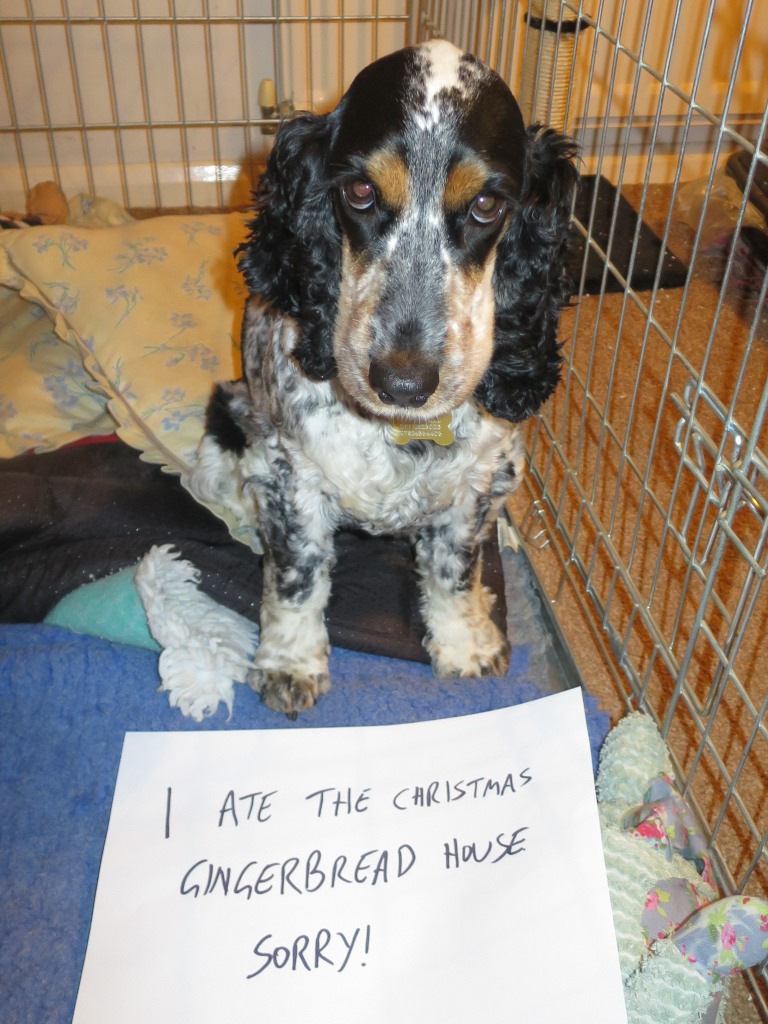
I mean, I can’t even get the dog to behave anymore. Lizzie spent six hours making a Christmas Gingerbread House. I then spent three hours correcting the mistakes Lizzie had made with the Christmas Gingerbread House. Since it kept collapsing under its own weight, I froze the pieces overnight then as I rebuilt it, I reinforced it with chocolate fingers so there was an internal frame, then glued it all together with icing sugar. It collapsed again, so I persevered, and finally I had something I was proud of. I put it on a plate on the table this evening, left the room for two minutes to change the baby’s nappy. In case you can’t guess the ending to this story, I’ve attached a photo. Now, if I can’t get an eighteen-month-old Cocker Spaniel to behave, what hope do I have with a spirited toddler?

IMG_0016

24 Hours of Fatherhood

Here is an unabridged, not untypical day-in-the-life of an Aspie Daddy.

06.00 – get up and feed baby.

07.00 – wake Lizzie to look after baby while I walk dog.

08.00 – feed dog, feed cat, open hen house, have breakfast (porridge oats and coffee).

08.30 – resume looking after baby. She scratches my left eye with her fingernail – very painful.

09.00 – autism support worker arrives. Continue to look after baby and chat about issues until Lizzie is free to take over.

09.45 – tidy hall, clean kitchen, clean bathroom.

11.00 – autism support worker leaves. Feed baby while supervising erection of Christmas lights.

11.30 – prepare and eat lunch (rice and tuna).

11.45 – prepare a bottle.

12.00 – pack car and head off as family to swimming.

12.30 – arrive at swimming, change and get baby ready.

13.00 – father-daughter swimming lesson with baby.

13.30 – dry and dress baby and self, go home.

14.00 – feed baby.

14.30 – put baby down to nap.

14.40 – baby wakes screaming.

15.30 – baby pokes me in right eye.

16.00 – hand baby back to Lizzie and go online to enter short story contest.

16.30 – power cut, world turns black. Phone electricity company who think power will be restored by 19.35.

17.00 – send Lizzie to her dad’s with the baby, bottles, formula and Perfect Prep machine.

17.15 – feed cat and dog by the light of a headtorch.

17.30 – light mango and pomegranate candle and cook bacon and eggs for tea. Boil water on stove for cup of tea.

18.00 – go join Lizzie and baby at her dad’s. Play with baby; cuddle baby; feed baby; watch Lizzie eat lasagne.

21.00 – return to cold house. Power still out. Phone electricity company who think power will be restored by midnight.

21.15 – Start to put baby to bed. She is excited by my headtorch. Thinks it’s a funny game.

22.15 – baby finally settles. Run bath for Lizzie. Shut up hen house.

22.30 – Lizzie goes to bed with runny nose and cough. I wash up baby’s bottles and fill dishwasher.

23.00 – batteries run out in baby monitor. Find one new AAA battery (it takes four). Replace one battery.

23.15 – check on baby. Put extra blanket over her.

23.45 – try to settle horrendously unhappy screaming baby who seems to have developed cough.

00.30 – battery in baby monitor runs out. No spares. Wake Lizzie to listen out for baby while I take steriliser out to electricity engineer’s van and sterilise bottles.

00.45 – dress in onesie and lie on floor of baby’s (freezing) room as no monitor. Lizzie back to sleep.

01.20 – power back on. Make up two bottles of boiled and cooled water, just in case. Turn off Christmas lights, let dog out to toilet, turn up heating, fill and put dishwasher on, eat bowl of cornflakes and drink coffee.

02.15 – go online to finish entering short story contest (see 16.00).

02.35 – check on baby and finally go to bed.

03.00 – baby sneezes and coughs, but still asleep.

05.00 – kick bastard cat out of the bedroom.

06.00 – get up to feed baby. Baby has runny nose and cough.

The moral of this story is to expect the unexpected. And if you’re planning on having kids and think it won’t utterly and irrevocably change your life – hahahahahaha!

Five Months of Autistic Parenting, Part 3

Having Asperger’s Syndrome means you struggle to say the ‘right’ thing, misinterpret what other people are saying, fail to give due diligence to the feelings of others, and don’t appreciate that people have different needs. It also makes you rather self-centred. Mostly I can use my intellect to overcome my natural shortcomings in these areas, but the more tired I become, the harder it is to do that.

Having two tired new parents with Asperger’s in the same house with a five-month-old baby is a recipe for disaster.

This morning, for example – Lizzie is spending the day in Southampton shopping with a friend and she’s taking Izzie with her. Since I’m in desperate need of a break, I’ve been looking forward to today – for once there are no support workers, social workers or family members coming over, no urgent writing deadlines, no charity shop, no cooking, so it’s all mine, yes, all mine (he says, rubbing his hands together with a maniacal grin). I can soak in the bath with a book, make my model that has sat untouched for five months, go to the local coffee shop in the village and watch the world go by. Or I can mooch about in my underwear and watch rubbish TV. My day. Bliss.

And Lizzie would know that if she’d been listening and considering my needs.

So I’ve been up since five, fed the dog, the cat and the chickens – not to mention the baby – and I’m just waiting for Lizzie to hurry up and go when she says, ‘Oh, by the way, I want you to mow the lawn today.’

The lawn takes two hours to mow because we have a rubbish mower and a massive lawn. I have to empty the grass collecting box around twenty-six times during mowing. And it’s raining.

So I said, ‘No. Not a chance in hell. I’d rather poke out my eyeballs. You want me to do chores while you’re out on a jolly? How dare you even suggest that? This is my day.’

In hindsight, a simple, ‘No, I’d rather not,’ would probably have sufficed. Yes, I overreacted. And then she overreacted to my overreaction. And that’s how it tends to go at the moment. If we were less tired, we’d probably be able to rein ourselves in, realise the other person wasn’t being belligerent or deliberately insensitive, they just hadn’t realised their partner had been looking forward to a day off. But we flip out instead.

That is, unfortunately, part and parcel of having autism, and only to be expected.

What is not so obvious is why, as a result of my Asperger’s, I find it so difficult to entrust the care of my baby to others.

It would make life so much easier, and would have done over the past five months, to have babysitters. Lizzie has a remarkable ability to go out and then not think about home, or babies, or really much of anything (miaow!). I, however, find it nigh impossible to switch off.

The autistic brain is very susceptible to obsession – I’m using up my ‘day off’ writing about the baby! But this could also be the result of the fact that the autistic brain is also so structured that your thoughts can go round and round and round, growing bigger and more frantic with each circuit. Since Izzie was born, I haven’t rested, haven’t dropped my guard for even a moment – I am a dad, and that means constant vigilance, care and concern. After years of learning that people let you down, it’s very difficult to trust anyone else with the most precious thing in my life.

This goes for Lizzie too. As I have mentioned in previous posts, thanks to difficulties with Theory of Mind – that is, understanding how other people think – I struggle to comprehend why people would do things in a different way to me (because clearly my way is the best, which is why I’m President of Earth). I therefore find it very hard to step back – I want to take over, because Izzie is my baby and I know what she wants and I’m the best at doing it so back the hell away. This has inevitably led to friction between me and Lizzie and I realise now that I’m a total control freak.

But that’s because control keeps me safe. I’ve cleverly structured my life to avoid stressful situations and thus remain asymptomatic. If I go out to a social situation, I drive so I can leave any time it becomes too much. I sit on the end of tables so I can slip out unnoticed. I actively shun noisy and crowded environments. And so if I let others take over, I can’t ensure Izzie’s safety. I can’t be certain she’s getting what she needs, which is me, because I know best.

You see? Even I can see that I need to let go, step back, have a break, learn to trust others, and stop worrying so much when I’m not with her. But can I?

Perhaps the biggest obstacle to this is, again, my autism. I’ve always struggled to understand relationships – how to form then, how to keep them, what they mean – and I’ve only ever managed to have one friend/partner at a time. If I have a second friend, or a friend other than my partner, I feel as though I am somehow betraying the people I care about. If I have a friend, then it means Lizzie isn’t enough, and how can I say that? Of course, Lizzie has plenty of friends and I don’t feel she’s betraying me, but I resist any overtures of friendship because I don’t want to betray her.

The same is true of Izzie. If I let someone look after her, I feel I’m somehow betraying her, letting her down. I’m failing her as a dad. People tell me to stop trying to be perfect, because I’m only human, but that is like an admission of failure. Why can’t I be both?

That’s the biggest lesson I have to learn from five months of autistic parenting – I have to learn how to let go and relax. If I’m not careful, my ten-month review of autistic parenting will describe how I don’t let Izzie out of my sight and I haven’t left the house for weeks. Or it’ll just be gibberish.

Five Months of Autistic Parenting, Part 2

Because you act in a way that is normal for you, it can sometimes be easy to forget you have Asperger’s Syndrome. That is, until someone points out that your way of doing things is perhaps not strictly conventional.

I figured that most of our struggles as new parents had to do with us being new parents, because you’re meant to suffer, aren’t you? That was how I explained it to my autism support coordinator yesterday. We’re no different to any other parent.

‘Except that most of them don’t have difficulties with communicating, understanding relationships and processing information,’ she replied. ‘You do.’

Touche.

As the stress and tiredness of having five unrelenting months of childcare have caught up with us, Lizzie and me have increasingly argued about our roles and responsibilities. That goes with the territory, of course – when you’re looking after a baby, there’s far less time and energy to invest in your relationship beyond occasional back rubs and I-love-yous – but I’ve come to realise that our difficulties have a distinctly autistic flavour. Because we’re not the same as every other parent, and that’s worth remembering.

In my last post I wrote about how the little idiosyncrasies of my condition affected my life as a dad. This post and the next (because it’s a big topic) are about how the larger underlying issues of Asperger’s have affected my relationship as a parent.

Probably the biggest thing I’ve struggled with throughout the past five months is the issue of fairness. Since people with Asperger’s can have very logical, systematic and pedantic ways of seeing the world, rules and routines are very important to us. Unfortunately, our understanding of fairness as a black-and-white, unbending entity does not relate to how fairness actually works in real life. And I have erroneously applied my logical yet unreasonable idea of fairness to mine and Lizzie’s roles as parents.

If Lizzie goes out for six hours on a jolly with her friends, for example, leaving me to look after the baby, I consider it only fair that the next day I get six hours to myself while Lizzie looks after the baby. If I put the baby to bed one night, I think it only fair that Lizzie does it the next night. And if I change a poopy nappy, it’s her turn to change the next. It’s logical, it makes sense, and it’s undeniably fair.

Apparently, however, this is not how parenting and relationships are done and I have been waiting in vain for a fairer distribution of duties. I said in an earlier post (It’s Not A Competition) that we each give what we can give, and if I can give more than Lizzie can, that’s okay. Lately, however, I haven’t been living up to that enlightened thinking. I look at how much I do and how much she does, how many warm meals she eats compared to the number of my cold dinners, the amount of sleep she gets, the frequency with which she has time out with her friends leaving me at home alone with the baby, and it’s all started to seem rather unfair and one-sided. And part of our problems of late have undeniably resulted from my resentment of this state of affairs.

But as I said, apparently this turn-taking thing isn’t how parents are meant to behave. Thanks to our autistic ways of thinking, we have been living like flatmates who pass a baby between us – you look after her for a couple of hours while I do my own thing, then I’ll look after her for a couple of hours while you do your own thing, and so forth. I thought that was totally normal, but apparently not. Instead, we should be doing things together as a family and supporting one another instead of playing pass-the-parcel.

I have to here point out that I love spending time with Izzie, and in actual fact I wouldn’t mind if that was all I ever did. But I’ve become hung up on this issue of fairness, particularly in regard to the amount that Lizzie goes out. In recent weeks it has reached six days out of seven, for a minimum of three hours at a time, maximum of nine, sometimes with the baby but mostly without, day after day after day leaving me to look after Izzie by myself. I thought she was running away from her responsibilities as a mother, and that is how I addressed it, but the truth is that it had to do with her Asperger’s.

You see, Lizzie has never really had friends, but in the past couple of years has made around seven of them. Having AS, however, means she doesn’t know how to manage her relationships. She’s terrified of losing them, and thinks that if she says ‘No’ when someone invites her out, they won’t be her friend anymore. And she doesn’t want to include me in her plans because that would be asking permission, and she’s an adult who doesn’t need permission from anybody. So if seven friends invite her out in the week, she says yes to all seven, without thinking about the impact it is having on our relationship and family life.

The way forward, then, is teaching her that when you have other responsibilities to a child, a partner, a home, you’re allowed to say no, and that if they’re true friends, the friendship will survive. Her support workers are trying to get her to limit her time out without the baby and spend more time in the home, because they feel that the balance needs to be redressed – though, when I ask them if ‘unbalanced’ is a euphemism for ‘unfair’, they strongly deny it.

So we have been doing things differently recently. We have spent more time doing things as a family, not just in the home but going out together too. Some of the things Lizzie would have done with friends, like painting a plate at a cafe, she has done with me, the baby on my lap. This weekend we’re all going to a Christmas market. And when Lizzie gets invites she asks me if I mind her going out, which isn’t asking permission but checking in with me as her significant other, which makes me feel more appreciated than before.

And life is so much better. If it hadn’t been pointed out to me that we were doing things separately that we should have been doing together, I don’t think we’d have figured that one out for ourselves. If people hadn’t told me that ‘fairness’ is not the criteria by which you divide up the responsibilities of parenthood, we might have continued passing her between us and inadvertently made her feel like an unwanted burden, which couldn’t be further from the truth. Sometimes you need other people to point out to you what you can’t see for yourself, and we’re lucky enough in our lives to have those people around us.

Five Months of Autistic Parenting, Part 1

Five months ago I started this blog with the question: what happens when a guy and a girl with Asperger’s Syndrome have a baby? I can answer that very simply: we have a gosh-darned gorgeous daughter. Beautiful, inquisitive, intelligent, happy and healthy. And it’s not just me that says that – health visitors, midwives, nurses, doctors, childcare specialists, social workers and swimming teachers all agree, and they have no reason to suck up to me so it must be true. Yay.

But of course, that’s only a fraction of the answer. How has our autism affected our parenting thus far? How has it affected our relationship? How have we compensated for or overcome our foibles and idiosyncrasies? What have we learned? These are the real meat of the answer, and I’ll do my best to cook them for you.

In this post, I’ll cover the small, humorous parts of autistic parenting. The next post will detail the larger, more serious problems of parenting with Asperger’s. So hang on in there if that’s what you’re looking for.

Firstly, I have to mention the mobile over Izzie’s cot because it drives me freaking insane. Why? Because you have to turn the mechanism ten-and-a-half times to wind it up fully. What kind of sadist designed that? Why can’t it be ten? Why ten-and-a-half? I’d even accept it if it went up to eleven (insert This Is Spinal Tap reference here). But leaving it with a half is plain belligerence. It’s practically warmongering. (For future designers, I would accept fifteen as well – multiples of five are always good).

This same sadist also made it run out of steam one solitary note from the end of its repetitive tune. Yes, one note. I lie awake listening to that simple tune on the baby monitor, round and round, knowing that soon it’ll stop short and leave me with a horrible sense of incompleteness. It’s like watching a firework shoot up into the sky and then splutter out without so much as a ‘fzzzzt‘.

The play mat bugs me too. All the tunes it plays are almost nursery rhymes, but not quite. Whether for copyright reasons or simple hatred of children, they’ve changed the last line of each one so you’re singing along and suddenly – boom – you can’t finish it! So Incy Wincy Spider never gets to climb up the spout again, the little boy who lives down the drain never gets his bag of black wool, and Frere Jacques doesn’t end with a ding, dang, dong. So annoying.

The monitor is a pain in the ass too. The first sound the baby makes switches it on, and then you’re treated to ten seconds of the microphone trying to pick up whatever white noise it can find. So, if the baby coughs, you don’t hear her cough – you hear the monitor come on, ten seconds of humming, buzzing static, and then it switches off again. She coughs again, the microphone comes back on. So you lie in bed listening to the monitor switching on and off without once hearing any baby noises. It drives me crazy.

But infinitely worse is when you can hear noise through it, specifically screaming. Izzie screams so loud, I imagine the neighbours wake up thinking, ‘Whose bloody baby is that?’ And when I say ‘neighbours’, I mean ‘the people in the next village’. It’s bad because I can hear Izzie screaming through the wall and I can hear her screaming in my ear through the monitor, so I get it in stereo.

And if that wasn’t bad enough, there’s a slight lag between the microphone picking up the sound and the speaker relaying it, so the screams are slightly out of sync. If you want to make a noise so unholy it could summon the devil, come to my bedroom around eight pm. Bring cake.

In truth, I’m not sure whether it’s my autism that makes these things bug me or if it would bug every parent. Certainly, my autism makes me pedantic and pernickety – I like completion, efficiency, accuracy, things working as they should and doing so logically – and whoever designs these things for babies seems to enjoy torturing parents like me. Grrrr.

Probably more directly related to autism is my dislike of slimy stuff. Autism is often accompanied by sensory issues, including a strong liking or disliking of particular textures, temperatures, smells, sights and sounds. One Easter at Sunday School when I was about eight we had to do egg-blowing, and I absolutely hated it – disgusting, squidgy raw egg dripping out the hole in the bottom of the shell. Yuck. The teacher lady, knowing I didn’t like mud, grass stains, getting dirty, told me I wasn’t like other boys – in hindsight she might have been suggesting I was gay. But she was right – I cannot stand slimy stuff.

Which means changing Izzie’s poopy nappies, especially when the crap has spilled out and soaked into her vest and top and trousers and I have to slip it off over her head and then there’s faeces in her hair, is particularly difficult. And when I get it on my hands I run to the bathroom screaming to wash my skin in scalding water with antibacterial soap and a wire brush.

Worse, though, is feeding the baby her solids. I’m not sure why they’re referred to as solids because, as everybody knows, baby food is sludge. Watery, slimy, smelly sludge that stains everything it comes into contact with.

Since babies learn about the world by watching our reactions, I’ve been told we have to act as though their food tastes lovely and there’s nothing we’d like to be doing more than feeding them this gunk, or else it might put them off. Now imagine you’re someone who is horrified by the feeling of sludge and who squeals if he gets mud on his Wellington boots. Yeah.

I spoon that gloopy, dripping, phlegm-like goo into Izzie’s mouth, force a smile onto my mouth as she dribbles it onto her hands then smears it over her face, try not to react as she grabs my forearm with her cold, slimy fingers and rubs that delightful substance into my skin. Mealtimes have become my least favourite activity by far – I’d rather clean out the cat litter, and that’s saying something.

And this fakery of enjoyment leads me onto the final and most profound observation on autistic parenting in this first part of the post. As someone with Asperger’s Syndrome, my life is one giant performance. My body language, facial expressions and tone of voice are not natural, but the result of study and conscious manipulation. I project confidence, contentment and cheerfulness when in truth I am filled with hidden insecurities and neuroses, discontentment and confusion, and I spend my life battling against my thoughts with a violence that nobody could ever guess at. How does this relate to parenting?

Since our babies look to us to learn how they’re supposed to react to new situations – should they be afraid, relaxed, excited, upset? – we have to act as though we know what we’re doing and everything’s fine and dandy. Well, having had a lifetime of practice hiding (masking) my problems, I’m an expert at making Izzie feel safe and secure. I might be terrified of setting foot outside my own front door, but Izzie will never see that, so she won’t grow up infected by my fear of the outside world.

So my autism is really a double-edged sword. Without it, I probably wouldn’t be a reclusive, hysterical pillock; with it, I’m able to pretend that I’m not a reclusive, hysterical pillock. What kind of parent does this make me?

The best that I can be.

Are You Raising a Demon Baby?

A handy checklist to see if you are raising the spawn of Satan. Has your five-months-and-one-day-old baby:

  1. Kicked you in the nuts?
  2. Kicked you in the chin?
  3. Twisted your beard until you screamed?
  4. Backhanded you across the mouth?
  5. Backhanded you in the nose?
  6. Punched you in the Adam’s Apple?
  7. Scratched your neck?
  8. Scratched your forehead?
  9. Used your ears as leverage to pull herself to her feet?
  10. Crushed your bottom lip in her meaty little hand while trying to ram her other fist down your throat?
  11. Shoved her fingers up your nostrils?
  12. Pulled off your glasses?
  13. Palm punched you repeatedly in the eyes?
  14. Tried to bite your head?
  15. Screamed when you tried to feed her?
  16. Screamed when you hugged her?
  17. Screamed when you put her down?
  18. Screamed on her front?
  19. Screamed on her back?
  20. Screamed non-stop right in your face?
  21. Thrown up pureed apple and banana down your shirt?
  22. Thrown up pureed apple and banana down your vest?
  23. Thrown up pureed apple and banana down your bare chest?
  24. Pulled out a handful of chest hair?
  25. Tugged on your armpit hair until your eyes watered?
  26. Spat on you?
  27. Sneezed on you?
  28. Done a pile of liquid yellow-green poo thirty seconds after you changed her nappy?
  29. Laughed uproariously as you tried to change her again while she kicked you and hit you?
  30. Shrieked like a banshee as you tried to put her sleepsuit back on while she kicked you and hit you?
  31. Stood up unassisted against the sofa for the first time?
  32. All of the above in the space of two hours this evening?

If the answer to all the above questions is yes, you may very well be raising the offspring of Beelzebub a.k.a. a teething baby.

To assist parents like us, I have set up a support group named Demon Dads Anonymous. Call me on 1-800-I-need-an-exorcist and we can help each other! Or we use more teething gel, yes, more teething gel, now.

The World’s Worst Word

Top of the list of words that should be expunged from the English language is ‘should’. Unfortunately, in order to make that statement, I’ve had to use it, so perhaps banning it isn’t the right answer. To rephrase, then: I would greatly appreciate it if the word ‘should’ was avoided in any conversation about life, lifestyle, parenting, babies, child development, behaviour and relationships, because ‘should’ is the world’s worst word.

Implicit, and often explicit, within the word ‘should’ is that there is only one way of doing things, the right way, and therefore if people use that word at you, they are telling you that you are not only falling short of the ideal, you are doing things wrong. ‘You should leave her to cry,’ means: ‘A proper parent leaves their child to cry. This is the only way to respond to a baby that cries. By not leaving her to cry, you are not being a proper parent. You suck.’

Okay, maybe that’s my autism reading too much into it, but how much nicer would that same sentence be if you replaced ‘should’ with ‘could’? ‘You could leave her to cry,’ means: ‘there are many options available to parents, of which this is just one. I leave it to you to make the decision as to which option is right for your family.’ See? Much better.

‘Should’ also fills your life with pressure. ‘She should be drinking five bottles a day.’ Great, but what if she only wants four? Or those days that she wants six? What then? Should we be forcing milk into her, denying her it when she’s hungry? Instead of following your instincts and adapting to reality, you feel an obligation to try to squeeze reality into a ‘should’-shaped hole, and that doesn’t make life easy for anyone.

That horrible imperative also changes the power relationship between you and whichever person said it. ‘You should change the brand of milk she drinks,’ is another way of saying, ‘I don’t respect you. There is no point in us having a conversation as adults because you are a child who cannot be trusted to make decisions. Therefore, I must fill the role of your parent and tell you exactly what to do. Switch to Aptamil.’

‘But Aptamil and Cow & Gate are the same company with different coloured packaging.’

‘Shut up, imbecile. You are incapable of deciding what is best for your baby so I will take that choice away from you. You are the hydrant and I am the dog.’

You see what I’m saying? ‘Could’ means that we are equals, you are making a suggestion and you respect my ability to sort through the conflicting information and select an appropriate course of action. ‘Should’, on the other hand, means you’re the expert and I’m the dunce, and I should do what you say because you’re the Man, and I’m the poop he just stepped in.

So next time you’re giving someone advice, think about turning that first phoneme from a ‘sh’ to a ‘c’, unless you really are that arrogant that you think you know the best way to raise my baby.

Rant over.