Historically, hysteria only affected those with wombs. Bizarrely, it was believed that the womb wasn’t fixed in a woman’s abdomen – it could go wandering about her body wherever the hell it felt like, going up and down and side to side like an animal within an animal. And depending on where it happened to be and what parts of the body it was pressing on, it could cause physical symptoms like headaches and nosebleeds and even bad knees. That’s the reason the words ‘hysteria’ and ‘hysterectomy’ are so similar – ‘hystera’ is ancient Greek for uterus.
By the time the Victorians got hold of it, knowledge about the location of the womb had moved on, but so too had the symptoms of being a woman. Instead of causing physical ailments, hysteria now described a cluster of mental symptoms typically associated with a drunk fifteen-year-old girl at a party: anxiety, excitability, irrationality, excessive outpouring of emotion, irritability, weepiness and fainting. Hence in modern parlance the word ‘hysteria’, and its derivative ‘hysterical’, means a ridiculously over-the-top reaction with a level of emotional performance not normally seen outside of musical theatre or reality TV.
I give this lesson in etymology because we have reached a phase with Izzie that can best be characterized by, you guessed it, hysteria.
Basically, multiple times per day for the past couple of weeks she has broken down in floods of tears, sobs and screams. Sometimes I think she’s broken a bone, she’s so distressed. She cries so hard she can’t breathe and starts to choke. She gets so hysterical, it’s scary, and she won’t be soothed. Cuddles, sing-songs, kisses, rocking, water, milk, biscuits, nothing. The only way to stop her sometimes is to run a bath and put her in it, stroke her back until she gradually gets her breathing back under control. And when she’s finally calm, you say, ‘My God, girl, you were hysterical!’ and she giggles.
It takes very little to set it off. One of the most regular is that she wants to hold your hand all the time and walk from every here to every there. The second you let go, she drops to the floor, her forehead touches her knees and the screeching begins.
Same with leaving the room. That’s all it takes. Your foot crosses the threshold and she’s reduced to a wreck.
The other times are weird and unpredictable. She undid the zip on her bag, right to the bottom, but as the zip didn’t keep going any further, she burst into tears. She ate her banana, then cried because she had finished her banana. The chair was against the wall and she wanted to squeeze through the inch-wide gap instead of go around it, and because she couldn’t fit, no matter how hard she forced her head against the wood, she started screaming.
She pointed at a cactus on the window sill and cried because I wouldn’t give it to her; she held a book horizontally with the spine at the top, and screamed because the pages wouldn’t open right to left; she sobbed uncontrollably because her right shoe had to go on her right foot when she wanted it on the left.
Then there are the times when you can’t work out what the hell is the reason. She’s sitting on your lap perfectly fine, and suddenly she’s out-and-out screaming and crying, and nothing has changed from one moment to the next. It frays your nerves and tests your patience. In your mind, a good dad keeps his kids happy, and this screaming, crying baby taunts you, every tear a knife to the heart saying, ‘bad dad, bad dad, bad dad, bad dad.’ She’s having a bath every day now – not to keep her clean but to stop the tantrums when they start.
So this is the phase we have reached. At least, I hope it’s just a phase and not her personality coming to the fore. In ancient Greece, the cure for a wandering womb was to get pregnant. If that’s the case, we’ve got a lot of years to wait until this passes!
One of the major milestones all parents look forward to is their child’s first word. After all, a spoken language is what distinguishes us from the rest of the intelligent apes, and the first word is the moment when your little bundle of neediness and poop becomes a fully integrated part of the human race. Every baby diary dutifully stipulates you must record this sacred first word, and people can often tell you what it was as it sinks into the familial consciousness as a treasured anecdote.
I’m finding it’s a bit more complicated than that.
Izzie talks. That is, she makes lots of babbling noises that she combines in long streams of phonemes. Every so often, she’ll therefore come out with something not simply resembling a word, but as clear a word as you’ve ever heard. By accident.
Do these random noises count as words? I bloody hope not. About five months ago when she was sitting on our bed, she looked at me, smiled, and said as plain as day, ‘Murder.’ When I was bathing her a month after that, she pointed at me, all innocent and sweet, and said, ‘Man-boobs.’ There’s no way in hell I’m writing that in her baby diary!
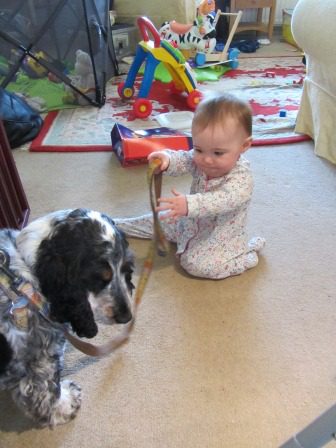
Then there are the words she uses that aren’t actual words. Whenever she sees my father-in-law’s dog she says, ‘Wo-wo,’ and does it consistently enough for us to know what she means. If a word is a bunch of sounds that carry a specific meaning that is used to communicate information, then ‘wo-wo’ is definitely her first word. But ‘wo-wo’ isn’t a word – at least, not in any language of which I’m aware.
And what about words she mispronounces? If you greet her and say, ‘Hello,’ she replies with, ‘Ay-oh’. There are two problems with this one. First, she’s simply repeating what you’re saying rather than volunteering the sound herself. Secondly, ‘ay-oh’ is not ‘hello’. So do these facts invalidate it as a word?
Anyway, what she can say seems, to my mind at least, far less important than what she can understand. It’s said that for every word they can say, a child understands ten. I think that’s an underestimate – Izzie seems to understand freaking everything.
Mummy, daddy, Nana, Granny, Poppa and Gramps are a given by this age, and there’s no doubting she knows her own name. Yes, no and don’t are also in the bag, even if she chooses to ignore them more often than not. And key events are well known – bedtime (rubs eyes), nappy change (runs away), bye-bye (waves).
More impressive are the actions. Most of them are quite simple, one-action commands. ‘Where’s so-and-so?’ will prompt her to seek it out. ‘Get it for daddy,’ results in her fetching it. ‘Put it in the box,’ will make her do just that, and she’s very good at ‘hands up’, ‘clap’, and ‘twinkle, twinkle’ (opening and closing fists).
Some, however, are far more complex. If you say, ‘Mummy needs to put on her shoes,’ she crawls over to a shoe, picks it up, brings it back, and tries to put it on mummy’s foot. Generally the wrong foot, but it’s still remarkable when you consider she can’t actually speak yet. Before you know it, she’ll be making daddy his morning coffee.
So if anyone asks, many years hence, about Izzie’s first word, it was ‘murder’, followed by ‘man-boobs’, ‘wo-wo’ and ‘ay-oh’. But until she says something like ‘mummy’, I’m leaving the baby diary blank!
I’ll lay out my position right at the start so those who have already made up their minds to the contrary are prepared for my vitriol: MMR does not cause autism. The MMR/autism link has no basis in reality. As an autistic father of a neurotypical child who has her MMR tomorrow, I am sick to death of people telling me that vaccinations cause autism, and I will therefore be disparaging towards the anti-vax movement and, by extension, anti-vaxxers as a whole. You have been warned.
There. Now we can get started.
To the average man on the street, the letters MMR and the word autism have been inextricably linked since the early noughties. The media had a field day whipping up a national health scare, frightening parents and misreporting the facts. As a result of this, there seems to be a general undercurrent of feeling that MMR mightcause autism, that scientists don’t really know the answer, and that the jury is still out on whether it’s safe or not.
Not true. The jury is in. The jury has been in for years. But news stories about all the studies published in the past decade showing how MMR doesn’t cause autism are far less newsworthy than sobbing, guilt-ridden parents with shattered lives bewailing the fact that a vaccination might have damaged their baby. Thus the one highly questionable, discredited and fraudulent study suggesting a link between MMR and autism has received massive amounts of media coverage, and the rest have received pretty much none at all. And that makes the press equally culpable in the propagation of the anti-MMR scam.
The fact is, the jury should never have been out in the first place as there has never been any evidence to suggest MMR causes autism beyond gut feelings and anecdotes. The thing is, I understand the parents jumping on the anti-vaccination band wagon. To discover your child has autism is obviously a big thing, and when life deals you a random blow, it’s human nature to look around for someone or something to blame. Thanks to a man named Andrew Wakefield, the object of blame became the vaccination for measles, mumps and rubella.
‘Who is Andrew Wakefield?’ I hear you cry. It might surprise you to learn that he was the lead author of the paper published in the Lancet in 1998 suggesting the link between MMR and autism. Surprising, because perhaps you thought there were numerous studies and a body of evidence that pointed towards this link, rather than one solitary paper based on a test group of a whopping twelve subjects. One paper describing twelve autistic children, eight of whose parents blamed MMR for their autism, provoked a total of 1257 news articles in 2002 alone. That’s like responding to the neighbour’s kid throwing a snowball at you with a full nuclear strike.
Now, I don’t need to tell the intelligent reader that a sample of twelve children is ridiculously small to extrapolate a global theory of cause and effect. Nor do I need to point out that one study, the results of which were never repeated and which were outright contradicted by various meta-analyses of massive data sets, should be described as ‘unreliable’ at best. What I do feel I ought to point out is that not only was Wakefield’s study an anomaly, it was also found to be fraudulent.
There are two key facts you need to know about Andrew Wakefield that might help you judge the efficacy of his work. Firstly, he was paid £435,643 by trial lawyers who wanted evidence to suggest MMR was unsafe, with payments starting a full two years prior to his paper being published. Secondly, he applied for patents for his own vaccine to rival MMR. Therefore, he was paid lots of money to try and prove MMR caused autism, and if he succeeded, he would make tens of millions from his own vaccine. This is what we call a ‘conflict of interest’, something he hid from the Lancet, who said that, had they known, they would never have published the paper.
What’s worse, it was discovered that many of the results in the paper had been manipulated. Diagnoses were adjusted and dates were moved in order to strengthen its conclusions that autistic symptoms started directly after the children received the MMR jab. Furthermore, the parents of eight of the twelve children in the study were already seeking compensation for MMR damaging their children before the study took place. Indeed, they were represented by the same lawyers who paid Wakefield to prove MMR was unsafe. Thus the selection of subjects for the study was far from random. That’s before we mention that Wakefield formed a partnership with one of these parents to market autism tester kits on the back of an MMR scare to rake in a predicted $43 million a year. To say the conclusions of this paper were ‘unreliable’ is an understatement.
Long story short, the General Medical Council said Wakefield had acted dishonestly and irresponsibly, and that his study was improperly conducted. He was found guilty of serious professional misconduct on four counts of dishonesty and was struck off the medical register. The Lancet then fully retracted the paper. Case closed.
Except it wasn’t, and it isn’t. The damage was done. In people’s minds, MMR might cause autism, and so rates of vaccination fell. According to the Psychiatric Times, as a result of Wakefield’s paper the number of cases of measles in the UK rose from 56 in 1998 to 1348 in 2008, with two deaths. Similarly mumps, very rare before 1999, was up to 5000 cases in January of 2005 alone. The MMR scare therefore caused some very real consequences for thousands of families.
I don’t want to ram the evidence down your throat since it’s ridiculously easy to Google any number of studies rejecting the link between MMR and autism, so I’ll just mention two. A study in Denmark including all children born between January 1991 and December 1998, covering 440,655 children vaccinated with MMR and 96,648 unvaccinated found no difference in the rates of autism or autism spectrum disorders between them. Likewise, a 2012 meta-analysis by the Cochrane Library covered 14,700,000 children and found no causal link between MMR and autism. Which is much more conclusive than a study carried out on a sample of twelve.
Yet despite this evidence, anti-vaxxers still maintain a link between vaccination and autism. They claim that rates of autism are increasing and that their child’s or their friend’s child’s symptoms started around the time of the MMR jab. There must be a link, right?
It’s true that rates of autism are increasing, but not because of an increase in the actual incidence of autism – rather, better screening methods and increased public awareness of autism mean more people are being diagnosed with it. And autistic symptoms often kick in around twelve months – right at the time they have the MMR jabs. As I said before, it’s understandable that parents of autistic children might want to blame something for their child’s condition, however inaccurate that might be.
What I find wholly unacceptable, however, is for celebrities like Jenny McCarthy, Jim Carrey, Charlie Sheen , Billy Corgan, Robert De Niro and Donald Trump to repeatedly preach about the dangers of vaccination, ignoring any and all scientific evidence to promote scare stories and misinformation, which has led to epidemic levels of measles and mumps. Why people would choose to listen to a Playboy model, Ace Ventura: Pet Detective, a drug addict, a Smashing Pumpkin, a man who strapped a boob to his chest, and an orange-skinned capitalist who makes sexually suggestive comments about his own daughter, rather than doctors, scientists and the National Autistic Society, is beyond me. In regards to their views on vaccination, these people are more similar to Boko Haram and the Taliban than they realise.
Now, in order to provide balance, I have to point out that no medical intervention is 100% safe. Around 1 in 5000 children who have MMR will suffer febrile seizures, while 1 in 40,000 will develop immune thrombocytopenic purpura and 1 in a million will contract meningitis. However, if you compare this to rates of complications from measles, mumps and rubella – 1 in 1000 with measles will get meningitis and 1 in 5000 will die, while 1 in 40,000 with mumps loses their hearing and 1 in 10,000 will die – then MMR is much safer than the alternative.
I have no qualms or doubts about having my daughter vaccinated. If you’re undecided, that’s okay. All parents have the right to choose what is best for their child. Do some research, weigh up the benefits and the risks. But make sure you choose with your head, not your media-induced irrational fear of giving your child autism. Because MMR does not cause autism.
And don’t get me started on ‘Why can’t we have them as three separate vaccinations?’…
The day you buy your child her first pair of shoes is meant to be a red letter day, the seminal event on her journey towards mobility and toddler-hood, and a time to pat yourself on the back for a job well done. Trouble is, there’s no time to savour this feeling of satisfaction because as soon as they’re on her feet, the world shifts beneath your feet again.
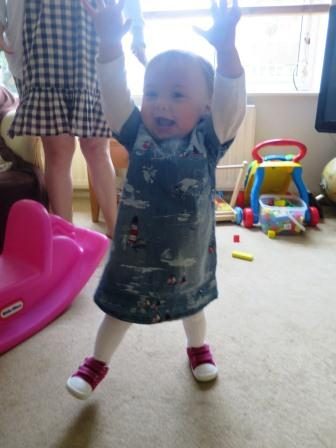
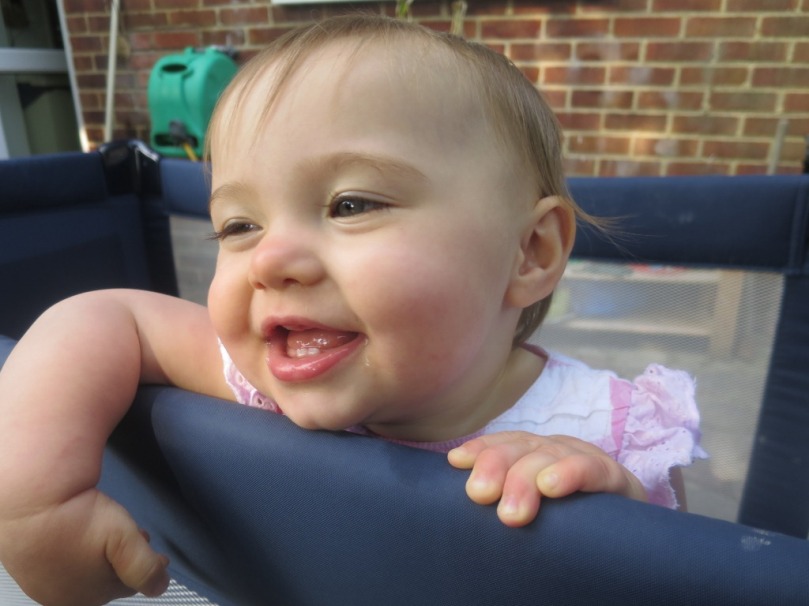
It’s not like walking is necessarily a new thing for Izzie – she was standing with support at two months, walking with support at seven, and took her first unaided steps at eleven – but now she can put a dozen steps together, everything has changed. As soon as we slipped on those cutesy pink shoes she decided that crawling was for babies. Even if she only has to move a foot, she’ll stand and walk it now. Her determination knows no bounds.
Bow before me and my big-girl shoes!
Unfortunately, and here is the reason her first pair of shoes is not a day for celebration, she has also now decided that she’s too grown-up for a pushchair. She just wants to walk, walk, walk. But not just anywhere – she wants to walk where she wants to walk, irrespective of you.
We put on her shoes in the shoe shop and walked her around in them and that was that. She screamed like a frustrated banshee when we put her in the pushchair, screamed like we’d never heard her scream, and in public too. We figured we’d let her walk since she had new shoes on, a little treat.
Holding onto both my hands, she wandered around the square. So far, so good. But the second I walked her into a shop, she let go with one hand, pivoted on her heel and walked out again. So I steered her in, and she walked out again. And again. So I picked her up.
Oh my gosh. More screaming. ‘I’m a big girl, daddy! I go where I like!’
And it’s been that way ever since.
If you’re taking her somewhere she doesn’t want to go, she either lets go and turns, drags you in another direction, or else drops to the floor. This spirit of independence is rapidly turning into a spirit of defiance that we’re really going to have to keep an eye on!
She certainly wants to run before she can walk – literally! When we’re not holding her hands, she runs everywhere, that whole ‘I’m-falling-forward-so-I’ll-just-walk-faster-to-counteract-gravity’ thing. Which means that when she falls – and she’s falling a lot – she lands with a bang. Her legs are covered in bruises and she keeps throwing herself headlong into the furniture with no regard for her safety. But when she does, she’ll just pull herself back up to her feet and run on again, the imprint of a chair leg down the side of her face.
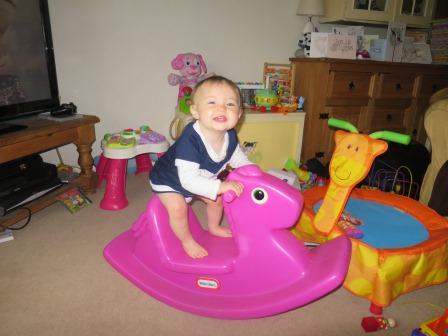
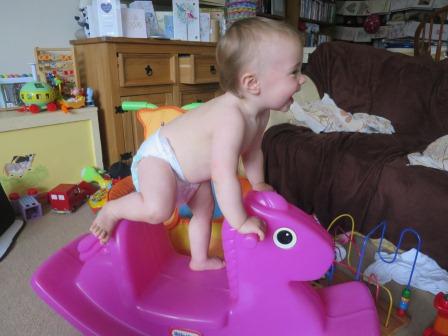
This devil-may-care attitude has extended to her rocking toys too. Sitting down is clearly too easy for a girl with big-girl shoes, too boring for someone who can (sort of) walk. So she does stunts that terrify the hell out of her daddy.
I call this one ‘standing on the crossbar with my butt overhanging the back’And this is called ‘holy shit she’s on one leg and still rocking!’
I have no idea where she gets it from.
No idea whatsoever…
So beware the day you buy your child her first pair of shoes – it might change things in ways you never expected.
Like many parents, the thought of leaving my twelve-month-old daughter with somebody else overnight fills me with dread, regardless of who that somebody is. Therefore, the thought of leaving her for four nights with her Granny while I went on honeymoon was a real crisis of character.
Regular followers of this blog will be aware that, when booking said honeymoon, all was not well in the Galton-Drew household. Lizzie wanted to go away for seven nights; I wanted to go for a maximum of four. She accused me of being unable to let go; I accused her of finding it too easy to let go. She wanted our old life; I wanted our new life. And so it went round.
Ultimately we went away for five days, four nights, a result of both my need to be a dad and be there for my child, and the fact we’d misinterpreted the website and couldn’t actually afford seven nights anyway. Building up to it, I wasn’t over eager to leave my troubles (I mean, my daughter) behind. How would she cope without me? How would I cope without her? What if something happened? How could I possibly enjoy myself knowing I’d abandoned my parental responsibility in order to have a jolly?
You know – normal, obsessive, neurotic parent thoughts.
For all parents considering time away from the baby, it’s of course entirely up to you and you should always do what you’re comfortable with, but having now had a holiday without the little one, perhaps my experience will help you make up your mind.
I needn’t have worried. At all. About myself or the baby.
If we start with the little one, she was absolutely fine. She didn’t seem to miss us, went to bed without a fuss and was thoroughly spoiled by her grandmother. Actually, that’s possibly the only real problem: having been fed home-cooked finger food she could feed herself with, she now steadfastly refuses food from jars and food that requires a spoon. Thanks Granny!
Not to blow my own trumpet, but I think the reason it went so well is that we’ve done a great job creating a confident, outgoing child. We’ve been there in the background but we’ve allowed Izzie her freedom, been ready to catch her when she falls but let her explore where and how she wants. It means she’s fearless, ready to face the unknown because she knows there’s a safety net beneath her and rescue just a chirrup away. It’s certainly confirmed there’s nothing wrong with our parenting style.
Going back to the baby-less holiday, I was fine too. Surprisingly fine. I put her out of my mind and barely thought about her. True, there were moments – when I saw someone pushing a pushchair, when I heard a baby crying, when I saw a strawberry-blonde toddler waddling awkwardly along the quayside – but for the most part, I didn’t find it as crippling and debilitating as I thought I would.
Perhaps this is because I’m a person, and not just a dad. It’s easy to forget, when you’re at the coalface, that there’s a whole other side to you – several sides. Lizzie and I finally got to do what we love doing: exploring. We drove down unmarked roads and walked along overgrown tracks, ducked through caves and peered into rockpools, squeezed up spiral staircases and descended into dungeons, danced on beaches in the rain and stared at Pagan trinkets scattered around Neolithic stone circles in celebration of the solstice, and still somehow found the time for hot tubs, steam rooms and meals out. That is who we are as a couple, and what we haven’t been since the baby was born.
Despite my previous claims that you can holiday just fine with a baby, the truth is that you can’t do everything. You can’t just stop at the side of the road because you’ve seen something interesting poking out of the long grass, examine it for five minutes, then jump back in the car. You can’t decide on a whim to explore this ruined castle, or wander across that causeway, or climb down these two-hundred steps to that isolated beach. Around a hundred times I thought, ‘We couldn’t do this with a baby.’
And it felt so good! Not having to think about nappies and food and waterproofs, being able to hold hands with each other instead of constantly focusing on someone else, is amazingly therapeutic after a year of unremitting parenthood. I saw many young families out with kids, and all of them were struggling, arguing, flustered, overloaded with bags and equipment, and it was such a relief not to be similarly encumbered for once.
Lizzie and I connected in a way we haven’t since forever. Of course, when you become a parent you don’t cease to be a partner, but it’s very easy to cease making an effort for one another since you’re so knackered and emotionally overwhelmed by the whole world of baby care. The arguments that characterised our lives over the past six months have gone. And that doesn’t just make you a better partner, it makes you a better parent too.
Before this honeymoon I could barely countenance the idea of going away without my child; now I think it’s a great idea. Parenting is a team sport, and the occasional team-building weekend is essential to keep it running smoothly.
A night with a couple of hours of broken sleep is normal when you’re a parent, and while unpleasant, more than bearable.
What’s slightly harder is when that night of broken sleep is followed by a day of doctors and hospitals, a night with no sleep, a day helping prepare for the wedding, another night of no sleep, and another day preparing for the wedding, and then a wedding rehearsal.
This evening, after bathing the baby at Lizzie’s dad’s farm, I had to get someone to take the baby off me before I collapsed. Possibly because, looking after Izzie around the clock for four days, trying to get her to eat, keep her fluids up and soothe her, I was not only in desperate need of sleep, I had neglected eating or drinking myself.
Lizzie, of course, has been understandably preoccupied with arrangements for Saturday, leaving the brunt to unfortunately fall upon me. Izzie is very grizzly, has a fluctuating temperature, and chronic diarrhoea – all a result of her gastroenteritis. Worse, since Wednesday’s stint in the Children’s Unit, she has developed a phobia of syringes. Every dose of Calpol or Ibuprofen or gripe water is met with stubborn resistance and followed by two hours of misery.
As a result of the experience of hospitals, she has become remarkably clingy. I have never been hugged so hard. If I so much as lean forward an inch, this vice-like grip tightens around my shoulders and she starts to scream.
So she will only sleep on me.
That’s great if you’re able to sleep with a baby snoring on your chest. If you can’t, after a few days it seems to result in a spinning head, pink eyes, trembling hands, a stiff neck, an aching back, a sore chest, intermittent breathlessness, and a face that twitches as though attached to a whole mesh of electrical wire. All I need now is a rash that doesn’t disappear when a glass is pressed over it, and I’ll be really worried!
Tonight, for the second night in a year, I am sans baby. The night before my wedding. I was always meant to spend it alone, but after my near-fainting episode, they sent me home early. And instead of luxuriating in my aloneness or living it up, or at the very least working on my speech, I can’t open my left eye, my head feels like someone is sawing through it with a spoon, and no matter how hard I try, I’m too tired to fall asleep!
In all honesty, I’m a tad worried about my little one. But there are fifteen people there, including her mum, aunt, great-aunt, grandmother and grandfather. It’s an important lesson to learn: I’m not invincible and I can’t do it all alone, despite how much I think I can. I guess that’s what marriage is all about.
And on that note, I’d better at least try to get some sleep, or they’ll have to Photoshop my eyes open in the pictures!
They say that life is what happens while you’re making other plans, and they’re definitely not wrong. I had this week planned out in fine detail. I have to: I’m getting married on Saturday. So there is an awful lot to do and I couldn’t afford any hiccups.
You can guess where this is going.
When you’re a dad, hiccups go with the territory. I expected a few things to crop up. I hadn’t imagined that life, death, birth, suicide and viral gastroenteritis would feature quite so prominently, however.
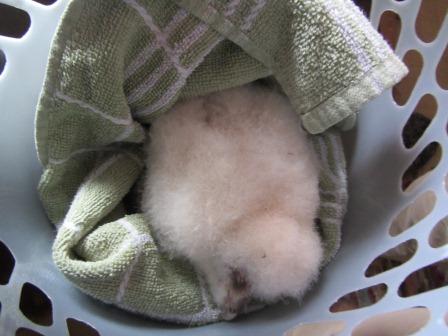
It started Monday. I was already up against it as I had my stag-do that night, when, driving home along a country lane, I saw a ball of white fluff wandering down the middle of the road. Since it’s a busy road and people drive like maniacs, I stopped to move it out of traffic, when I realised it was something I really couldn’t leave to get run over.
There were no trees about – just bushes – and those on the other side of a ditch, and if I left it in a random hedge there was no way it’d survive. Now I know you’re supposed to leave balls of fluff alone, but these were extenuating circumstances. So I did what I thought was best – I picked it up and I put it in my car.
I had no clue what it was, but given it had a hooked beak and long, sharp talons, I had a fairly good guess.
Any ideas?
Since the last bird of prey I tried to rescue didn’t make it, I was determined that this one would. Luckily a few miles down the road is an owl, raptor and reptile sanctuary, so I took it there. Turns out it was a barn owl chick, far too young to be out of the nest. They’re going to get him well and then find a nest with similar aged chicks and slip him in, to be raised by a surrogate mother back in the wild.
My good deed for Monday was done – but it ate up a massive chunk of the day.
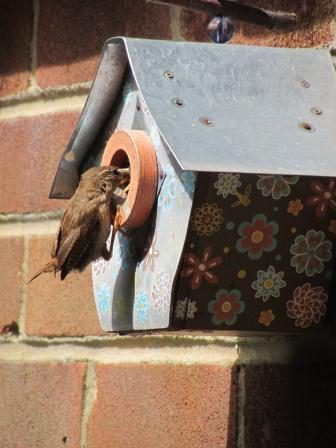
On Tuesday, I did a few wedding-related things like writing my groom’s speech, but I have to confess to being distracted all day by the wrens nesting two feet outside the back door. Every three or four minutes they return to the box with an insect, whereuopon three very hungry chicks lean chirping out of the hole. I guess I don’t have to watch them, but it’s hard not to when they’re so busy from sun up – around half-four in the morning – right the way through to after sunset – gone nine-thirty at night.
Industrious little buggers
Part of the reason I couldn’t look away was this whole parenting thing. I couldn’t help feeling a kinship with these tiny little birds looking after their kids, sacrificing their time and energy to care for their young ones around the clock. I admired them their energy, and felt it needed to be acknowledged, if only through my observation. And if I’m honest, I wondered if I’d be able to cope if I had to expend so much effort on my child as they did on theirs.
The answer wasn’t long in coming.
I put the baby to bed as usual around seven Tuesday night. At ten came the most horrible sound, and when I rushed in there I found little Izzie soaked in vomit. I picked her up and, my god, she was burning up! With a temperature of 38.6, I gave her some Calpol, two hours of TLC, got her to bed shortly after midnight, and checked on her every two hours.
By six o’clock this morning she was 39.1 degrees and very unhappy. It’s awful, knowing she’s unwell but unable to do much about it. So many thoughts and possibilities run through your mind, and after so few hours sleep, you jump to worst case scenarios.
I spoke to a doctor at 8.30, saw her at 11, when Izzie was 39.3, and was sent straight to the hospital so she could be assessed. And that was just the start of six hours of shenanigans.
Izzie was the most distressed I’ve ever seen her, and Lizzie almost as bad. As the stable presence in their lives, I have to take it in my stride, act confident and calm, reassure them that everything’s okay and we’ll deal with whatever happens, even though inside I’m just as churned up. Watching Izzie get poked and prodded and howl like a banshee must rank up there as one of the least comfortable experiences of my life.
Well, worse was to come. They needed a urine sample to test, and despite this being 2016, guess how you get a urine sample from a baby? You sit the over-hot, kicking, squirming, screaming sweetie on your partner’s lap on a waterproof sheet, crouch between their legs with a plastic tub, and get ready to catch whatever comes out.
I always figured that since they’re incontinent, babies drip-drip-dripped, little and often. Nope. They pee just like normal people – when they need to.
So we waited.
And waited.
And waited.
And waited.
For an hour and three-quarters. Crouched, ready to jump into action in a split second to catch that pee! And true to form, Izzie waited for the doctor to arrive and the precise moment I looked away to make her entrance to the stage. In the event, I got it all over my hands, but managed to salvage enough to test.
Meanwhile, doctors and nurses and mothers and boyfriends came to visit the girl in the bed next to us, a teenager who took an overdose this morning, and, by dint of still being classed as a child, was placed in a bay surrounded by screaming babies.
It’s impossible not to overhear things in a hospital – the curtains aren’t exactly soundproof, after all.
‘Did you intend to kill yourself?’
‘Dunno.’
‘Are you happy you’re still here?’
‘Dunno.’
She gave her mother a pretty hard time, lots of effing and blinding. And as a dad, I thought how odd it was that fourteen years earlier, she’d have been like Izzie, a little girl, an innocent, unsullied, perfect creature. I can’t comprehend how I would feel if in fourteen years time it’s Izzie in that bed following a suicide attempt, telling me to ‘shut up, I just don’t care, leave me alone, I don’t give a f**k.’
The stark contrast really struck me, two girls in two beds, separated by nothing more than a curtain and a few years; one so simple and dependent and full of the joys of spring, the other so complex and cynical and utterly jaded. And I want to cling to Izzie and stop her growing up, retain her innocence at any cost, arrest the passage of time.
But I can’t.
In one bed, we’re planning our futures together; in the other, she could have been dead. She might still be – it was paracetamol and they were waiting to see how much damage she’d done to her organs.
The thing is, in my life I’ve been suicidal. I’ve self-harmed. I’ve always been a little bit crazy. My teens are a blur of high emotions and antidepressants, hidden knives and hidden scars. I’m not always rational. People tell me I’ve said things, done things, and I have no recollection whatsoever. At times of high stress I become paranoid that people can hear my thoughts. I am the girl in the bed beyond the curtain – at least, I was. But I got through it. Saved, as it were, by the love of my family, a stubborn unwillingness to give in, and by the miracle that is my daughter.
I don’t ever want her to grow up like me. Stay this side of the curtain, sweetheart.
Long story short, after I wiped the piss off my hands, we discovered she didn’t have a UTI, and they diagnosed it as viral gastroenteritis. Eventually we were allowed to go home, after eight hours away.
Things have calmed a little this evening – Lizzie and Izzie are both snoring, but the latter wakes up every ten minutes, has a little cry, and drops back off. I’m monitoring temperatures, wiping up diarrhoea, and preparing for another night of broken sleep. In the test of whether I’m as good a parent as a wren, I think I’ve passed.
All day I’ve acted tough. Now the world has gone to sleep I can be honest. I feel tearful. Seeing Izzie going through all that, not knowing what was wrong – I was more scared than anyone can imagine. Because Izzie is my world.
So much has happened this week and it’s only Wednesday! If tomorrow is anything like today, I don’t know what I’ll do. Did I mention I’m getting married in three days?
[EDIT: I have just discovered from the Barn Owl Trust that I did exactly the right thing. It says finding barn owl chicks out of the nest before they can fly is not normal, they are only fed in the nest and parents will ignore one on the ground and leave it to starve to death, they have very little sense of smell and will not reject it if you handle it, and leaving it well alone is usually not the appropriate course of action. On the other hand, if it was a tawny owl chick, you should leave it as it is normal for chicks to be out of the nest before they can fly and parents will feed them anywhere – even on the ground. Barn owl chick = intervene. Tawny owl chick = leave alone. Yay me.]
When you have AS, you don’t process information the same as other people. We have rigid, systematic ways of thinking that give us excellent rote memory, but that hinder our ability to combine different pieces of data to create a larger whole or easily shift from one thought sequence to another. Sounds complex? Let me explain.
If you imagine each sensory input, thought or piece of knowledge as a sheet of paper, and the autistic brain as a giant filing cabinet, it goes some way to understanding how we operate. Every sheet of paper needs to be analysed, categorised, related to other sheets of paper and then filed in its relevant folder in the relevant drawer before we are done with it. It seems great in theory, but in practice? Bloody exhausting.
Processing information in this manner takes both time and huge expenditure of mental energy. Sometimes people with AS can seem a little slow when you’re talking to them, but they’re not – they’re just busily interpreting all those little nuances of social interaction that neurotypicals do automatically. Sometimes you can say something to an Aspie, and it’ll be minutes, hours or even days before they get back to you, because that’s how long it can take to work through everything you’ve said, figure out what it all means, and create an appropriate response. And if you give me a list of instructions, you can bet your bottom dollar that I’ll focus so intently on the first step to make sure I understand it that I’ll switch off from everything you say thereafter.
This is because we can only think about one thing at a time. With a mind like a filing cabinet, every detail is separated and stored in an individual folder. If we’re thinking in a certain way about a certain thing – say, file Z284 in Drawer C (the book we’re reading) – then how on earth can we suddenly start thinking about something else – file B827 in Drawer F (the gas bill), for example? So we focus on the first file, and the others cease to exist – at least until they come knocking on the door.
And when we try to do too many things at once, or switch from thinking about one thing to thinking about another, we often screw up our whole filing system. We open a drawer, take out a file, study the page; then we open another drawer, take out another file, look at it; open a third; and before we know it, all the drawers are open, we’ve got files all over the place, we can’t work out what goes where and can’t put anything away or let anything go, our thoughts spiral round and round and, unless we manage to stop this process, we go into what is affectionately called an ‘autistic meltdown’. That’s what it’s like having a filing cabinet for a brain (and that’s without mentioning how, because our thoughts are separated into different files, we focus on the details and miss the ‘bigger picture’ – we see trees instead of forests – but that is by the by).
Anyway, ‘what does all of this have to do with babies?’ I hear you ask. Simple. My house is a tip.
Actually, that’s putting it mildly. My house is, at current, a shithole. I know this because both of Lizzie’s parents have separately described it as a ‘disgrace’ and said that they would be embarrassed to have people over. Ouch!
To be fair, I don’t really notice the mess most of the time. We’ve been blaming it on having a baby – how can anyone have a baby and a tidy house? – but I’ve stumbled unannounced into two houses in the past fortnight who have kids the same age as Izzie, and their houses are freaking immaculate: toys put away, the sideboards clear of stained coffee mugs, no dishes in the sink, clothes hung up instead of strewn over the backs of chairs, everything in its place. Where in God’s name do they find the time or the energy to do that? What makes us so different?
The answer, which has been eluding me for so long, is horrifyingly obvious: they don’t have autism; we do.
To have a tidy house and a baby, you have to be able to multitask. You have to be able to keep one eye, or part of your brain, on the baby and the other on the washing, the ironing, the cleaning. And that’s not something I’m capable of doing.
When I look after the baby, I look after the baby. That’s my job, that’s my focus, and that’s what I do. When I tidy, I tidy. I can’t do both at the same time. So I leave the tidying to the evening, after Izzie’s gone to bed, by which time I’m exhausted and tend to flop down on the sofa or, to be entirely honest, obsess over random things like making lists of all the WWE wrestlers from my teens who are now dead, or researching the million-and-one rebuttals to 9/11 conspiracy theories, or writing 10,000 word treatises on why Jack the Ripper was not Arthur Sickert (take that, Patricia Cornwell!) – you know, useful, productive things like that.
Raising a baby as a person with autism is surprisingly mentally taxing. There is so much information to process, so many sensory inputs and new experiences to file away, my brain is constantly distracted. I used to go to bed between midnight and two every night, getting around six hours sleep – now, I’m lucky to be able to function past ten. That’s how draining it is.
I’m not entirely sure how to rectify this situation. I mean, the house is mostly clean – it gets hoovered, the sides are anti-bacced and we’re still sterilising the baby’s bottles; bleach down the toilets, dog poo picked up, nappy bin emptied regularly, rubbish put out – it’s just got stuff everywhere. And until I can figure out a way of thinking about two things at once without tying my thoughts into knots, that’s the way it’s going to remain.
But it’s all worth it to see that smile every day!
Lately I have been metamorphosising into a strange, inhuman creature known as a ‘dad’.
Now, of course, I’ve been a dad for eleven months, but it’s only now that it’s sinking inside and reorganising my DNA. Becoming a father doesn’t change you very much, but living as a father clearly does something to your body chemistry.
I went to a wedding on Friday. Normally I don’t dance, but as the music started I was suddenly driven by this urge to take Lizzie’s hands and lead her to the dance floor, where I jiggled about arrhythmically, rocked from foot to foot, did a few spins, and then caught sight of someone else doing exactly the same thing and realised: oh my gosh, I’m dad-dancing!
I was never a good dancer, but at the very least I could bop to the beat and unleash a bit of inner funk – now it’s just plain embarrassing!
I guess like most dads, I have to prove that I’m still young and try to impress my child by throwing myself into apparently ‘fun’ activities. When Lizzie was jumping up and down on a trampoline, of course I had to do it too to show I’m still with-it…and threw out my back, and hurt my neck, and hobbled around for the following week like an octogenarian. Before the baby came along, I’d never have got on a trampoline, so why do my dad genes make me do that?
And speaking of dad jeans, I went shopping the other day and spent the whole time going, ‘Why can’t I find any normal jeans? Why are they all skinny-fit, or slimline, or tapered? I don’t want trendy, I want comfort, with a high waistline and a zip fly for easy access and…whoops, when did I turn into a fifty year old?’
In fact, I’ve developed some rather strong opinions about youth fashion of late. Girls’ skirts are too short and their T-shirts don’t cover enough of their midriff. If I ever catch Izzie showing off that much skin, I’ll…damn, talking like a dad again.
Along the way I’ve grown fond of a hideously repetitive style of unfunny dad-ish one-liners. Every time Izzie poops herself, I say, ‘Shall we change you? We could change you for a nice Italian baby. That’d be good.’
I say that at least three times a day. It wasn’t particularly witty the first time I said it, and it doesn’t get any funnier as time goes by, but for some reason, that doesn’t stop me from saying it.
The same with opening the blinds in the morning: the moment they’re open and the light streams in onto my tired frame, I cry out, ‘Ah, I’m melting, oh, what a world, what a world,’ as I pretend to liquify down into the floor. Izzie has never once even smiled, but I still do it. Every day. Not funny, dad. Stop it.
Bathtimes have developed their own cheesy humour: we have a little blue shark bath toy, and no matter how many times I’ve done it, I whoosh it around the tub with just the dorsal fin poking above the water humming the Jaws theme and saying things like, ‘You’re gonna need a bigger bath,’ and, ‘Smile you son of a duck,’ and I listen to myself doing it and think, ‘Just shut up you sad old man!’
But at least I’ve not turned into a mum that talks through her child, the way Lizzie does.
‘Is daddy going to get mummy a drink?’ she says to the baby, or, ‘Mummy’s going to look after you while daddy mows the lawn,’ or even, ‘Daddy’s made a great big mess of the house and if he doesn’t tidy it up mummy will kick him out and cancel the wedding’ (see: passive-aggression for a full explanation of this behaviour!). T’would be nice if she’d ask me to my face instead of through a proxy!
Perhaps it’s inevitable that having a child turns you into a dad. In fact, most people would argue that having a child is pretty much the key factor in becoming a dad. But there’s a big difference between being a dad and being a ‘dad’. And while I’ve been the former for a while, the latter has crept up on me and cold-cocked me on the jaw.






 Aspie Daddy