Casualties of the Parenting War

There’s a line in The Hunt For Red October where defecting Russian submarine captain Marko Ramius says something along the lines of, ‘It’s a war without battles, without monuments…only casualties’. He’s talking about his dead wife at the time, but I’ve always taken it as a description of the Cold War as a whole: two great nations circling one another like prize fighters, watching, waiting, testing, provoking, through storm and shine, day and night, summer and winter, year on year, the dead on each side mounting up from accidents, collisions, clumsiness, fatigue, bravado, without a shot being fired or any open form of hostility being declared.

The relationship between parent and child is a lot like that.

I have been kicked in the nuts more times in the past few months by my daughter than I ever was by the jackasses I went to school with, and believe me, I used to get kicked in the nuts a lot. I’ve been punched in the face, headbutted on the nose, had fingers rammed into ears and nostrils and down my throat, been strangled, throttled and choked, and had almost every hair on my body pulled, tweaked or ripped clean out. At the moment she enjoys jumping on me, hitting me, throwing things at me and smacking me around the head with whatever’s at hand. And lately she’s discovered the joys of poking her plastic toy forks in my eyes – cheers for that, sweetheart!

Then there are the accidents: as a person with autism, I have a tendency towards clumsiness, which generally translates to walking into things, banging my head on things, tripping over things, and falling down a lot. Many times I’ve hooked my foot around the leg of Izzie’s high chair, refrained from grabbing onto it as that would be dangerous, and thus fallen like a ton of bricks to the floor. Many times I’ve been holding her hand in the street and watching to make sure she doesn’t walk into anything, only to crack my shin on a bollard myself. And getting her lunch out of the oven today, I burned the back of my hand on the shelf.

The worst thing at the moment though is my back. The other day I was opening her pushchair on the quayside, pressed down on the foot-plate, got my shoelace caught in the mechanism, and fell flat on my back in front of a whole cohort of leather-clad bikers, pulling the pushchair over on top of me, bruising my ribs and wrenching my spine and shoulder in the process – I couldn’t lift my right arm for hours after.

Perhaps as a result of this fall, or perhaps because I carried her around on my back up and down cliffs and over hill and dale all last week, I made my back susceptible to further damage. You see, I have a semi-slipped disk in my spine, not bad enough to do anything about, but bad enough that every few years it trips and leaves me bedridden for days. And it’s tripped.

A couple of days back I put Izzie in her cot for a nap, bent down to pick up the nappy I’d just changed, and the next thing I knew I was on my elbows and knees with my forehead pressed into the carpet and my lower back muscles in agonising spasm. And a poopy nappy right under my cheek. Luckily, although I can barely walk, hobbling around like the Hunchback of Notre-Dame, I can actually walk. For now. Izzie still needs putting in and out of her high chair and her cot, bathing, changing, dressing and all the other back-breaking tasks of parenting, and in spite of the pain, it’s what you have to do. But in all honesty, it hurts like hell.

For her part, Izzie has the good grace to freak out every time I fall down and hurt myself. And it’s not exactly all one-way traffic.

When she was on my back last week, I did on one occasion walk under a low branch and hear a rather dramatic thud. More than once I’ve knocked her head on the top of the car door when I’ve been putting her in her car seat. She tried to run away from her shadow the other day, tripped and face-planted on the patio, tearing open her knee. A couple of weeks ago I was lying on my back on the floor when she charged at me and stumbled, slamming her head against mine and cutting her chin open on my tooth (I felt so freaking guilty as the blood poured down my T-shirt!). And every day she adds to the bruises on her legs and arms and forehead as she trips and falls and bashes into things and bounces off your knee and tumbles off the sofa. It’s a jolly good thing toddlers are resilient or else she’d feel as rough as I do now!

And that, fair readers, is one of the little-discussed aspects of parenting: without battles, without monuments, you will injure the crap out of each other. There will be blood, there will be tears, and sometimes you’ll feel like you’ve gone ten rounds with Mike Tyson, but ultimately you’ll look back on it and laugh – that is, unless she puts your eyes out first!
The Fear

This week I encountered The Fear. He was on a holiday park in North Devon, of all places, roaming between the static caravans that sit on a hillside overlooking the bay. I’m pretty sure most parents meet him at some point, but this week was my turn.

I’ve been anxious about Izzie before, concerned about her safety, worried about the future, but it’s always been small scale, fantasy-land fear, the kind you get before the dentist or a particularly unpleasant meeting – you’d rather avoid it, but you know that if you have to face it, you’ll get through the discomfort because it’s not really actually all that bad. The Fear is another matter entirely.

It crept up on me unannounced. Everything was fine – a bright, crisp morning, fluffy white clouds scudding across an azure sky, the ocean stretching out below us towards the horizon. Lizzie was walking down the hill holding Izzie’s hand and while I locked up the caravan, my little girl looked over her shoulder at me, the breeze tousling her hair. Her face was a picture of innocent joy, her toothy smile so infectious as she waved at her daddy that in that moment I knew what it was to be loved and what true happiness felt like.

And an instant later I was struck by The Fear – the all-pervading, nausea-inducing, gut-wrenching, knee-weakening presentiment that I would lose her.

The closest I’ve come to this feeling before is when Izzie was around three months old. I went into her room in the middle of the night to check on her and she was so still and quiet I thought she was dead. My first thought – nay, instinct – was to travel to wherever she had gone, because she needed me and I couldn’t bear the thought of not being there for her. Short story even shorter, she wasn’t dead, she was just asleep – but the incident cleared up any lingering doubts about whether I truly believed in the hereafter.

The Fear wasn’t like this at all. It didn’t come from anything scary but from something joyous. It was as though upon reaching the heights of happiness, my body reacted and rebelled, viscerally and violently. Out of the clear blue sky I was filled with the most terrible and heartbreaking dread.

I’m not just talking about death, though that’s a given – cancer, meningitis, kidnap, murder, an accident, The Fear showed me it all – I’m talking as much about change. If I could have frozen that moment she waved at me with innocent joy, I would have done, because right now Izzie adores me – I’m the smartest, coolest, funniest, most-lovable chunk of a man she knows. But all that will change, and quickly too. My days as my daughter’s faultless hero are well and truly numbered.

I spent all that day with The Fear. Maybe, I thought, it’s here because I was talking to somebody about Seneca a few days ago, and his belief that your mind is the only thing you can rely on as everything else you can lose – friends, family, status, job, home, health, hair, all of it. Or maybe, I thought, I’m preoccupied with losing Izzie because police believe they might be days away from locating the body of Ben Needham, a British 21-month-old who went missing 25 years ago in Kos. Or perhaps it’s because I had the unfortunate experience of overhearing a fourteen-year-old girl and her mother screaming life-affirming statements at one another like, ‘I’ve effing had it with you,’ ‘you effing well ruin everything,’ and, ‘I wish you were effing dead!’

But that’s not it at all. If it was, The Fear would be with me all the time. No, it’s because in that moment of perfect happiness I realised my unbridled love for another person – and simultaneously my utter and total vulnerability. Izzie has me, heart and soul, and if anything happens to her, I would be destroyed. The Fear was a safety mechanism, a reality check, because I was walking too close to contentment, and believed my happiness to be immortal. Keep away from the sun, Icarus, or you’ll fall into the sea.

And that is the dilemma of parenting. You give yourself and hold nothing back, but in so doing you risk everything. Your fate is tied to that fragile, fickle bundle of cells you call your child. And the price for your joy is The Fear, cropping up when you least expect him, reminding you you’re dancing with a moonbeam that can never be contained.

But in the meantime, long live this moment.

Imitation, experimentation, and intuition

How do children learn about the world? This is the issue dominating my mind right now, partly because fourteen-month Izzie is learning at an exponential rate and partly because I’ve ploughed through Sophie’s World over the last few nights and 3000 years of philosophy compressed into 400 pages is enough to make anyone’s head spin.

You can get really deep and complex and ponder the effects of sensory perceptions and experience versus the influence of innate cognition and primitive, pre-verbal mental reasoning. But if I’m not mistaken – which I might be as I haven’t really been sleeping – I’ve been able to reduce the entire field of infant learning down to three key processes:

  • Imitation: watching and copying;
  • Experimentation: fiddling until you’ve figured it out; and
  • Intuition: good god, how the hell did you know to do that?

Imitation is pretty simple. Since Izzie has seen us drink from cans, whenever she comes across one she lifts it to her mouth as though drinking. She does the same thing with deodorant cans, so it’s not a foolproof system, but the idea is right.

The good thing about imitation as a learning tool is that you don’t have to teach her – she just picks it up. Watching us press the pointy end of the pen to paper, whenever she gets her hands on a writing implement she now seeks out a newspaper, TV guide, or daddy’s book so that she can make lots of lovely little squiggles. Seeing us use the sponge to wash her face, every time I bath her now she grabs it off me, wets it, and washes my face – usually covering me with water. And when we tell her we’re going out, she grabs our shoes and tries to put them on our feet to help us get ready quicker – or not, as the case invariably is.

On the other hand, the bad thing about imitation as a learning tool is that you don’t have to teach her – she just picks it up. So when mummy playfully throws one of the baby’s cuddly toys at me, Izzie discovers that wonderful game called ‘throwing things at daddy’, but instead of limiting herself to soft, light toys, she thinks it’s all fair – books, coasters, wooden blocks, the kinds of things that really hurt when they connect with your shin bone, or elbow, or forehead. Likewise, because she sees daddy turn on his Xbox by pressing the on/off button on the front and hears a terribly interesting ‘beep’, at random times she’ll toddle over and press it – even if daddy has been playing a game for half an hour and hasn’t saved it! And because she sees Ozzie the dog chasing the cat around the lounge, for the last few days she’s been terrorising Korea (in case you’re wondering, she’s a rescue cat and that’s the name we’re stuck with).

Experimentation is a slightly more cerebral process. It’s all about taking an object and figuring out its intrinsic physical qualities. Whenever Izzie gets a new toy she starts out by bashing it against things (how heavy is it? What noise does it make?), proceeds to bite it (is it food? What does it taste like?), and then turns it all round and decides which is the most enjoyable way of interacting with it. So she’s gradually discovered that it’s more rewarding to press the keys on the piano thing we got her from a car boot sale (plinky-plonky style) than slap it or slobber all over it – although I kind of wish she hadn’t. And she’s discovered that if she pulls the oven door on her toy kitchen really hard, she can yank it off and then throw it at daddy – thus combining experimentation and imitation.

She’s also been using experimentation to discover how, if something doesn’t work one way, another way might produce a better outcome. Hitting her xylophone with the end of the beater that the string was attached to made a muffled thudding sound; now she uses the proper end and smacks the crap out of those metal bars with the volume and melody of a pneumatic drill. Drawing on paper with marker is all well and good, but drawing on her legs and/or dress gets a much more exciting reaction. And if she wants me to read her a book, she brings it to me and puts it on my lap, and if I don’t read it, she hits me with it, which is equally as fun.

You see, Izzie also experiments by varying causes to provoke multiple effects – a long-winded way of saying she tries various methods to manipulate her parents to get what she wants. Screaming, crying, stamping her feet, balling her fists – and if daddy doesn’t give in, she goes to mummy and repeats the process, and vice versa. She likes to point, to say ‘uh’ to indicate ‘that’, and failing that, to reach for it and clamber up on the furniture and move things about until she either gets it or gets given an equally attractive alternative. And if you’re walking in a direction she doesn’t want to go, she’s discovered that instead of resisting, screaming or crying, she can just go limp and sink down to the ground like a puppet with its strings cut, refusing to budge until you turn the other way, whereupon she springs into life like Popeye with spinach in his belly. Too clever for her own good, that one.

Which brings us to the final learning process: intuition. Or rather, instead of a learning process it’s more like a remembering process because I have no freaking idea how to explain some of Izzie’s behaviours beyond the possibility that past lives exist. These are the things she does that she has not witnessed so can’t be imitating, hasn’t experimented with, and by rights should not have the reasoning power or cognition to achieve.

Like a few weeks back when I drank a Coke from a glass bottle and left it with a few dregs in the bottom on my father-in-law’s lawn. A few minutes later, Izzie totters over, picks up the bottle, sees it has some left in it, carries it over to the table, pours it into a glass, puts the bottle on the table top, picks up the glass, knocks back the Coke in a single gulp, puts the glass back on the table and toddles off again. If there weren’t other witnesses, I would have doubted the evidence of my own eyes. We’re not the kind of people who pour drinks from bottles into glasses – we drink it from the bottle or else drink cans – so where did that come from?

Similarly, I was bathing her the other day when she picked up her mum’s lady razor from the side of the bath, and despite never having seen or touched one before, proceeded to shave my forearm. Had it not had the plastic cover over the blade, I would have an arm as bald as an Olympic swimmer’s. The thing is, holding a wiggly-handled lady razor is quite a skill for a baby, especially getting it the right way up and to then run it down my arm multiple times in perfect imitation of a person shaving – where did that come from?

My mum took her to a toy shop and after looking around for a few minutes, Izzie took a box off the shelf, lay it on the floor, and then pressed it repeatedly with her foot. So far, so normal, except that inside the box was a mat you put on the floor then press with your foot to make noises – so how the hell did she know to do that?

And the other day we gave her a yellow duster, and what did she do with it? Yup. Started dusting the surfaces. I can guarantee she’s never seen us do that before!

So here is my treatise on child learning: imitation, experimentation, intuition…unless my daughter is the reincarnation of a Coke-drinking, music-mat-playing barber who likes cleaning, in which case I’m not sure I can generalise using her as my case study.

Asperger’s, Parenting and Negativity

When you become a parent you make a decision: you decide you’re going to sacrifice your own needs in order to look after those of another. You commit to giving up your time, energy, sleep and even your life, if necessary, so that your child is kept healthy, happy and safe. And you swear you will do everything in your power to create a well-adjusted, confident, stable and successful human being.

When you have Asperger’s Syndrome, you have to make a further decision: I’m not going to let my autism stop me being a good parent, come what may.

There are a number of natural deficits that afflict parents with Asperger’s. We love routines and struggle to cope with change, two characteristics that don’t really lend themselves to looking after an unpredictable ball of poop and pee. Our rigid thinking and difficulties processing information impinge upon our ability to do the multitasking required for effective parenting. Problems with motor clumsiness make baby handling somewhat awkward, while sensory issues such as hypersensitive smell and hearing make nappy-changing a horrific burden. But none of these are insurmountable.

When I encounter sudden change, I grit my teeth and bear it, fight down the anxiety that rips through my insides, and recover later, after the baby has gone to bed. Since I get easily distracted and can’t multitask, all I do when watching the baby is watch the baby – I can’t watch TV, read a book, enjoy a coffee or even go to the toilet, and when we’re out and about I pay scant attention to the outside world, but that is the price I pay, and the decision I’ve made, to keep her safe. And when I change her nappy I hold down the disgust and queasiness, smile as though everything is fine, and get on with the job at hand.

More difficult for the Aspergic parent is understanding and meeting your child’s needs. Given our difficulties interpreting social communication and problems understanding how other people think and feel, we can be oblivious to our child’s emotional state and struggle to give appropriate support. Since we often have limited social needs we can fail to appreciate our child’s social needs and thanks to social phobia fail to provide for them. And because we struggle to understand our emotions we can have difficulties regulating our behaviour in front of our children.

Again, none of these problems are insurmountable. Just because we do not intuitively ‘get’ our children the way a neurotypical parent might doesn’t mean we can’t consciously learn to meet their needs. I get advice from other parents, books and the internet to understand my daughter’s developmental needs and how to meet them. I study her noises and facial expressions to work out what they might mean. I take her to social events, the fair, the park, to give her the opportunity to mix with other children. I know she’s looking to me for reassurance so I make sure I smile and act confident even though inside I’m on the verge of panic. Going forward, I will encourage her to communicate her needs and feelings in an open and honest fashion, and I will discuss them and adapt my behaviour to meet them.

My life as a parent with Asperger’s is all about lists, and study, and systems, and hard-thinking. I compensate for my natural deficits by using my intellect. Since I spent 28-years without a diagnosis masking my condition, I hide my problems from my daughter and refuse to let them stop me from being a good parent. It is hard, it is thankless, and it is painful, but it is the decision I chose to make when I had a child.

And it is working. At thirteen months my daughter is a bubbly, happy, confident, outgoing, highly sociable little girl who only wants to run around the park playing with children she’s never met and get involved in anything and everything that’s going on around her. She is in every way the very model of a healthy, successful human being despite having two parents on the autism spectrum.

So you can imagine my anger and disgust when, upon entering ‘parenting’ and ‘Asperger’s’ into a search engine, I was confronted by pages and pages of horrendous, prejudiced, discriminatory anti-Aspie bile.

There is a paper by a psychologist calling for parents with AS to be labelled with a ‘parenting disability’. There is an article saying an Aspergic parent raising a neurotypical child is ‘the definition of abuse’. Everywhere you look there are articles and opinion pieces about how bad Aspergic people are at parenting, and how all children of autistic parents suffer long-term psychological damage, depression and low self-esteem. It is inevitable, apparently, that our children will suffer lifelong difficulties as we are such failures as human beings.

Autistic parents, so says the rhetoric, are inhuman unfeeling monsters who are incapable of expressing love or meeting any of their child’s needs; we should have our children closely monitored and/or removed for their own welfare; and we place a massive burden on child services and mental health teams. And even if we think we’re doing a good job, we’re actually not – we simply don’t have the insight or self-awareness to realise we’re crap, abusive, emotionally neglectful parents. While it is rarely explicitly expressed, it’s hard not to get the impression that a lot of people out there think that people such as myself should not be allowed to procreate. As parents, people with AS are the proverbial lepers.

As a parent with Asperger’s, it’s hard not to be affected by such bigoted negativity. It’s hard not to let that negativity seep inside and colour your parenting experience. But the fact is, they’re wrong, so, so wrong.

True, some people with Asperger’s Syndrome will make terrible parents, just as many neurotypical parents shouldn’t have a dog, let alone a child. But because I know I have Asperger’s Syndrome, it makes me a better parent because I am constantly assessing and evaluating my behaviour and consciously adapting it to better meet my daughter’s needs. Knowing kids need to feel love and Aspergic people are rarely demonstrative, I make sure to express my love in demonstrative ways. Knowing children need to develop their self-esteem and Aspergic people are too honest, when she brings home a picture from school that I think is rubbish I will tell her how good it is and put it on the fridge. I will study, and sacrifice, and tirelessly toil to be the best damned parent I can possibly be because that is the choice I have made.

And I will fight for the rights of any other Aspergic parent who makes the same choice, because saying that people with AS are incapable of being good parents is the real ‘definition of abuse’. 

Hot Weather Parenting

You think you’re getting the hang of this parenting thing – dang it, you know you’ve definitely got the hang of this parenting thing – and then you enter a heatwave and have to learn it all again from scratch.

Where before you spent your time worrying that your child will be too cold, now you have to strike a compromise between keeping her cool and keeping her covered. Instead of cardigans and sleepsuits, you’re packing sunhats, suncream and sunshades, dresses, shorts, cotton shirts and sandals. You overload on water until you’re weighed down like a pack mule, and you start to spend all your time in gardens and parks because the house is like a freaking furnace.

At thirteen months, Izzie is happily walking, running, playing, and being a normal little girl, and that makes it worse. You’re constantly chasing her around the lawn, trying to steer her into the shade, rescuing her sunhat from the bush she’s thrown it into, surreptitiously spraying her with the sunscreen, pulling twigs and acorns from her inquisitive fingers, fending off over-friendly dogs and local children, and swatting away stinging insects, all the while trying not to trip over the pink plastic crap that has turned your back garden into a garish graveyard of slides, paddling pools, sandpits and water tables.

Since she’s wearing dresses without a vest, her nappy is exposed, meaning within minutes it turns into a grass-stained, leaf-carrying, twig-dragging mess. Add to this that her mother and grandfather have a penchant for throwing her into paddling pools and dousing her with watering cans – which she loves, by the way – it turns said nappy into a gargantuan jellyfish that collects around her ankles. Unsurprisingly, she’s now spending a lot of her time naked from the waist down.

While that’s totally normal, the downside to this is that although she can walk, she’s not exactly ready for the Olympics. Twenty steps, perhaps, before she loses balance and slams down onto her bottom, then repeats the process ad finitum. And being in the middle of a heatwave, the ground is like concrete. With a nappy on, there’s a certain amount of padding – without, and her bottom is a mottled black-and-blue mess of bruises. No wonder she fidgets whenever we put her in her high chair!

And that’s another unexpected difficulty of hot weather parenting. All the good, hearty, wholesome, home-cooked grub that she was eating fine before, she now treats as though we’re trying to force feed her dog poo. She wants crisps, cheese, ham, wafers, raisins, biscuits, toast – the kind of stuff that’ll keep you alive, but probably isn’t the most healthy diet three meals a day. So mealtimes have become a lesson in patience and torture.

Nights are tough, too. Her room got up to 29-degrees the other evening. We borrowed an incredibly noisy A/C unit and got it down to 23, but the second I turned it off and put her to bed it jumped back up to 26. But then, of course, it cools as the night presses on. The current procedure is that I put her to bed in just a nappy, then a couple of hours later I put a breathable blanket over her, a couple of hours after that I slip her into a sleepsuit, and around four in the morning she’s ready for a gro-bag. Then the sun rises, and by the time we get her up the temperature is starting to rocket again. And I find I’ve barely slept.

Then there are the little indignities. Because of the heat, nappies start to smell like cheese within minutes of a wee. You change them twice as often, but can’t eliminate the noxious odour that pervades your house, even after you’ve emptied the steaming nappy bin and consigned it to the dustbin outside.

And to add boredom, social isolation and frustration to your plight, none of the mother-baby groups run over the summer holidays so you have to entertain yourselves, in public places now overrun with screaming terrors and their children. The other day, Lizzie suggested we take the little one to a water park at a local recreation ground. It’s free, like a little play park with fountains and water features and a paddling pool. So as I have committed myself to going out with Lizzie and Izzie more as a family (since I’m a hermit), I agreed.

We went in the afternoon. In a heatwave. In the summer holidays. As expected, the place was RAMMED. A veritable cornucopia of colours and movement and noise, noise, noise! Kids splashing you, bumping into you, stepping on your feet, shooting you with water pistols, screaming, shouting, throwing things, urgh!

I may have mentioned before that, as someone with Asperger’s Syndrome, I get rapidly overwhelmed by, well, colour and movement and noise and touch.

Lizzie and Izzie loved it. I went and sat under a tree.

It’s going to be a long hot summer.


Hysteria

Historically, hysteria only affected those with wombs. Bizarrely, it was believed that the womb wasn’t fixed in a woman’s abdomen – it could go wandering about her body wherever the hell it felt like, going up and down and side to side like an animal within an animal. And depending on where it happened to be and what parts of the body it was pressing on, it could cause physical symptoms like headaches and nosebleeds and even bad knees. That’s the reason the words ‘hysteria’ and ‘hysterectomy’ are so similar – ‘hystera’ is ancient Greek for uterus.

By the time the Victorians got hold of it, knowledge about the location of the womb had moved on, but so too had the symptoms of being a woman. Instead of causing physical ailments, hysteria now described a cluster of mental symptoms typically associated with a drunk fifteen-year-old girl at a party: anxiety, excitability, irrationality, excessive outpouring of emotion, irritability, weepiness and fainting. Hence in modern parlance the word ‘hysteria’, and its derivative ‘hysterical’, means a ridiculously over-the-top reaction with a level of emotional performance not normally seen outside of musical theatre or reality TV.

I give this lesson in etymology because we have reached a phase with Izzie that can best be characterized by, you guessed it, hysteria.

Basically, multiple times per day for the past couple of weeks she has broken down in floods of tears, sobs and screams. Sometimes I think she’s broken a bone, she’s so distressed. She cries so hard she can’t breathe and starts to choke. She gets so hysterical, it’s scary, and she won’t be soothed. Cuddles, sing-songs, kisses, rocking, water, milk, biscuits, nothing. The only way to stop her sometimes is to run a bath and put her in it, stroke her back until she gradually gets her breathing back under control. And when she’s finally calm, you say, ‘My God, girl, you were hysterical!’ and she giggles.

It takes very little to set it off. One of the most regular is that she wants to hold your hand all the time and walk from every here to every there. The second you let go, she drops to the floor, her forehead touches her knees and the screeching begins.

Same with leaving the room. That’s all it takes. Your foot crosses the threshold and she’s reduced to a wreck.

The other times are weird and unpredictable. She undid the zip on her bag, right to the bottom, but as the zip didn’t keep going any further, she burst into tears. She ate her banana, then cried because she had finished her banana. The chair was against the wall and she wanted to squeeze through the inch-wide gap instead of go around it, and because she couldn’t fit, no matter how hard she forced her head against the wood, she started screaming.

She pointed at a cactus on the window sill and cried because I wouldn’t give it to her; she held a book horizontally with the spine at the top, and screamed because the pages wouldn’t open right to left; she sobbed uncontrollably because her right shoe had to go on her right foot when she wanted it on the left.

Then there are the times when you can’t work out what the hell is the reason. She’s sitting on your lap perfectly fine, and suddenly she’s out-and-out screaming and crying, and nothing has changed from one moment to the next. It frays your nerves and tests your patience. In your mind, a good dad keeps his kids happy, and this screaming, crying baby taunts you, every tear a knife to the heart saying, ‘bad dad, bad dad, bad dad, bad dad.’ She’s having a bath every day now – not to keep her clean but to stop the tantrums when they start.

So this is the phase we have reached. At least, I hope it’s just a phase and not her personality coming to the fore. In ancient Greece, the cure for a wandering womb was to get pregnant. If that’s the case, we’ve got a lot of years to wait until this passes!

First Words

One of the major milestones all parents look forward to is their child’s first word. After all, a spoken language is what distinguishes us from the rest of the intelligent apes, and the first word is the moment when your little bundle of neediness and poop becomes a fully integrated part of the human race. Every baby diary dutifully stipulates you must record this sacred first word, and people can often tell you what it was as it sinks into the familial consciousness as a treasured anecdote.

I’m finding it’s a bit more complicated than that.

Izzie talks. That is, she makes lots of babbling noises that she combines in long streams of phonemes. Every so often, she’ll therefore come out with something not simply resembling a word, but as clear a word as you’ve ever heard. By accident.

Do these random noises count as words? I bloody hope not. About five months ago when she was sitting on our bed, she looked at me, smiled, and said as plain as day, ‘Murder.’ When I was bathing her a month after that, she pointed at me, all innocent and sweet, and said, ‘Man-boobs.’ There’s no way in hell I’m writing that in her baby diary!

Then there are the words she uses that aren’t actual words. Whenever she sees my father-in-law’s dog she says, ‘Wo-wo,’ and does it consistently enough for us to know what she means. If a word is a bunch of sounds that carry a specific meaning that is used to communicate information, then ‘wo-wo’ is definitely her first word. But ‘wo-wo’ isn’t a word – at least, not in any language of which I’m aware.

And what about words she mispronounces? If you greet her and say, ‘Hello,’ she replies with, ‘Ay-oh’. There are two problems with this one. First, she’s simply repeating what you’re saying rather than volunteering the sound herself. Secondly, ‘ay-oh’ is not ‘hello’. So do these facts invalidate it as a word?

Anyway, what she can say seems, to my mind at least, far less important than what she can understand. It’s said that for every word they can say, a child understands ten. I think that’s an underestimate – Izzie seems to understand freaking everything.

Mummy, daddy, Nana, Granny, Poppa and Gramps are a given by this age, and there’s no doubting she knows her own name. Yes, no and don’t are also in the bag, even if she chooses to ignore them more often than not. And key events are well known – bedtime (rubs eyes), nappy change (runs away), bye-bye (waves).

More impressive are the actions. Most of them are quite simple, one-action commands. ‘Where’s so-and-so?’ will prompt her to seek it out. ‘Get it for daddy,’ results in her fetching it. ‘Put it in the box,’ will make her do just that, and she’s very good at ‘hands up’, ‘clap’, and ‘twinkle, twinkle’ (opening and closing fists).

Some, however, are far more complex. If you say, ‘Mummy needs to put on her shoes,’ she crawls over to a shoe, picks it up, brings it back, and tries to put it on mummy’s foot. Generally the wrong foot, but it’s still remarkable when you consider she can’t actually speak yet. Before you know it, she’ll be making daddy his morning coffee.

So if anyone asks, many years hence, about Izzie’s first word, it was ‘murder’, followed by ‘man-boobs’, ‘wo-wo’ and ‘ay-oh’. But until she says something like ‘mummy’, I’m leaving the baby diary blank!

Walking on Sunshine

The day you buy your child her first pair of shoes is meant to be a red letter day, the seminal event on her journey towards mobility and toddler-hood, and a time to pat yourself on the back for a job well done. Trouble is, there’s no time to savour this feeling of satisfaction because as soon as they’re on her feet, the world shifts beneath your feet again.

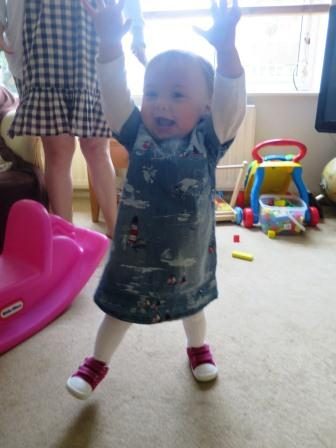
It’s not like walking is necessarily a new thing for Izzie – she was standing with support at two months, walking with support at seven, and took her first unaided steps at eleven – but now she can put a dozen steps together, everything has changed. As soon as we slipped on those cutesy pink shoes she decided that crawling was for babies. Even if she only has to move a foot, she’ll stand and walk it now. Her determination knows no bounds.

IMG_2558
Bow before me and my big-girl shoes!

Unfortunately, and here is the reason her first pair of shoes is not a day for celebration, she has also now decided that she’s too grown-up for a pushchair. She just wants to walk, walk, walk. But not just anywhere – she wants to walk where she wants to walk, irrespective of you.

We put on her shoes in the shoe shop and walked her around in them and that was that. She screamed like a frustrated banshee when we put her in the pushchair, screamed like we’d never heard her scream, and in public too. We figured we’d let her walk since she had new shoes on, a little treat.

Holding onto both my hands, she wandered around the square. So far, so good. But the second I walked her into a shop, she let go with one hand, pivoted on her heel and walked out again. So I steered her in, and she walked out again. And again. So I picked her up.

Oh my gosh. More screaming. ‘I’m a big girl, daddy! I go where I like!’

And it’s been that way ever since.

If you’re taking her somewhere she doesn’t want to go, she either lets go and turns, drags you in another direction, or else drops to the floor. This spirit of independence is rapidly turning into a spirit of defiance that we’re really going to have to keep an eye on!

She certainly wants to run before she can walk – literally! When we’re not holding her hands, she runs everywhere, that whole ‘I’m-falling-forward-so-I’ll-just-walk-faster-to-counteract-gravity’ thing. Which means that when she falls – and she’s falling a lot – she lands with a bang. Her legs are covered in bruises and she keeps throwing herself headlong into the furniture with no regard for her safety. But when she does, she’ll just pull herself back up to her feet and run on again, the imprint of a chair leg down the side of her face.

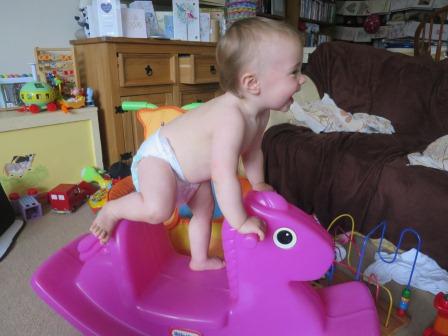
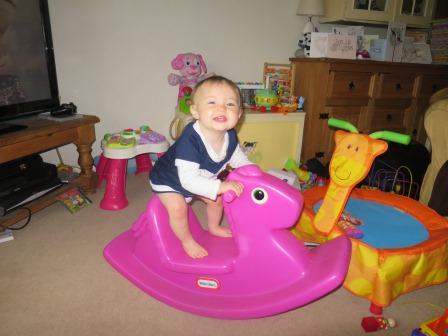
This devil-may-care attitude has extended to her rocking toys too. Sitting down is clearly too easy for a girl with big-girl shoes, too boring for someone who can (sort of) walk. So she does stunts that terrify the hell out of her daddy.

IMG_2541
I call this one ‘standing on the crossbar with my butt overhanging the back’
IMG_2551
And this is called ‘holy shit she’s on one leg and still rocking!’

I have no idea where she gets it from.

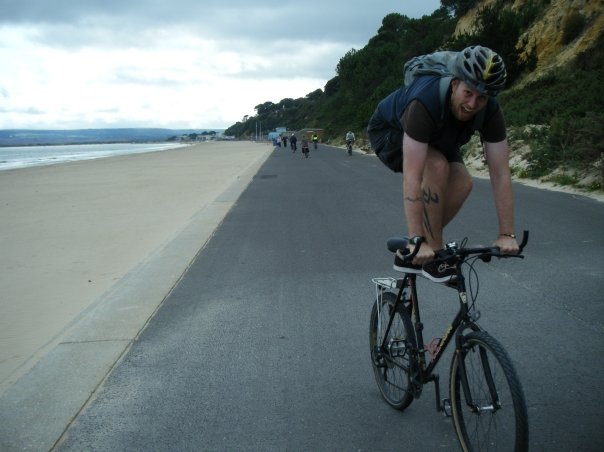
bike stunt

bike stunt 2

No idea whatsoever…

So beware the day you buy your child her first pair of shoes – it might change things in ways you never expected.

Time away from baby

Like many parents, the thought of leaving my twelve-month-old daughter with somebody else overnight fills me with dread, regardless of who that somebody is. Therefore, the thought of leaving her for four nights with her Granny while I went on honeymoon was a real crisis of character.

Regular followers of this blog will be aware that, when booking said honeymoon, all was not well in the Galton-Drew household. Lizzie wanted to go away for seven nights; I wanted to go for a maximum of four. She accused me of being unable to let go; I accused her of finding it too easy to let go. She wanted our old life; I wanted our new life. And so it went round.

Ultimately we went away for five days, four nights, a result of both my need to be a dad and be there for my child, and the fact we’d misinterpreted the website and couldn’t actually afford seven nights anyway. Building up to it, I wasn’t over eager to leave my troubles (I mean, my daughter) behind. How would she cope without me? How would I cope without her? What if something happened? How could I possibly enjoy myself knowing I’d abandoned my parental responsibility in order to have a jolly?

You know – normal, obsessive, neurotic parent thoughts.

For all parents considering time away from the baby, it’s of course entirely up to you and you should always do what you’re comfortable with, but having now had a holiday without the little one, perhaps my experience will help you make up your mind.

I needn’t have worried. At all. About myself or the baby.

If we start with the little one, she was absolutely fine. She didn’t seem to miss us, went to bed without a fuss and was thoroughly spoiled by her grandmother. Actually, that’s possibly the only real problem: having been fed home-cooked finger food she could feed herself with, she now steadfastly refuses food from jars and food that requires a spoon. Thanks Granny!

Not to blow my own trumpet, but I think the reason it went so well is that we’ve done a great job creating a confident, outgoing child. We’ve been there in the background but we’ve allowed Izzie her freedom, been ready to catch her when she falls but let her explore where and how she wants. It means she’s fearless, ready to face the unknown because she knows there’s a safety net beneath her and rescue just a chirrup away. It’s certainly confirmed there’s nothing wrong with our parenting style.

Going back to the baby-less holiday, I was fine too. Surprisingly fine. I put her out of my mind and barely thought about her. True, there were moments – when I saw someone pushing a pushchair, when I heard a baby crying, when I saw a strawberry-blonde toddler waddling awkwardly along the quayside – but for the most part, I didn’t find it as crippling and debilitating as I thought I would.

Perhaps this is because I’m a person, and not just a dad. It’s easy to forget, when you’re at the coalface, that there’s a whole other side to you – several sides. Lizzie and I finally got to do what we love doing: exploring. We drove down unmarked roads and walked along overgrown tracks, ducked through caves and peered into rockpools, squeezed up spiral staircases and descended into dungeons, danced on beaches in the rain and stared at Pagan trinkets scattered around Neolithic stone circles in celebration of the solstice, and still somehow found the time for hot tubs, steam rooms and meals out. That is who we are as a couple, and what we haven’t been since the baby was born.

Despite my previous claims that you can holiday just fine with a baby, the truth is that you can’t do everything. You can’t just stop at the side of the road because you’ve seen something interesting poking out of the long grass, examine it for five minutes, then jump back in the car. You can’t decide on a whim to explore this ruined castle, or wander across that causeway, or climb down these two-hundred steps to that isolated beach. Around a hundred times I thought, ‘We couldn’t do this with a baby.’

And it felt so good! Not having to think about nappies and food and waterproofs, being able to hold hands with each other instead of constantly focusing on someone else, is amazingly therapeutic after a year of unremitting parenthood. I saw many young families out with kids, and all of them were struggling, arguing, flustered, overloaded with bags and equipment, and it was such a relief not to be similarly encumbered for once.

Lizzie and I connected in a way we haven’t since forever. Of course, when you become a parent you don’t cease to be a partner, but it’s very easy to cease making an effort for one another since you’re so knackered and emotionally overwhelmed by the whole world of baby care. The arguments that characterised our lives over the past six months have gone. And that doesn’t just make you a better partner, it makes you a better parent too.

Before this honeymoon I could barely countenance the idea of going away without my child; now I think it’s a great idea. Parenting is a team sport, and the occasional team-building weekend is essential to keep it running smoothly.

So, anyone know of any cheap getaways?

Now You Are One

Now you are one, my little girl, and what things can you do?

Let’s list them off and show the world so they can see them too.

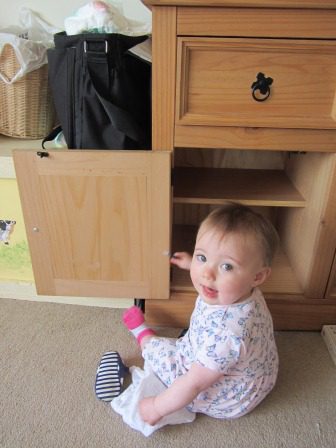
Open doors all by yourself

IMG_1265
I really wish you wouldn’t

And open cupboard doors as well

IMG_5364
Even though you know you shouldn’t!

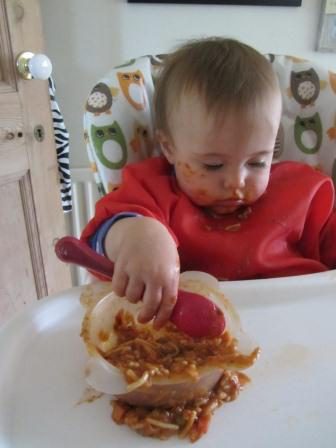
You can feed yourself apparently

IMG_5444
I think your skills need work

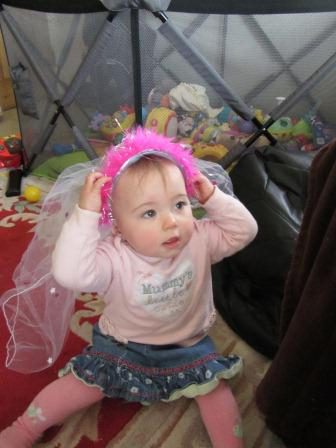
You’re a fashion victim aged twelve-months

IMG_5365
You’d better not learn how to twerk!

You’re discovering how keys turn locks

IMG_5448
Though you’re too short to reach it

You watch TV as though you’re five

IMG_1842
And we didn’t have to teach it!

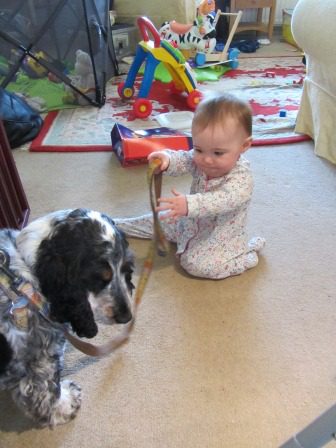
You like to walk the dog sometimes

IMG_5350
Though perhaps she’s walking you

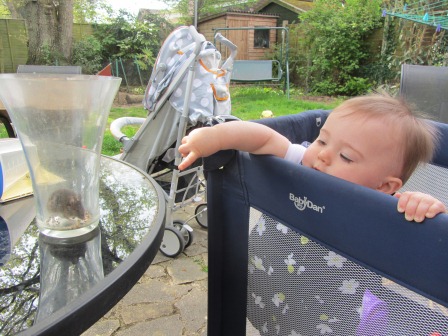
You love all of our animals

IMG_5363
And even the mouse I caught too!

You like to drive your pretty car

IMG_1782
And how you slam that door!

You tried to paddle a kayak once

IMG_5439
But only on the floor!

So here’s to all the fun we have

IMG_1517
(Here’s you driving a digger)

I know we’ll keep on having such fun

IMG_1493
Even when you’re bigger!

Happy birthday, sweetheart!